VN
VN
 EN
EN
23/07/2026, 01:50
Legal environment
Party General Secretary and State President To Lam: Science and technology must become the new pillar in Vietnam-China relations
The Business Forum Magazine respectfully presents the full text of the policy speech by Party General Secretary and State President To Lam at Tsinghua University, China, on April 14th.
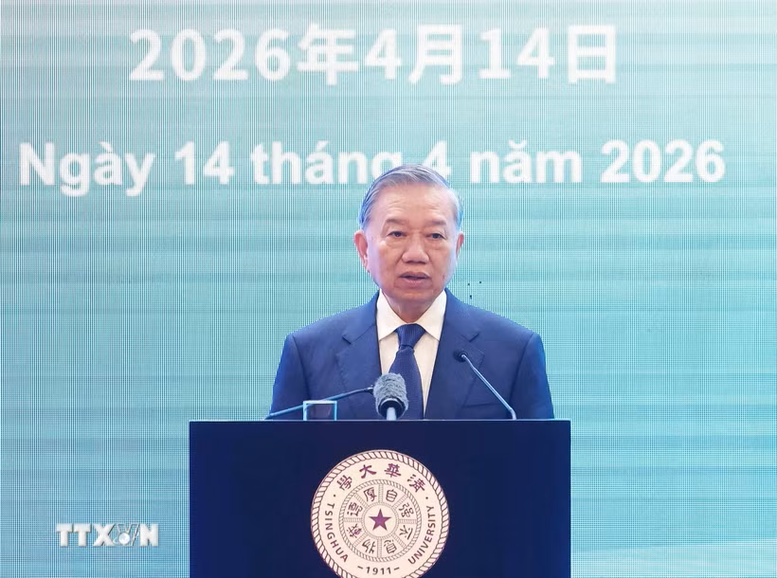
Party General Secretary and State President To Lam delivered a policy speech at Tsinghua University, China, on April 14th
Dear Comrade Doan Luc, Member of the Political Bureau, Secretary of the Beijing Municipal Party Committee,
Dear Comrade Qiu Yong, Secretary of the Party Committee of Tsinghua University, Academician of the Chinese Academy of Sciences,
Dear comrades from China and Vietnam,
Dear professors, lecturers, students, and all distinguished guests,
Today, I am very pleased to visit and speak at Tsinghua University – one of China's and the world's leading educational, research, and innovation institutions, a center of knowledge with profound influence in Asia and globally, especially in the fields of science, engineering, digital technology, and artificial intelligence. What makes Tsinghua so special is its spirit of pursuing excellence, its discipline, its systems thinking, and its aspiration to contribute to society. Not only is it outstanding for its quality of education and research, but Tsinghua is also a hub of great minds, where ideas have the potential to shape policy, technology, and the future development of humanity. Tsinghua University has produced great friends of the Vietnamese people, the outstanding leader of China, Comrade General Secretary and President Xi Jinping, and many other leaders of the Chinese Communist Party and the Chinese government.
This meeting with you all today is one of my first official activities during this State visit to China. Tomorrow I will meet with Comrade Xi Jinping. This is also my first State visit in my capacity as General Secretary and President of the Socialist Republic of Vietnam.
Dear comrades and friends,
Speaking here today, I am deeply concerned about the profound connection between history and the future; between revolutionary traditions and aspirations for development; and between the friendship painstakingly cultivated in the 20th century and the responsibility of today's generation in bringing Vietnam-China relations into a new phase of development.
Vietnam and China are two neighboring countries with many similarities in culture and moral traditions. Nature has placed our two countries and two peoples side by side forever. Geography has bound us together with mountains and rivers; history has linked us through thousands of years of diplomatic relations. The people of both countries have persistently nurtured this relationship with sincere affection and a shared aspiration for peace, stability, and development.
In Vietnam's modern history, China is not only a close neighbor but also a particularly important region in the formation and development of the Vietnamese Revolution. President Ho Chi Minh – the beloved leader of the Vietnamese people – spent extremely important years of revolutionary activity in China. From Guangzhou, Guilin, Chongqing to Guangxi, he organized forces, trained cadres, expanded relations with Chinese revolutionary friends, and prepared the conditions that were decisive for the victory of the Vietnamese Revolution.
In 2024, during my visit to China, I chose Guangzhou as my first destination. Visiting the historical site of the headquarters of the Vietnam Revolutionary Youth Association, I gained a deeper understanding of why Guangzhou holds such special significance for the history of the Vietnamese Revolution; at the same time, I further appreciated the fact that the Party Committee, government, and people of China preserve these historical sites as living symbols of the traditional friendship between the two countries.
This year, we commemorated the 85th anniversary of President Nguyen Ai Quoc's return from Guangxi to Pac Bo, Cao Bang, to directly lead the Vietnamese Revolution. This was a historical turning point of decisive significance for the Vietnamese people's national liberation and independence. Guangxi is also a region closely associated with many activities in preparing forces and training cadres for President Nguyen Ai Quoc before the August Revolution. These places, these journeys, these historical evidences once again affirm that in Vietnam's struggle for national liberation, China is a particularly special historical space.
The national liberation struggles of our two countries have forged a very special bond between our two peoples, between generations of revolutionary leaders, between President Ho Chi Minh and Chairman Mao Zedong, Prime Minister Zhou Enlai, and the revolutionary predecessors of both countries. In the struggle, the two Parties, the two countries, and the two peoples stood shoulder to shoulder, providing each other with invaluable support and assistance, both material and spiritual. In national construction, our two countries have consistently pursued the path of reform, innovation, opening up, and integration, adapting to the conditions of each country, and achieving historically significant accomplishments. The Party, State, and people of Vietnam always cherish, remember, and highly appreciate the immense, sincere, and loyal assistance and support that the Party, State, and people of China have given to Vietnam during the periods of national liberation, reunification, and national development.
Seventy-six years ago, on January 18, 1950, the People's Republic of China became the first country in the world to recognize and establish diplomatic relations with the Democratic Republic of Vietnam. This historic milestone opened a new chapter in bilateral relations and served as a great encouragement to the just resistance struggle of the Vietnamese people. From that point onward, overcoming the trials and tribulations of history, friendship and cooperation between the two countries have always been the main current. This has been proven by history.
Building upon that solid foundation, in recent years, the friendship and cooperation between Vietnam and China have continued to achieve many very positive, comprehensive, and substantive results. Particularly, during the State visit to Vietnam by General Secretary and President Xi Jinping in December 2023, the two countries made a historic decision. Based on the "16-word motto" and the "four good" spirit, both sides agreed to elevate the relationship to a comprehensive strategic cooperative partnership, building a Vietnam-China Community with a shared future, which is of strategic significance and opens a new stage of development at a higher level in bilateral relations. In April 2025, both sides reaffirmed their determination to realize the high-level common understanding and further deepen bilateral relations according to the "six more" orientation. These are major orientations and an important strategic framework for the relationship between the two countries in the new period.
I would like to emphasize that the Party, State, and people of Vietnam have always considered developing relations with China as an objective requirement, a strategic choice, and a top priority in the overall independent, self-reliant, self-strengthening, multilateral, and diversified foreign policy of Vietnam. This is a consistent understanding, a choice stemming from the fundamental and long-term interests of both countries, in line with the aspirations of the people of both countries, and of significant importance to peace, stability, cooperation, and development in the region as well as globally.
Along with increasingly strengthened political trust, cooperation between the two countries in various fields is deepening. A very noteworthy milestone is that in March 2026, the two countries held their first ever 33 Strategic Dialogue at the ministerial level (Foreign Affairs, Defense, and Public Security). This represents a new development in higher-level strategic cooperation between the two sides, demonstrating that Vietnam-China relations today are not only driven by political goodwill, but also by practical, comprehensive, and in-depth coordination mechanisms between key agencies of the two countries.
Economically, cooperation between the two countries continues to develop strongly. Vietnam remains China's largest trading partner among ASEAN countries and China's fourth largest trading partner. But more important than the numbers is the quality of the connectivity. Both sides are shifting from traditional trade to supply chain connectivity, infrastructure connectivity, technology connectivity, and human resource connectivity. Cooperation in railways, logistics, smart border crossings, digital trade, energy, finance, industrial production, and science and technology is opening up enormous new opportunities for bilateral relations between our two countries.
Regarding strategic infrastructure connectivity, both sides agreed to prioritize accelerating connections in railways, expressways, and border trade infrastructure; in particular, the three standard-gauge railway lines: Lao Cai - Hanoi - Hai Phong, Dong Dang - Hanoi, and Mong Cai - Ha Long - Hai Phong are of special importance. If implemented synchronously and effectively, these will not only be new transportation routes but also new development corridors, connecting Vietnam not only with China but also more deeply with Southeast Asia, Central Asia, and Europe. I hope that, in the not too distant future, these trains will truly become trains of cooperation, development, and friendship between our two countries.
Dear comrades, dear students,
Vietnam is entering a new stage of development. The 14th National Congress of the Communist Party of Vietnam has clearly defined the country's development path for the coming period: By 2030, the 100th anniversary of the Party's founding, the goal is to become a developing country with modern industry and a high-middle income; by 2045, the 100th anniversary of the nation's founding, the goal is to become a developed country with a high income. These are two centenary goals of special strategic significance, reflecting the aspirations for development of the Vietnamese nation in the new era.
To achieve these goals, Vietnam has determined that it must drastically reform its growth model, develop rapidly and sustainably, maintain independence and self-reliance while proactively and effectively integrating into the international community. In particular, we have clearly defined that science, technology, innovation, and digital transformation are not merely tools to support development, but must become the main driving force of development. This is a top priority breakthrough, a new impetus to propel the country's strong development in the new era.
With this new development mindset, Vietnam places special emphasis on education, training, and the development of high-quality human resources. We understand very well that to move quickly in the 21st century, we must first move forward with knowledge, science, technology, and people. To have a self-reliant, innovative, and highly competitive economy, we need a young generation capable of mastering strategic technologies, with the courage to integrate, and with the ambition to contribute. I have repeatedly emphasized: Vietnamese youth, students, and university students must cultivate great ambitions and aspirations, study and train to become global citizens, gradually integrating into international standards while always maintaining Vietnamese identity and spirit.
Therefore, Vietnam places great importance on sending a new generation of young people abroad to study, research, and access leading centers of knowledge and technology in the world. But we do not see this as "leaving," much less as a separation from the homeland. We see it as a journey to learn, to absorb, to connect, and most importantly, to return and contribute to the country. Young Vietnamese people go out into the world to broaden their horizons, enrich their capabilities, enrich their mindset for development, and then use that intellect, courage, and experience to serve the people and the cause of building and developing the country.
At this moment, Tsinghua University holds a very special significance. Tsinghua is a leading university in Asia, ranking among the world's top universities, with outstanding strengths in engineering, technology, computer science, artificial intelligence, materials science, energy, environment, and the training of internationally renowned talents. In particular, Tsinghua established its School of Artificial Intelligence (AI) in 2024, with the aim of training top-tier AI talent, connecting basic research with interdisciplinary applications. I believe this is a model that developing countries like Vietnam should learn from: the development of science and technology is inseparable from national strategy, from the needs of industrialization and modernization, and from the task of educating human resources.
I am also very pleased to see the positive developments in cooperation between Vietnamese educational and research institutions and Tsinghua University. In 2024 and 2025, many leading Vietnamese universities such as Vietnam National University, Hanoi, Vietnam National University, Ho Chi Minh City, and the National Economics University have promoted the signing and expansion of cooperation with Tsinghua University. Leaders from both sides have emphasized priority areas such as artificial intelligence, semiconductors, science and technology, and training high-quality human resources. These are very necessary steps in the right direction and should be further expanded in the future.
I understand that there are currently around 25,000 Vietnamese students studying in China. This number demonstrates the growing depth of educational exchange between the two countries. I believe that each Vietnamese student studying in China, including those at Tsinghua University, is a bridge of friendship, a cultural ambassador, and a representative of the studious, inquisitive spirit and aspirations of Vietnamese youth. I also believe that each Chinese student who comes to Vietnam to study, research, and gain practical experience will contribute to deepening the understanding between the people of our two countries.
Dear comrades, dear students,
From this very significant forum, building on the high-level common understanding between the two Parties and two countries, and the "six more" orientation established by the leaders of both sides, I hope that in the coming time, both sides will focus on doing well the following major things:
First and foremost, it is necessary to continue strengthening the political and social foundations of Vietnam-China relations. For the relationship between the two countries to develop stably, healthily, and sustainably in the long term, it must first be based on political trust, mutual respect, mutual understanding between the peoples of the two countries, and the shared determination of successive generations of leaders of the two Parties and countries. But what I want to emphasize most is that lasting friendship must be passed down from generation to generation, nurtured in the hearts of the people, especially the younger generation. Therefore, along with high-level delegation exchanges and cooperation between ministries, sectors, and localities, we need to pay more attention to people-to-people exchanges, youth exchanges, academic exchanges, cultural exchanges, education, and tourism; so that every citizen of the two countries, every young person of the two countries, feels responsible for preserving and enriching the Vietnam-China friendship.
Secondly, a stronger shift towards substantive cooperation is needed, focusing on strategic connectivity, using concrete results as a measure, and aiming for the benefit of the people of both countries. In this new stage of development, cooperation between Vietnam and China cannot be limited to trade scale or growth figures, but must aim for higher quality, greater depth, and greater sustainability. I hope both sides will continue to promote strategic infrastructure connectivity, especially railway, road, border crossing, and logistics connections; strengthen connectivity between the two economies, between supply chains, between localities, border regions, and growth poles of both countries. New connectivity projects, new economic corridors, and new logistics centers, if implemented well, will not only create more favorable conditions for trade, investment, and people's travel, but also create new development space for both countries and contribute to regional connectivity.
Thirdly, science, technology, innovation, and digital transformation need to become new highlights and pillars of Vietnam-China relations in the new era. Vietnam is entering a new period of development, in which science, technology, innovation, and digital transformation are identified as the main driving forces for achieving strategic goals by 2030 and 2045. In this process, we attach particular importance to cooperation with China in areas where the two sides can complement each other and develop together, especially artificial intelligence, big data, cloud computing, semiconductors, automation, robotics, green technology, biotechnology, new materials, clean energy, and other strategic technologies. I hope that in the future, Vietnam-China cooperation will not only be stronger in trade and investment, but also stronger in knowledge, technology, innovation, and the capacity to shape the future.
In that orientation, education, training, and the development of high-quality human resources must be the top priority. To move forward quickly in the 21st century, Vietnam needs a new generation with a solid scientific foundation, capable of mastering modern technology, possessing innovative thinking, and the ability to integrate internationally. Vietnam hopes that more and more of its students, researchers, and young scientists will study and conduct research at leading training and research centers in China, including Tsinghua University. I also hope that Tsinghua University will continue to expand cooperation with Vietnamese universities and research institutes; strengthen student exchanges, scholar exchanges, joint training programs, collaborative research, and build co-supervision programs, joint research groups, and joint laboratories in key fields. I believe that investing in people, investing in education, and investing in young scientists is the most strategic investment for the future of relations between our two countries.
Fourth, it is necessary to further deepen the friendly ties between the youth of the two countries, so that the younger generation truly becomes the successor force to this friendship, and at the same time, the pioneering force in building the future. The history of Vietnam-China relations has been built by revolutionary predecessors; but the future of that relationship will be largely determined by today's youth. The younger generation should not only be the recipients of the achievements of the bilateral relationship, but must also be the ones who directly write the next chapter of that relationship. When each student learns more about the country, culture, and people of our neighboring country, we gain another bridge of connection. Exchange programs, joint research projects, joint startup initiatives, and sincere meetings between the youth of the two countries all contribute to making the friendship more concrete, vibrant, and sustainable. I hope that the younger generations of Vietnam and China will not only learn from each other, but also collaborate in innovation, start businesses together, and solve major development problems together, from education, healthcare, environment, energy, smart cities to green agriculture and the digital economy.
Fifth, along with expanding cooperation, both sides need to continue to maintain a peaceful and stable environment, strengthen strategic coordination, and effectively handle remaining differences. The world today is undergoing rapid, profound, and unpredictable changes. In this context, it is even more crucial to uphold multilateralism, respect international law and the UN Charter, and persistently resolve disagreements through peaceful means, for the long-term benefit of each country, the region, and the world. Vietnam always desires to strengthen coordination with China in multilateral mechanisms, maintain a peaceful, stable, cooperative, and developmental environment in the region; and at the same time, jointly manage disagreements effectively, preventing them from affecting the overall friendly relations between the two Parties, the two countries, and the two peoples. The value of good neighborly relations lies not only in mutual development when conditions are favorable, but also in the ability to jointly and appropriately handle remaining differences in a constructive spirit, with mutual respect and responsibility for the future.
I believe that by properly inheriting the legacy of friendship painstakingly cultivated by previous generations, with trust as the foundation, substantive cooperation as the driving force, science, technology, and innovation as the breakthrough, and youth as the bridge to the future, the Vietnam-China relationship will certainly continue to develop well, healthily, stably, and sustainably in the long term; bringing practical benefits to the people of both countries; and making positive contributions to peace, cooperation, and development in the region and the world. With this orientation, the role and contributions of the younger generation of both countries are especially important. Looking at the intelligent and confident faces of the Tsinghua University students, known not only for their outstanding academic abilities and their approach to problem-solving with a scientific and practical spirit, but also for their courage, vision, and dedication, I am even more confident in the bright future of China and the friendship and cooperation between our two countries.
Once again, I would like to extend my warmest congratulations to the leadership, professors, scientists, and all students of Tsinghua University. May Tsinghua University continue to achieve even greater accomplishments and make ever greater contributions to China and the world. May the friendship between Vietnam and China remain ever vibrant and enduring. May the younger generations of our two countries worthily continue the traditions of their predecessors, and together write a new and better chapter for Vietnam-China relations in the 21st century.
On the occasion of Tsinghua University's 115th anniversary, I would like to wish Tsinghua University continued growth and development, making positive contributions to the development of China and the world.
Thank you very much, comrades and friends!
Author: Editorial Board
RECOMMENDED TOPICS