VN
VN
 EN
EN
15/07/2026, 10:39
Investment
Stock Market Weekly Forecast: Short-term selling pressure may continue
The stock market’s negative momentum may continue under growing short-term selling pressure.

The VN-Index experienced a volatile last week, with 4 out of 5 trading sessions declining
The VN-Index experienced a volatile last week, with 4 out of 5 trading sessions declining, particularly with a sharp drop of over 50 points in the final trading session, ending the week below 1,650 points. The VN-Index rose at the beginning of the week thanks to demand from Vingroup stocks and other large-cap stocks such as SAB and VNM.
However, in subsequent sessions, the cash flow weakened, as evidenced by limited liquidity, while Vingroup stocks peaked and then corrected downward. Selling pressure gradually spread across the market, showing an overwhelming dominance of buying demand, especially in large caps, causing the VN-Index to record four consecutive days of decline.
Conversely, there was more active participation in mid- and small-caps, particularly in sectors that had not seen strong gains recently, such as livestock and food.
Foreign investors sold a net total of VND 5,136 billion in the first four trading sessions of the week, a complete contrast to the strong buying activity in the same period the previous week.
In the final trading session of the week, the VN-Index continued to open lower under the downward pressure of Vingroup stocks. The red also spread to other sectors such as securities, banking, and real estate, but the decline was not significant, so the VN-Index generally remained around 1,680 points in the morning session.
Entering the afternoon trading session, selling pressure intensified, especially in the last 30 minutes and during the ATC session. Red dominated across most stocks in the banking, securities, and real estate sectors, causing the VN-Index to quickly lose the 1,650 point level.
Trading volume increased by over 40% year-on-year due to significant selling pressure, with 296 stocks falling and only 40 rising.At the end of the session, VN Index closed at 1,635.46 points, up 4.02 points, equivalent to 0.25%. At the end of the week, the VN-Index increased by 36.36 points (2.27%) compared to the previous week.
At the close of last week's final session, the VN Index settled at 1,646.89 points, down 52.01 points, or 3.06%. For the week, the VN Index fell 94.43 points (-5.42%) compared to the previous week.
The VN-Index closed today's trading session with a solid red candlestick and slightly higher trading volume compared to the 20-day average, indicating that supply is still overwhelming demand at the bottom.
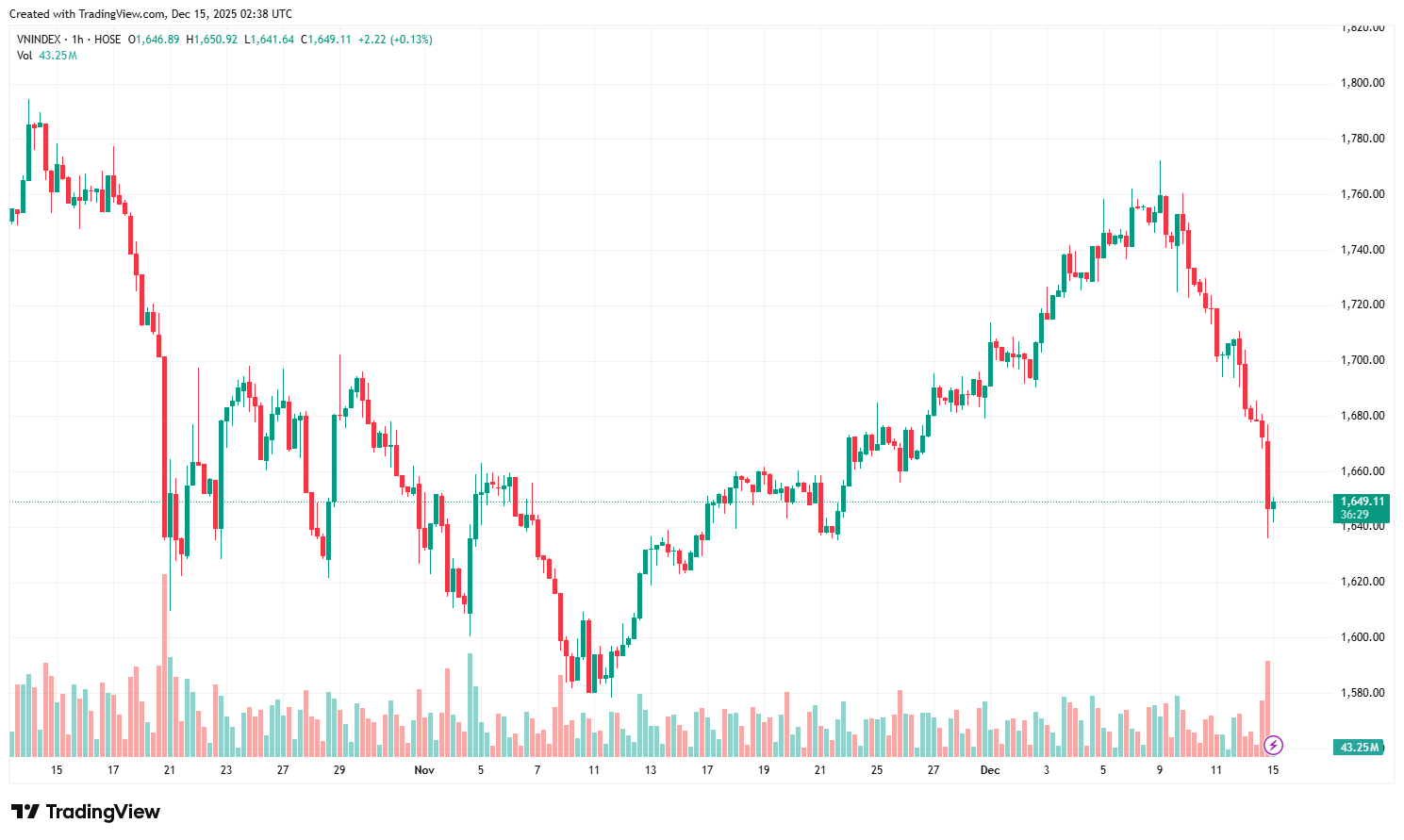
At the close of last week's final session, the VN Index settled at 1,646.89 points, down 52.01 points
On the daily chart, the MACD indicator crossed the signal line from above while the index fell sharply below the 20-day MA, confirming the downtrend. In addition, the RSI indicator continues to trend downwards with increased trading volume, also showing that supply pressure is still dominating the market trend.
On the hourly chart, both the RSI and MACD indicators continue to trend downwards to low points, and the index touched the lower boundary of the Bollinger band, indicating that the correction pressure is continuing and shows no sign of stopping. Therefore, there is a high probability that sideways consolidation will continue in the next session, with the support level expected to be around 1,580–1,620 (equivalent to the most recent previous bottom).
The VN-Index resumed its steep slide of 52 points in the last trading session of the week after declining for the preceding three days. Wide-ranging swings in the next sessions are anticipated as the negative momentum may continue under growing short-term selling pressure. VCBS advises investors to put risk control first in the present market environment by proactively lowering leverage and closely monitoring the market. Wait for a price stability signal before looking for fresh investment possibilities because trying to purchase at the bottom early at this time entails considerable risks due to the ongoing selling pressure.
Author: NGOC ANH
RECOMMENDED TOPICS