VN
VN
 EN
EN
26/07/2026, 02:00
Investment
Stock Market Weekly Forecast: Taking a partial profit on some stocks
Investors could review their portfolios and consider partial profit-taking for stocks that have reached their T surfing target.
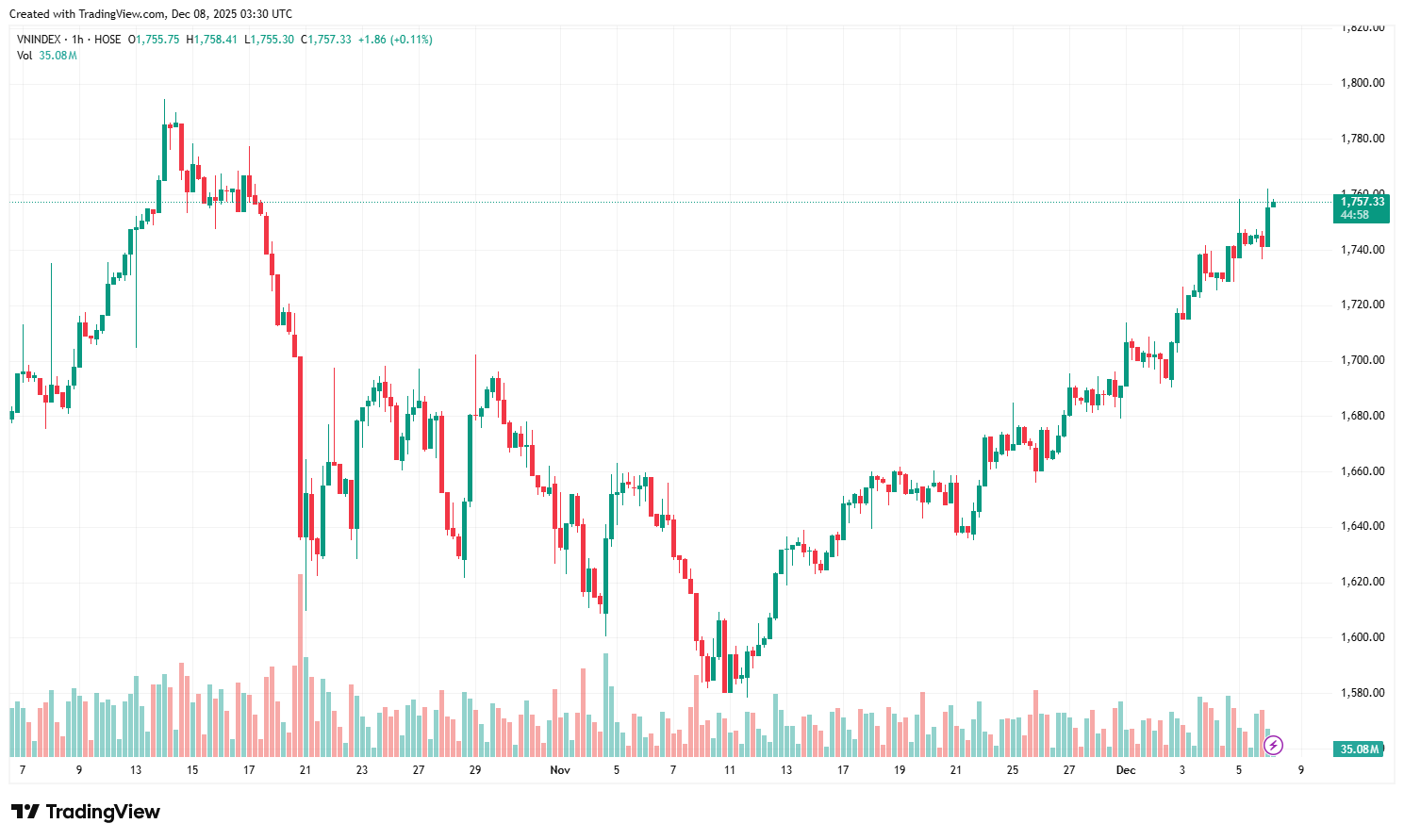
At the end of the last week, the VN-Index closed at 1,741.32, up 4.08 points, equivalent to 0.23%.
In the week of December 1 - December 5, the VN-Index recorded an increase of more than 50 points from the previous week's closing level. The large caps continued to support the VN-Index to conquer the old resistance zones.
Specifically, Vingroup’s stocks were still the main pillar leading the index despite slight adjustments in 2 sessions during the week, in addition to support from the banking and consumer-retail groups. Demand also spread to small and medium-sized stocks such as securities, real estate, and rubber. In addition, liquidity in the sessions during the week gradually improved compared to the average of 20 sessions.
On the foreign side, this group reversed to net buying again, focusing mainly on a number of blue-chip codes such as VPL, MBB, and VJC.
In the last session of the week, the exciting performance of Vingroup stocks at the beginning of the session, highlighted by the purple color of VIC, created momentum to help the VN-Index open with a gap of nearly 11 points and accelerate to near 1,760. After that, the selling pressure increased along with the narrowing of the increase range in VIC, VHM, and VPL, causing the VN-Index to lose steam and gradually retreat to near 1740.
Trading in the market was generally quiet, with liquidity decreasing by 35% compared to the same time of the previous session. In the afternoon session, the VN-Index continued to move in a narrow range around 1,745. Red dominated with 211 red codes and 101 green codes. In that context, the green color of the general index was maintained thanks to the efforts of Vingroup stocks.
Foreign investors also returned to the net selling trend with a total net value of VND 605.21 billion, mainly selling VIC, ACB, and SSI. At the end of the session, the VN-Index closed at 1741.32, up 4.08 points, equivalent to 0.23%. At the end of the week, the VN-Index increased by 50.33 points (2.98%) compared to the previous week.
At the end of the session, the VN-Index closed at 1,741.32, up 4.08 points, equivalent to 0.23%. At the end of the week, the VN-Index increased by 50.33 points (2.98%) compared to the previous week.
The VN-Index ended the weekend session with a spinning top candle, showing a tug-of-war in the market when the index approached the strong resistance zone around 1,770.
On the daily chart, the VN-Index recorded fluctuations when approaching the resistance zone of 1,760-1,770. The RSI indicator broke horizontally in the high zone; however, the MACD indicator has not yet shown a peak formation signal, so it can be seen that this is a normal supply-demand test when the index is in strong resistance zones. The DI line is above the 25 mark; however, the ADX line is below this mark, so the tug-of-war around the 1,730-1,750 zone to find a balance point will continue in the short term.
On the hourly chart, the RSI and MACD indicators are pointing down from the high zone, so it is difficult to avoid short-term fluctuations when the VN-Index is under pressure at old resistance levels. The CMF indicator gradually decreases in height but is still anchored above the 0 mark, showing that active cash flow is still moving in the market, thereby helping the VN-Index strengthen the momentum for the uptrend.
The VN-Index recorded a trading week of more than 50 points, with the main effort still coming from the Vingroup stocks, contributing 26 points to the stock market. The plus point of the week is that the demand has spread to other market sectors such as banking, retail consumption, public investment, and securities.
However, with the VN-Index moving up to strong resistance zones, the general sentiment is also somewhat more cautious with the continuous fluctuations occurring in the sessions of the week. VCBS recommends that investors review their portfolios and consider partial profit-taking for stocks that have reached their T surfing target while maintaining holding stocks in industries that attract cash flow and have not recorded a strong increase from the nearest support zone.
Author: NGOC ANH
RECOMMENDED TOPICS