VN
VN
 EN
EN
21/07/2026, 02:38
Business economics
Strategic vision set for future development
The revised Lam Dong Provincial Master Plan for the 2021–2030 period, with a vision to 2050, provides a vital foundation for guiding the province's long-term, comprehensive and sustainable development while improving the quality of life of its people.
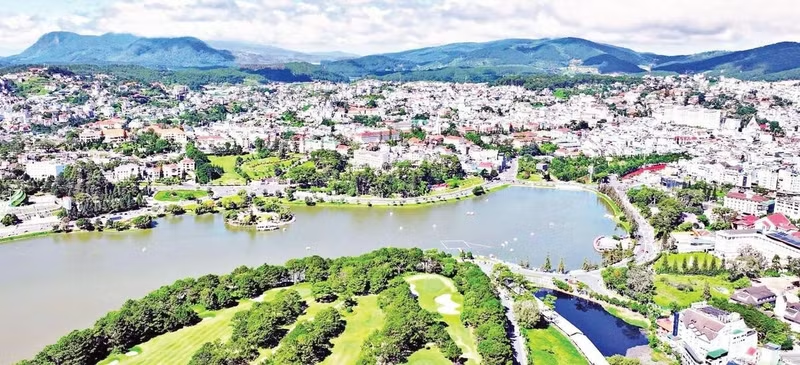
The revision represents a strategic step towards redefining Lam Dong’s role in regional connectivity, establishing a new growth model and realising its ambition of becoming a dynamic growth pole within the region.
Shaping long-term development vision
With its development space now extending from the Central Highlands to the coastline, Lam Dong possesses the full range of conditions needed to develop high-tech agriculture, processing industries, energy, logistics, the marine economy, the forest economy and high-quality tourism.
Ho Van Muoi, Member of the Party Central Committee and Chairman of the Lam Dong Provincial People's Committee, said that revising the provincial master plan enables the locality to shape a long-term development vision, reorganise development space in an integrated, connected and synchronised manner, maximise the potential and advantages of each region and locality, attract investment, mobilise resources and promote rapid and sustainable development.
The revised master plan clearly defines a "highlands–foothills–coastal" development structure that integrates the sea, the Central Highlands and border areas. It envisages the creation of six interregional economic corridors, seven socio-economic development zones and 19 sub-regional development areas within a unified spatial framework.
This model reflects a planning approach that moves beyond administrative boundaries towards greater connectivity, complementarity and synergy among regions, while expanding development space towards the coast through investments in transport infrastructure.
Under the plan, the Central Highlands area of Lam Dong will become a hub for high-value agriculture, eco-tourism, resort tourism, cultural industries, renewable energy, mining and major urban centres. The foothill region will focus on processing industries, energy, logistics and economic corridor connectivity, while the coastal area is expected to emerge as a new growth engine driven by the marine economy, resort tourism, coastal economic zones, free trade zones, industry, energy and coastal urban development.
According to Ton Thien San, Director of the Provincial Department of Finance, building on the planning orientations of the three provinces approved before the merger, the revised master plan identifies Lam Dong as the core regional centre and a strategic gateway linking the South Central Coast and the Central Highlands with the Southeast Region, Cambodia and ASEAN through economic corridors, interregional transport infrastructure and integrated production and service value chains.
By 2030, Lam Dong aims to become one of Viet Nam's better-performing provinces and a key growth pole for the South Central Coast and Central Highlands, with gross regional domestic product (GRDP) per capita reaching approximately 210 million VND and average annual GRDP growth of 10–10.5% during the 2026–2030 period.
By 2050, the province aims to become a highly developed and dynamic regional centre characterised by sustainable growth, a modern economic structure, strong international competitiveness and a prosperous, civilised and happy society. These ambitions are underpinned by the province's newly expanded development space and its increasingly significant regional linkages.
Strategic breakthroughs
To achieve its development goals in the new era, Lam Dong has identified four strategic breakthroughs: developing strategic infrastructure; advancing science, technology, innovation and digital transformation; strengthening key industrial clusters and competitive value chains; and improving institutions, policy mechanisms and local governance.
The province will focus on key economic pillars including renewable energy, processing and manufacturing industries, the marine economy, the forest economy, seaports, airports, logistics services, ecological and high-tech agriculture linked with deep processing, and high-quality tourism.
Priority will be given to investment in strategic transport infrastructure, particularly expressways and major interregional transport corridors connecting the Central Highlands with the South Central Coast and the Southeast Region, alongside the development of new urban areas and integrated commercial, service and tourism complexes.
At the same time, Lam Dong will accelerate the development of digital infrastructure and the application of emerging technologies such as artificial intelligence and big data. The province also plans to establish research and innovation centres, strengthen its start-up ecosystem, promote technological innovation among enterprises, and develop the bauxite–alumina–aluminium smelting–downstream aluminium processing value chain into a strategic industry. Efforts will also focus on strengthening collaboration between businesses, research institutions and local authorities to enhance value addition and deepen participation in national and global value chains.
Le Ngoc Tien, Director of the Provincial Department of Construction, said alongside accelerating expressway construction and other major transport projects, the province will invest in east–west transport links, upgrade national highways crossing the province and strengthen connectivity with neighbouring localities to create new development space for the wider region.
Lam Dong also plans to promote urban development and tourism while ensuring the sustainable use and protection of natural landscapes, forest ecosystems and distinctive ecological areas. Meanwhile, the province will continue to advance administrative reform and significantly improve the investment and business environment. New development models and growth drivers will be introduced where appropriate, including free trade zones, innovation centres, data centres, coastal economic zones and high-tech parks.
Arnaud Ginolin, Managing Director of The Boston Consulting Group (BCG), which advised on the revision of the master plan, said innovation would be the key to enabling Lam Dong to make the most effective use of its existing resources and fully unlock the value of its natural assets.
He noted that innovation would help increase the value of the province's core industries, including high-tech agriculture, processing industries and logistics, while attracting highly skilled professionals and scientists to conduct research and work in the province.
Lam Dong has determined that the success of its revised master plan will ultimately be measured by the infrastructure it delivers, the projects it attracts, the resources it mobilises, the development opportunities it creates and the continuous improvement of people's material and spiritual well-being.
Chairman of the Provincial People's Committee Ho Van Muoi emphasised that the revised master plan has broadened the province's strategic vision and reinforced its aspiration to build a fast-growing, green, sustainable and prosperous Lam Dong, positioning it as a dynamic growth pole for the region.
Author: NDO
RECOMMENDED TOPICS