VN
VN
 EN
EN
10/07/2026, 02:38
Business economics
Transformation in new-style rural area construction
In building new-style rural areas, Son La Province has adopted a development approach that takes agriculture as its foundation, science and technology as its driving force, and farmers as the central actors. The shift from fragmented production to modern, sustainable commodity agriculture has created a strong momentum for transformation.
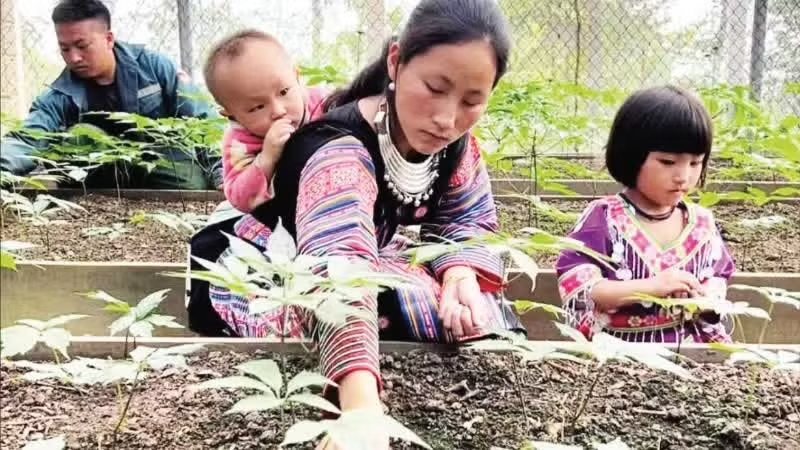
Today, many high-tech agricultural production models in Son La generate incomes two to three times higher than those achieved through traditional farming methods.
Changing production mindsets
In recent years, the application of automated irrigation systems, greenhouses, and temperature and humidity sensors has helped farmers in Son La to move from experience-based farming to data-driven production aligned with market demand. Concentrated production areas applying VietGAP and GlobalGAP standards have been established and granted planting area codes, meeting export requirements for demanding international markets and significantly improving economic efficiency.
These achievements have not only encouraged farmers to adopt scientific and technological advances into production but have also fostered a commodity-production mindset in the province.
According to the provincial Department of Agriculture and Environment, Son La’s agricultural sector recorded average growth of 3.44%/year over the past five years, accounting for around 23% of the provincial economy. Average income generated from one hectare of cultivated land increased by more than 10%/year, reaching approximately 85 million VND per hectare.
The Quyet Thanh Agricultural Cooperative in Thao Nguyen Ward is one of the pioneering units in investing in deep-processing technologies, helping address the long-standing challenge of fluctuating agricultural prices during bumper harvests.
Deputy Director Luong Thi Thanh said that since 2020, the cooperative has invested in six cold-drying machines with a capacity of around five tonnes of fresh fruit per day. Products are processed using modern techniques, including ozone technology and cold drying, ensuring food safety while preserving flavour and nutritional value.
The cooperative currently has five OCOP products, including four four-star products and one three-star product. In 2025, thanks to the application of advanced technologies, its revenue increased by 20% compared with the previous year.
According to the provincial Department of Agriculture and Environment, Son La’s agricultural sector recorded average growth of 3.44%/year over the past five years, accounting for around 23% of the provincial economy. Average income generated from one hectare of cultivated land increased by more than 10%/year, reaching approximately 85 million VND per hectare.
Alongside successful agricultural production models, Son La has also developed numerous eco-tourism destinations combined with experiential activities. Among them, Moc Chau stands out as a leading example of agricultural production, business integrating model and tourism experiences.
According to the provincial Department of Culture, Sports, and Tourism, Son La welcomed nearly 19 million visitors during the 2021–2025 period, generating tourism revenue of more than 20.6 trillion VND. This has contributed to economic restructuring, job creation, and improving incomes for rural residents.
Nguyen Thi Hoa, Chairwoman of the People’s Committee of Moc Chau Ward, said that the ward has 22 agricultural cooperatives operating effectively and making significant contributions to local socio-economic development. Through cooperative models, member households and farmers receive guidance on production processes, expand the application of science and technology, promote products, and strengthen connections with consumption markets and experiential tourism activities, gradually developing a stable and sustainable agricultural sector.
Building new-style rural areas through internal strength
During the 2021–2025 period, Son La Province focused on developing high-tech, clean, and organic agriculture in association with sustainable new-style rural development. The province currently maintains five high-tech agricultural zones while implementing numerous modern production models using sensors, automated control systems, greenhouses, net houses, and LED lighting technologies.
Son La has also expanded models for managing planting area codes and applying integrated pest management to mangoes, oranges, mandarins, and longans. Forest fire monitoring stations and automated forest fire warning systems have been deployed, helping improve agricultural product productivity and quality while accelerating digital transformation in agriculture.
The province has effectively utilised hydroelectric reservoir surfaces to develop high-tech cage fish farming, incorporating environmental monitoring and traceability systems to create high-value products. Meanwhile, the cultivation of medicinal plants under forest canopies is emerging as a strategic direction that both increases incomes and supports forest protection.
According to Nguyen Chi Long, Director of Thanh Long Construction Investment One Member Co., Ltd., more than a decade of experimentation with cultivating Ngoc Linh ginseng in Xam Ta, Muong Chanh Commune, has opened new opportunities for medicinal herb development while creating jobs, increasing incomes, and linking livelihoods with forest protection. Linking economic benefits of local residents with forest has strengthened awareness of forest protection and created sustainable livelihoods — an important criterion in advanced new-style rural area development.
Practical experience in Son La demonstrates that building new-style rural areas is not simply about investing in infrastructure. More importantly, it requires changing mindsets and enhancing farmers’ capabilities. When rural residents actively apply scientific and technological advances, participate in value chains, and adapt to market demands, rural areas become more dynamic and attractive development space to live.
According to Duong Gia Dinh, Deputy Director of the provincial Department of Agriculture and Environment, Son La’s model of agricultural development linked with new-style rural area development is on the right track and is gradually delivering tangible results.
Practical experience in Son La demonstrates that building new-style rural areas is not simply about investing in infrastructure. More importantly, it requires changing mindsets and enhancing farmers’ capabilities. When rural residents actively apply scientific and technological advances, participate in value chains, and adapt to market demands, rural areas become more dynamic and attractive development space to live.
The transition from small-scale farming to commodity production, combined with high-tech applications, deep processing, and market-oriented consumption, has increased the value of agricultural products and improved incomes for local people. In particular, production linkages, cooperative economic models, the integration of agriculture with tourism, and the effective use of local resources are creating new momentum for development in rural areas. These efforts not only promote economic development but also enhance the quality and sustainability of new rural area development criteria.
Currently, agricultural products of Son La Province are exported to 21 countries and territories, including demanding markets with high requirements on quality, food safety, and traceability. In the coming time, the province plans to further promote science and technology applications, improve human resource quality, expand consumption markets, and develop green agricultural models that adapt to climate change, aiming to build advanced and exemplary new rural areas.
At present, Son La has 64 communes that meet new rural standards, an increase of nine communes compared with previous years. The province also has 11 advanced new rural communes and 28 model new rural villages. During the 2026–2030 period, Son La aims to add 36 more new rural communes and develop between one and three modern new rural communes.
Author: NDO
RECOMMENDED TOPICS