VN
VN
 EN
EN
10/07/2026, 02:38
Business economics
Viet Nam seeks greater control of core materials technologies
In the global race for technological leadership, the ability to master advanced materials is increasingly becoming a key determinant of national competitiveness. For Viet Nam, narrowing the gap between research and the marketplace, developing infrastructure and human resources, and strengthening capabilities in core materials technologies are essential prerequisites for building a self-reliant materials industry.
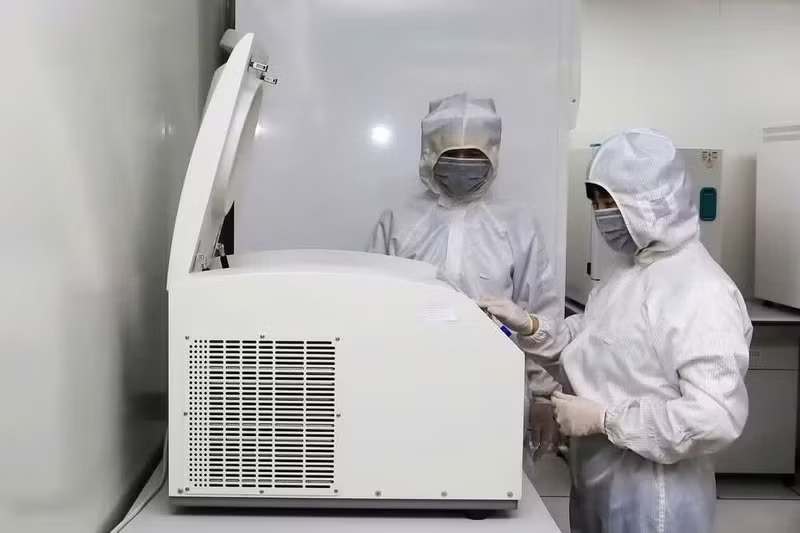
Today, advanced materials are not merely production inputs, they form the foundation of industrial and technological strength. For Viet Nam, mastering new materials means gaining control over critical technologies that underpin strategic sectors such as semiconductors, clean energy, defence, biomedicine and advanced manufacturing.
In recent years, Viet Nam’s materials science community, particularly its leading research institutes, has achieved notable results and gradually developed strategic core technological capabilities. In the defence and security sector, scientists have successfully developed and manufactured a range of advanced materials, including polymer composites for launch-tube sensors, specialised alloys for armour-piercing ammunition cores, and high-performance protective coatings that meet international standards.
These achievements carry not only scientific and economic significance but also contribute to strengthening national defence self-reliance.
In the field of advanced materials, Viet Nam has established research capabilities in nanotechnology, thin films, graphene, energy-storage materials, hydrogen fuel cells and biomaterials. In addition, with its abundant bauxite resources, the country has an opportunity to develop a modern alumina-aluminium industrial chain focused on deep processing and circular economy principles, laying the groundwork for high-value-added materials industries.
Despite these achievements, the full potential of Viet Nam’s materials science sector has yet to be realised due to persistent gaps between research and commercialisation, as well as limitations in infrastructure and collaboration between research institutes and businesses. The country also remains heavily dependent on external supplies for many strategic materials.
According to Professor Dr Tran Dai Lam, Director of the Institute of Materials Science under the Viet Nam Academy of Science and Technology, Viet Nam still primarily participates in assembly, processing and intermediate manufacturing stages, while its capacity to master core materials remains limited. In the field of energy storage batteries and electric vehicles, for example, despite possessing resources such as graphite, nickel and cobalt, the country has yet to develop sufficient capabilities to produce critical materials. The gap between resource availability and deep-processing capacity continues to leave the electric vehicle and renewable energy industries reliant on imported technologies and materials.
In metallurgy and advanced materials, many specialised steels, ultra-high-strength alloys, heat-resistant alloys and high-performance composites are still not produced on an industrial scale. This represents a significant bottleneck to the development of an autonomous defence industry, aerospace manufacturing and other high-tech sectors. Such dependence poses substantial risks to technological sovereignty and may prevent Viet Nam from moving up to the highest-value segments of global supply chains.
Professor Dr Nguyen Dinh Duc, Director of the Advanced Materials and Structures Laboratory and former Chairman of the University Council at the VNU University of Engineering and Technology, noted that while many Vietnamese materials research projects meet international standards, translating research outcomes into industrial products remains a major challenge. This requires coordinated participation across the entire innovation ecosystem.
Currently, many research projects are still driven primarily by scientists’ interests rather than being closely aligned with market demand and the needs of strategic industries. As a result, many research outcomes remain confined to laboratory scale.
In addition, Viet Nam lacks the intermediate infrastructure needed to bridge the gap between research and pilot production. The materials industry requires advanced equipment, pilot production lines, testing centres and internationally accredited certification facilities. These elements have not yet been developed in a sufficiently integrated manner, making it difficult to bring new materials to market.
Experience worldwide demonstrates that materials self-reliance is no longer simply a matter of possessing natural resources, it is fundamentally about mastering science, technology and innovation.
Experience worldwide demonstrates that materials self-reliance is no longer simply a matter of possessing natural resources, it is fundamentally about mastering science, technology and innovation. Professor Tran Dai Lam emphasised that even countries with strong manufacturing capabilities can face shortages of strategic materials or ultra-pure chemicals essential for production. As such, “materials sovereignty” should become a key pillar of national economic security. This requires a shift from a resource-extraction mindset to the development of a comprehensive materials industry ecosystem, encompassing the entire value chain from extraction and refining to deep processing, materials production and end-use applications.
Achieving self-reliance in advanced materials must rest on three pillars: core technologies, long-term investment capital and highly skilled human resources. National technology programmes should therefore focus on priority areas such as semiconductors, battery materials, aluminium and lightweight alloys, defence materials, biomaterials and low-carbon materials.
These programmes should feature clear commissioning mechanisms, adequate funding, strong participation from leading enterprises and a focus on tangible industrial outcomes, ranging from patents and production processes to pilot products and university spin-offs.
Professor Dang Vu Minh, former President of the Viet Nam Academy of Science and Technology, argued that Viet Nam needs a comprehensive development strategy built on several pillars: improving institutions, investing in research and pilot-testing infrastructure, promoting deep processing, establishing long-term state procurement mechanisms and developing high-quality human resources linked to international expertise.
These, he said, are the essential conditions for strengthening technological self-reliance and enhancing Viet Nam’s position in the industrial value chains of the future.
Author: NDO
RECOMMENDED TOPICS