VN
VN
 EN
EN
26/07/2026, 02:38
Business economics
Viet Nam strives to enhance the competitiveness of marine aquaculture
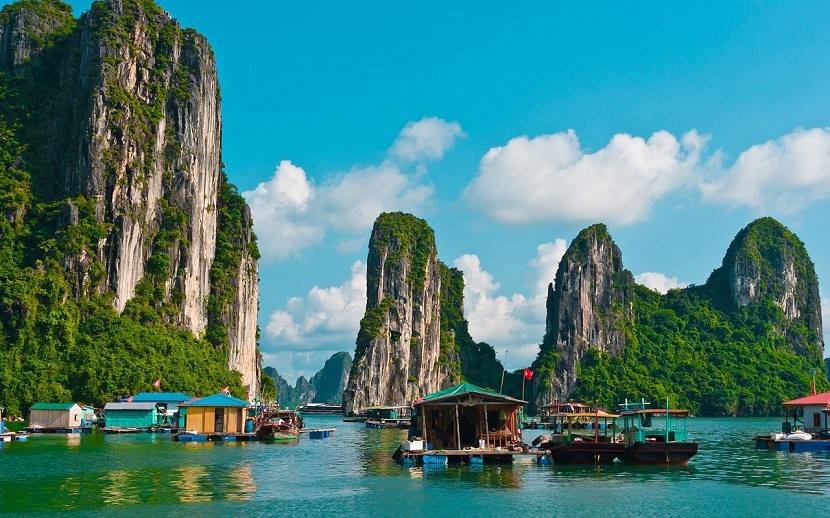
Viet Nam’s long coastline, together with its numerous islands, bays and lagoons, provides favourable conditions for developing diverse forms of aquaculture. Today, many cooperatives and coastal communities are applying new technologies in marine farming, helping to improve productivity, product quality and household income.
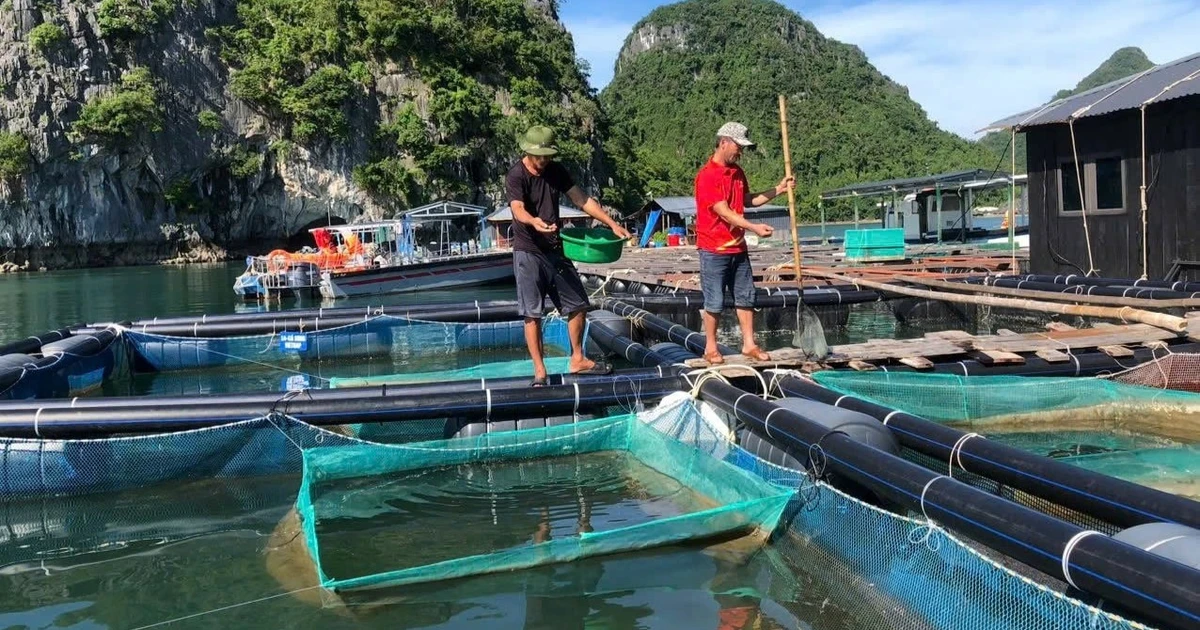
Nguyen Vu Mai Anh, representative of the Fisheries and Fishery Surveillance Department (under the Ministry of Agriculture and Environment), said that in 2024, the total volume of marine cage culture reached 9.7 million cubic metres, an increase of 38.6% compared with 2020, with an average annual growth rate of 8.7%. Key cultured species include marine fish, molluscs and seaweed, with molluscs playing the dominant role. Major farming localities include Khanh Hoa, An Giang and Quang Ninh.
Marine aquaculture has contributed to economic growth, job creation and higher incomes for coastal communities. According to Dang Xuan Truong, Head of Extension and Rural Occupations (under the National Agricultural Extension Centre), many marine aquaculture models have demonstrated positive results. Among them, HDPE cages—capable of withstanding strong waves and offering larger volumes—combined with industrial feed, have delivered high economic efficiency and environmental sustainability.
Typical examples include a 2,700 m³ cobia farming model in central Viet Nam. After nine months of culture, fish reached an average weight of 5 kilogrammes, generating average profits of nearly 200 million VND per cage—up 308% compared with traditional wooden cages. A farming model for two-siphon clams in Quang Ninh and Khanh Hoa, combined with product linkage, yielded about 37.5 tonnes per hectares after 12 months and profit exceeding 900 million VND per hectare.
With extensive advantages—over 40,000 hectares of tidal flats, 20,000 hectares of straits and bays, and rich fishing grounds—Quang Ninh province has significant potential for marine aquaculture.
Phan Thanh Nghi, Deputy Director of the provincial Department of Agriculture and Environment, said: “The province has zoned 45,146 ha of marine areas for aquaculture. To date, 29 projects covering nearly 2,000 hectares have been allocated, mainly farming key species such as grouper, golden pompano, oysters and clams.
In the first eight months of the year, the province produced around 66,783 tonnes of aquaculture products, including more than 45,000 tonnes from marine farming. Many models linking farming with consumption and value chain development have emerged, such as marine fish farming using industrial feed, integrated seaweed–oyster farming, and sustainable aquaculture in Ha Long Bay associated with heritage conservation.”
The province has zoned 45,146 ha of marine areas for aquaculture. To date, 29 projects covering nearly 2,000 hectares have been allocated, mainly farming key species such as grouper, golden pompano, oysters and clams
Following major losses from Typhoon Yagi in 2024, cooperatives and households in Quang Ninh are focusing on rebuilding production with hopes for strong harvests. Nguyen Van Cuong, Director of Cuong Hoa Cooperative in Van Don, said: “We are now farming 158 ha of milk oysters, grouper and two-siphon clams. Among them, two-siphon clams are developing well, yielding 4–5 tonnes per 10,000 seedlings.”
Despite positive outcomes, Viet Nam’s marine aquaculture remains largely small-scale. Many farms still use simple materials such as bamboo, wood and foam buoys, which are easily damaged by storms; investment capital and skilled labour are lacking. Nearshore traditional farming also faces challenges including disease outbreaks and declining water quality.
In Quang Ninh, weak linkages between production–processing–consumption have led to situations of high yields but low prices. Management capacity in many aquaculture facilities, especially cooperatives, is limited; seed and industrial feed sources remain heavily reliant on imports; and the legal framework for marine farming remains incomplete.
To support sustainable development, the Fisheries and Fishery Surveillance Department recommends that localities, enterprises, cooperatives and farmers shift from a production mindset to an economic mindset; move from single-value to multi-value models; meet market-based standards; and build national branding for marine aquaculture products to increase value and competitiveness. Developing traceability systems, smart data management, workforce training, production linkages and market expansion are also essential.
Nguyen Huu Dung, Chairman of the Viet Nam Marine Aquaculture Association, emphasised the need to prioritise marine spatial and coastal zoning for large-scale industrial marine aquaculture; control farming density in enclosed waters to reduce pollution; and promote multi-trophic aquaculture models aligned with circular economy principles. He also stressed the importance of accelerating digital transformation in marine area allocation and calling for enterprises to jointly develop marine aquaculture industrial clusters.
Author: NDO
RECOMMENDED TOPICS