VN
VN
 EN
EN
26/07/2026, 11:20
Investment
Will the global economic growth be weaker in 2026?
Most forecasters believe that global economic growth will be weaker this year than last year; albeit not by much. But the odds are stacked the other way around. If correct, that could weigh on the US dollar even if the US is one of the stronger performers.
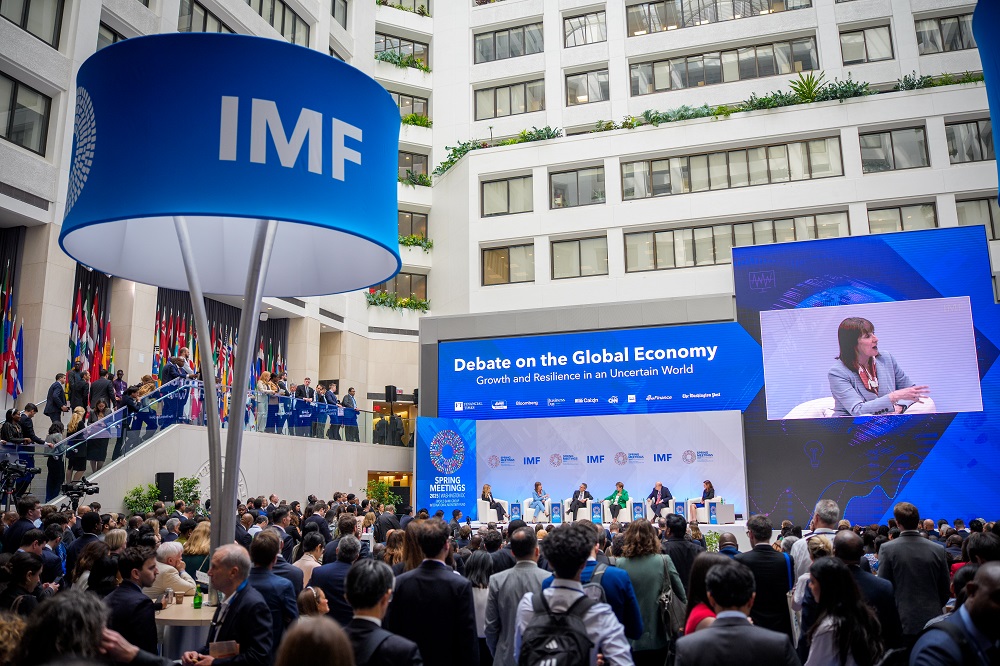
The IMF is forecasting that global economic growth this year will be 3.1% in 2026, slightly lower than the 3.2% that was assumed for last year.
The IMF is forecasting that global economic growth this year will be 3.1% in 2026, slightly lower than the 3.2% that was assumed for last year. Most other forecasters see the same pattern. For instance, of the nineteen banks in the Bloomberg survey, seventeen see lower growth this year than last year, two see the growth rate unchanged, and none see a higher growth rate. However, Steven Barrow, Head of Standard Bank G10 Strategy, thinks there's a good chance that growth will be higher this year than last year for a number of reasons.
The first, as we have mentioned before, is that the US Administration is doing everything in its power to run the economy as hot as it can, and as the US accounts for around 15% of the global economy in purchasing power parity (PPP) terms, US growth that is north of 3% rather than the median forecast of 2.4% (from the Bloomberg poll) could clearly add to global growth.
US fiscal policy is expansionary as the effects of last year's one big, beautiful bill come through, deregulation is running at full pelt, monetary policy is likely to ease more even if inflation stays above target, the AI-related investment boom should keep rolling, and the tariff-related uncertainty from last year has eased. This same tariff-related uncertainty has eased elsewhere as well; often helped by reductions in US tariff rates, as we have just seen for India.
“We have always believed that the biggest damage from tariffs is the uncertainty they cause rather than their actual economic effects, and we think we have seen clear signs of this already,” said Steven Barrow.
There will also be fiscal support outside of the US, at least in many developed nations. Europe will likely be lifted by increased defense spending, and Germany, in particular, should see extra stimulus from its decision to ease the debt brake. In Japan, victory for the LDP in this weekend's election could see more fiscal support in addition to that granted already by PM Takaichi. There is talk of a temporary suspension of the consumption tax. And although Japan does face some challenges from tightening financial conditions, much of the rest of the world has entered the year with financial conditions that are very easy.
If the Fed continues to ease and the US dollar falls, then these financial conditions should become easier still, especially in emerging markets, and that should aid economic growth. If we put all this together, it could push global growth closer to 3.5% this year. Now that might not sound like much compared to the IMF forecast of 3.1%, for instance, or the 3% median of analysts' forecasts in the Bloomberg survey, but it could have important effects on financial markets.
Given that, Steven Barrow believes that the US's avowed ‘go for growth' strategy could prove a major part of any global upside economic surprise, and it might seem that we favor the US dollar. But that's not the case. For a start, fast US growth could come with inflation risks made worse by the likely reticence of the Fed to lift rates. In contrast, other central banks may prove more willing to react to upside growth and inflation surprises, as we have just seen in Australia.
Another point we'd make is that upside growth surprises in other countries, such as those in Europe, would be more of a surprise than in the US, where, as we've said, policy is fully geared towards creating a hot economy. In addition, if global growth is faster, it should bolster investor reorientation out of AI-heavy US stocks into not just other sectors of the US stock market but, more importantly, non-US equities.
At the same time, if robust US growth reflects the fact that policymakers are playing a bit fast and loose with inflation risks, it is likely to make global investors wary of treasuries relative to other bond markets. In short, the US could be a key instigator of stronger global growth this year but at the cost of a weaker US dollar.
Author: NGOC ANH
RECOMMENDED TOPICS