VN
VN
 EN
EN
20/07/2026, 14:32
Legal environment
A new vision for Vietnam auto industry policy needed
The government's decision to retain business conditions for automobile manufacturing, assembly and imports under Resolution No. 66.17/2026/NQ-CP has brought a short but significant debate over the future of Viet Nam's automotive industry to a close.
The debate, according to Nguyen Thi Xuan Thuy, lecturer at the University of Economics, Vietnam National University, Hanoi, points to a broader question: should Viet Nam view the automotive sector primarily as a consumer market or as a pillar of national manufacturing capability?
On the surface, the issue concerns business environment reform. Supporters of deregulation argue that removing market entry requirements would enhance competition, reduce compliance costs, and improve the investment climate. Critics warn that opening the market too quickly could expose domestic manufacturers to a surge of imported vehicles and weaken the country's industrial base.
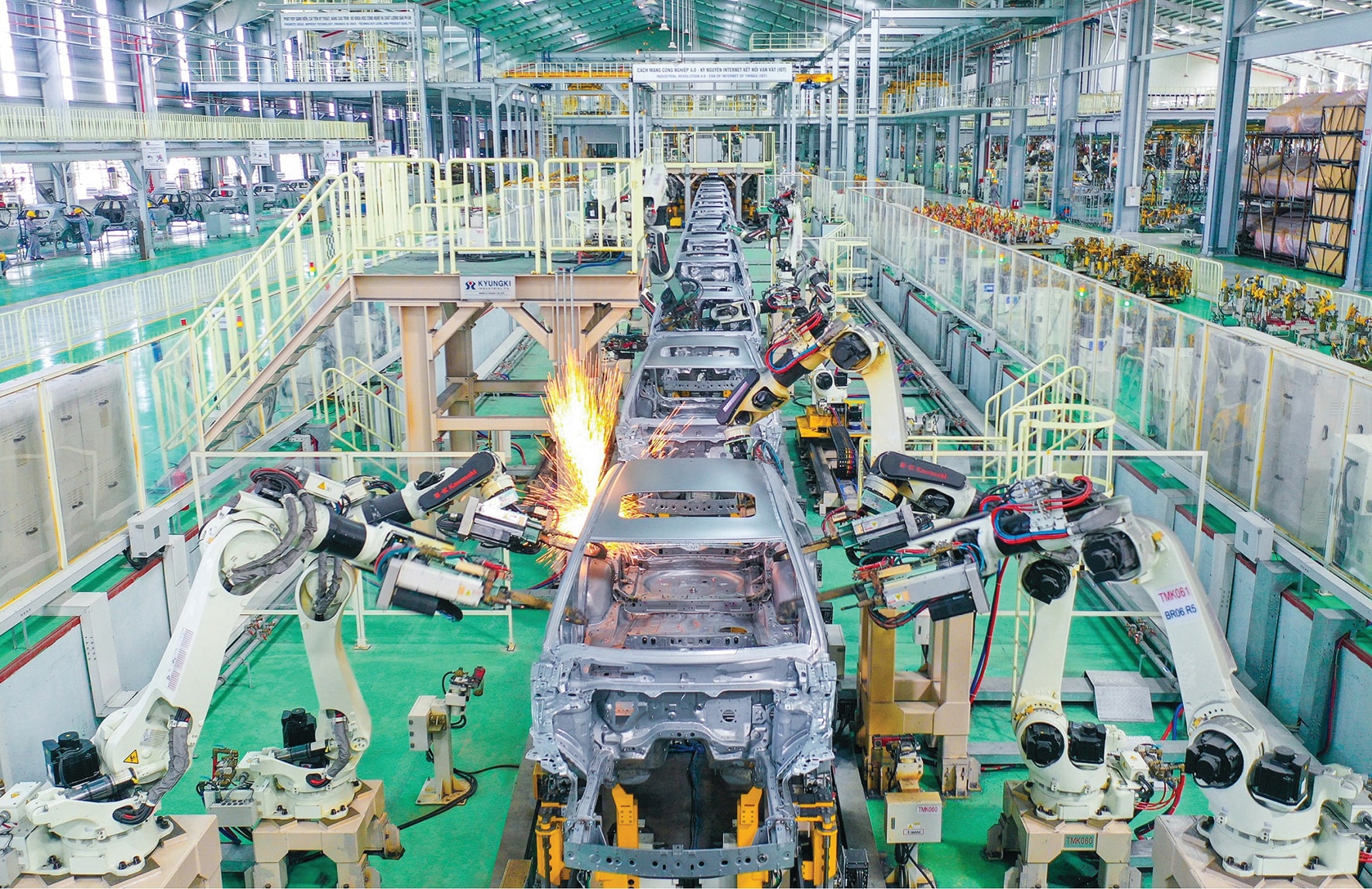
Major economies are increasingly turning to industrial policy tools to strengthen domestic production capacity, particularly in sectors considered strategic.
Yet the debate points to a broader question: should Viet Nam view the automotive sector primarily as a consumer market or as a pillar of national manufacturing capability?
For decades, the dominant trend in the global economy was trade liberalization and the reduction of market barriers. In recent years, however, that trend has begun to shift. Major economies are increasingly turning to industrial policy tools to strengthen domestic production capacity, particularly in sectors considered strategic.
The United States provides a notable example. Since 2025, Washington has increased tariffs on imported vehicles while introducing incentives tied to domestic production and local supply chains. Europe and China have also expanded support for electric vehicles, batteries, and related technologies as they seek to preserve industrial competitiveness.
Against this backdrop, Viet Nam's automotive debate is no longer simply a choice between protectionism and liberalization.
After nearly three decades of development, the country has built a manufacturing base with a degree of industrial capability. While still modest compared with regional production hubs, the sector has fostered a network of suppliers spanning mechanical engineering, electronics, plastics, rubber, materials, logistics, and industrial automation.
Few industries in Viet Nam generate such broad spillover effects. The value of the automotive sector extends beyond vehicle sales. It contributes to technology accumulation, workforce development and the growth of thousands of supporting industries.
At the same time, arguments for maintaining existing protections face a difficult reality. Despite years of policy support, the domestic industry has yet to achieve the level of competitiveness many policymakers had hoped for.
Localization rates remain limited across many vehicle segments. Research and development capacity is still developing. Vehicle and component exports have yet to emerge as a major growth engine. If protective measures continue without stronger incentives for technological upgrading and productivity gains, companies may become increasingly dependent on a sheltered market rather than improving their competitiveness.
Conversely, a fully liberalized market carries risks of its own. With supporting industries still relatively weak, Viet Nam could find itself evolving into a consumption market rather than a manufacturing hub within regional value chains. Small and medium-sized enterprises that have gradually integrated into automotive supply networks would likely face the greatest pressure.
This suggests that the policy choice does not lie at either extreme.
The more pressing challenge is how to move from administrative protection toward a new generation of industrial policy. Rather than relying primarily on licensing requirements and pre-approval mechanisms, policymakers could place greater emphasis on tools that strengthen competitiveness, including technical standards, incentives linked to genuine localization, support for research and development, investment in supporting industries, and the development of an electric vehicle ecosystem.
Such an approach would mirror the direction taken by many countries that are reshaping industrial policy. The objective is no longer simply to protect domestic markets but to create conditions that encourage innovation, productivity growth, and deeper integration into global value chains.
Viewed from this perspective, the decision to retain business conditions for the automotive sector may be only a short-term policy choice. The more important question is whether Viet Nam can develop a long-term industrial strategy for the industry.
As global competition intensifies and supply chains continue to be reconfigured, the central issue is not merely how to protect the automotive sector. It is what role the industry should play in strengthening Viet Nam's manufacturing capabilities over the coming decade.
Author: TRUONG DANG
RELATED TOPICS
RECOMMENDED TOPICS