VN
VN
 EN
EN
09/07/2026, 11:15
Investment
Automotive stocks enter new cycle on electrification wave and tax incentives
The wave of electrification and extended tax incentives are creating fresh momentum for Vietnam’s automotive market, opening up growth opportunities for businesses and stocks benefiting from the green vehicle transition.
Momentum from Support Policies
Vietnam’s automotive market is undergoing a profound transformation as green vehicles gradually gain dominance. The combination of prolonged tax and fee incentives together with a tightening emissions roadmap in major cities is expected to become a turning point for the industry during the 2026–2030 period.

Summary of taxes and fees for electric versus gasoline vehicles (Source: Goutai Junan Vietnam)
According to an updated report from Goutai Junan Vietnam Securities, the first quarter of this year recorded a clear shift in consumer behavior, with electric vehicles no longer viewed as an experimental option but increasingly becoming a mainstream trend in the domestic market.
In a market where vehicle ownership costs are heavily affected by taxes and fees, the Government’s extension of preferential policies is seen as a key driver for maintaining demand and supporting automakers during the early stage of large-scale electrification investment.
Under the current roadmap, the special consumption tax (SCT) for electric vehicles with fewer than 24 seats will remain at low levels until 2030. Specifically, from January 1, 2026, electric vehicles with fewer than nine seats and passenger pick-up trucks will be subject to a 3% tax rate, rising to 11% from 2031. Vehicles with 10 to under 16 seats will face a 2% rate before increasing to 7%, while vehicles with 16 to under 24 seats will be taxed at 1%, rising to 4% after 2031. Double-cabin cargo pick-up trucks are currently taxed at 2%, increasing to 7% in the future.
At the same time, Decree 51/2025/ND-CP also extends the 100% registration fee exemption for battery electric vehicles until February 28, 2027. After that point, registration fees will equal 50% of those applied to comparable gasoline or diesel vehicles.
Analysts believe the significant tax gap between electric and internal combustion engine vehicles is creating a major competitive advantage for EV manufacturers. Currently, the SCT rate for electric vehicles with fewer than nine seats is only 3%, while conventional gasoline cars with engines below 2.0L are taxed as high as 45%.
This gap gives EV manufacturers greater room to compete on pricing and features despite still-high production costs. Meanwhile, maintaining incentives through 2030 also substantially reduces policy risks for long-term investment plans in charging station ecosystems and supporting infrastructure.
If tax and fee incentives serve as encouragement, Hanoi’s low-emission zone (LEZ) rollout roadmap is viewed as a mandatory factor that could significantly reshape consumer behavior in central urban areas.
Under the plan, from July 1, 2026 through the end of 2026, Hanoi will pilot LEZs in the core area of Hoan Kiem District. During this phase, gasoline-powered ride-hailing motorcycles will be completely banned, while gasoline-powered cars will face time-based restrictions and stricter emissions standards.
In 2027, the pilot area will expand to neighboring wards in Hoan Kiem and Cua Nam, covering approximately 3.6 square kilometers. During 2028–2029, the city plans to ban all gasoline-powered vehicles within Ring Road 1, equivalent to more than 26 square kilometers of inner-city urban space.
Alongside administrative measures, Hanoi is also imposing new infrastructure requirements, with 20–30% of parking spaces required to integrate charging stations. AI-powered camera systems will be deployed to automatically monitor vehicles violating emissions standards.
According to experts, the new regulations are likely to trigger a large-scale vehicle replacement wave in urban areas. As access to city centers increasingly becomes a “privilege” reserved for electric vehicles, consumer choice may shift from voluntary adoption to practical necessity.
Companies Adopt Diverging Strategies
Market data from the Vietnam Automobile Manufacturers’ Association (VAMA) showed total sales by member companies reached 38,704 vehicles in March 2026, up 101% compared to February 2026 and 122% year-on-year. The figures indicate a strong recovery in market demand after the Lunar New Year holiday period.
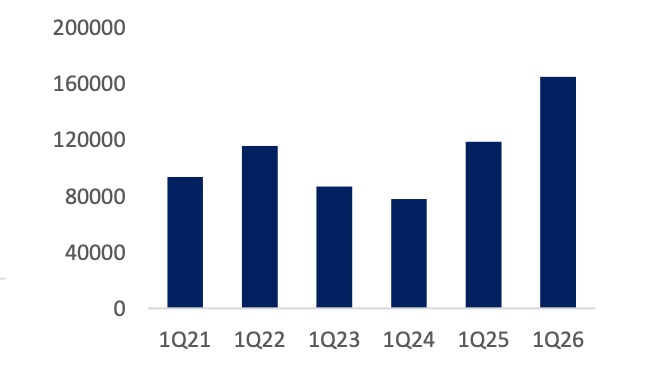
Automobile sales growth in Q1/2026 (Source: VAMA, VinFast, TC Motor, GTJASVN)
For the entire first quarter, total vehicle sales reached 76,790 units, up 30% year-on-year. The brightest spot in the market picture was the sharp rise of green-energy vehicles. Of total sales, electric vehicles reached 53,685 units, accounting for more than 33% of nationwide market share, while hybrid vehicles recorded 5,125 units, up around 50% compared to the same period in 2025 and representing 3.5% market share. This marks a record-high ownership rate for green vehicles, reflecting a clear shift in consumer habits.
Beyond policy support, fluctuations in fossil fuel prices driven by global geopolitical tensions are also strongly influencing consumer sentiment. Buyers are increasingly prioritizing vehicles with more stable operating costs, further accelerating the transition toward electric vehicles.
Nguyen Ngoc Hiep, an analyst at Goutai Junan Vietnam, said the market transition is creating clear divergence among companies in the sector.
VinFast is likely to maintain its leadership position in the EV segment with strong sales growth. Meanwhile, HAX is pursuing an aggressive pivot toward EVs through a proposal to acquire 65–85% of Vietnam Future Group (VFG), allowing the company to directly participate in operating and developing VinFast dealership chains. The move is viewed as a major strategic shift aimed at adapting to the accelerating electrification trend.
In contrast, VEA has chosen a more cautious approach by focusing on supporting industries, benefiting from overall sector growth without directly bearing the pressure of transforming its distribution model.
Overall, 2026 is expected to become the most substantive transition period yet for Vietnam’s automotive industry, as policy, infrastructure, and consumer behavior all evolve simultaneously. Over the next 6–18 months, market prospects are expected to depend on three key factors: the stability of tax and fee incentive policies; the pace of tighter emissions standards in major cities; and EV manufacturers’ ability to optimize operating costs.
The analyst also noted that under a 6–18 month investment rating framework, “buy” rated stocks are those expected to outperform the VN-Index by more than 15% or benefit significantly from industry trends. “Accumulate” rated stocks are expected to outperform by 5–15%, while “watch,” “reduce exposure,” and “sell” ratings reflect progressively weaker prospects relative to the broader market.
Author: DIEM NGOC - TRUONG DANG
RELATED TOPICS
RECOMMENDED TOPICS