VN
VN
 EN
EN
15/07/2026, 10:39
Investment
Are aviation stocks moving against the market?
Although business performance and capital flows into aviation stocks have varied across companies, the aviation sector is still widely expected to be approaching a new growth phase.
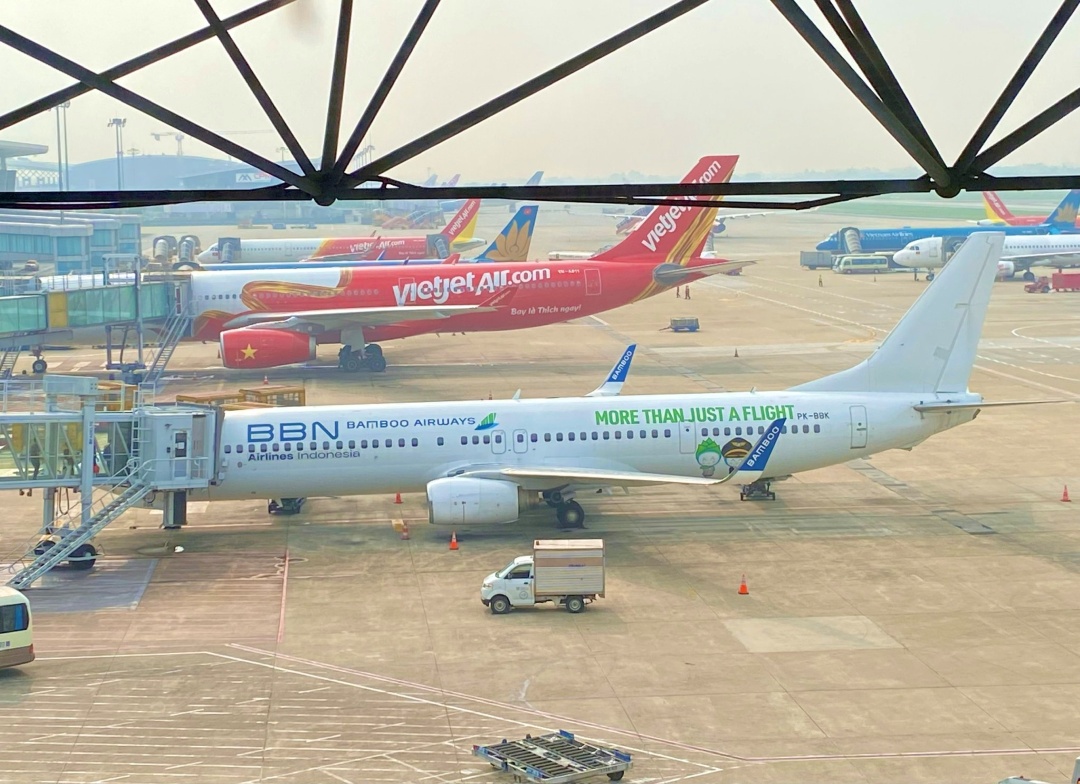
Strong aviation activity has helped airlines such as Vietnam Airlines and Vietjet, as well as airport service providers such as ACV, achieve improved financial results.
Aviation Showing Signs of Recovery
In the first quarter and the first five months of 2026, the aviation industry faced unexpected challenges as soaring energy prices pushed costs sharply higher. Fuel expenses, which account for approximately 40% to 60% of airlines' operating costs, increased significantly. Due to the lag in fare adjustments and fuel hedging strategies, profit margins were immediately squeezed, creating a short-term shock for the industry.
But has this shock been reflected in the actual business results of Vietnam's major aviation companies?
According to Vietnam Airlines (HOSE: HVN), the carrier operated nearly 43,000 flights in the first quarter of 2026, serving more than 6.9 million passengers. This represented increases of 11% in flight volume and nearly 12% in passenger traffic compared with the same period last year.
As a result, the airline reported consolidated revenue of more than VND 37.5 trillion and after-tax profit of VND 4.514 trillion. The parent company alone recorded revenue of more than VND 29.5 trillion and after-tax profit of VND 3.948 trillion.
Vietnam Airlines also noted that from the second quarter onward, the aviation industry would face a more challenging operating environment as uncertainties become increasingly evident, particularly those related to fuel prices.
As of the end of April, Jet A1 fuel prices remained elevated, averaging between US$190 and US$220 per barrel, and at times exceeding US$240 per barrel due to geopolitical developments. This is nearly three times the normal range of US$80 to US$90 per barrel.
Given the nature of the aviation industry, every US$1 increase in fuel prices above plan can add more than VND 300 billion to Vietnam Airlines' annual costs. Fuel price volatility therefore places considerable pressure on operating expenses, narrows profit margins, and poses challenges for business performance in the coming quarters.
Vietjet Air (HOSE: VJC) reported consolidated first-quarter revenue of VND 21.021 trillion, up 17% year-on-year, while consolidated pre-tax profit reached VND 1.142 trillion, up more than 36%.
At the parent company level, Vietjet posted revenue of VND 19.473 trillion, up nearly 9%, with pre-tax profit of VND 1.02 trillion, up 24%, and after-tax profit of VND 922 billion, up 47%.
.jpg)
During the first quarter, Vietjet carried 7.2 million passengers, up 5% year-on-year, operated 39,903 flights, up 3%, and transported 23,344 tonnes of cargo. The airline continued expanding its network by launching five routes connecting Vietnam and China. Vietjet currently operates 186 routes, including 45 domestic and 141 international services. As of 31 March, the company's total assets stood at VND 143.534 trillion.
Airport Corporation of Vietnam (UPCoM: ACV), the country's dominant airport operator and ground services provider, also posted record profits in the first quarter of 2026. Despite making provisions for bad debts related to Bamboo Airways, Pacific Airlines, Vietravel Airlines and Mekong Aviation, with total doubtful receivables approaching VND 3.8 trillion, ACV generated revenue of nearly VND 6.861 trillion, up 7.7% year-on-year, and after-tax profit of more than VND 3.346 trillion, up 7.2%.
Industry participants and analysts expect passenger and cargo traffic in 2026 to continue growing strongly in both international and domestic segments despite geopolitical tensions in the Middle East. Long-term transportation demand remains highly positive. With aircraft supply still constrained, airlines are not only preparing for a recovery cycle but are also accelerating investments to expand capacity for the next phase of growth.
Earlier this year, Vietjet signed several multi-billion-dollar agreements, including a US$6.3 billion partnership with U.S. counterparts focused on aircraft engines, maintenance services, and aircraft financing.
Similarly, Vietnam Airlines signed an agreement to purchase 50 Boeing 737-8 aircraft to support domestic and regional Asian routes, helping strengthen growth and improve service quality.
Meanwhile, although construction progress at Long Thanh International Airport slowed during the first quarter, ACV recently appointed an Acting Chief Executive Officer. The Government aims to put the airport into operation by the end of 2026.
Although analysts expect ACV to face certain operational pressures during the initial phase, Long Thanh is viewed as a transformational infrastructure asset. For a company that manages and operates 22 airports nationwide, the new airport is expected to reshape ACV's growth outlook for years to come.
Outlook for Aviation Stocks
Based on the fundamentals of Vietnam's leading aviation companies, a recent sector report by SHS Securities noted that aviation is a highly cyclical and seasonal industry. The performance of aviation stocks is therefore closely linked to fluctuations in passenger and cargo volumes.
According to SHS, this dependency often leads investors into a classic mistake. Poor investment decisions are not necessarily caused by weakening business fundamentals, but rather by mistimed expectations.
Historically, international passenger traffic tends to peak in January and February during the Lunar New Year period, in August during the summer travel season, and again in November and December during winter holidays and year-end festivities. Passenger traffic typically reaches its lowest point between May and July.
This means corporate earnings often peak during these high-travel periods, attracting speculative interest. However, SHS argues that this is often the most expensive trap for aviation stock investors.
Historical performance data over the past decade tells a very different story.
"Consider ACV, the backbone of Vietnam's aviation industry. March has historically been the worst-performing month for the stock, with an average return of minus 3.62%, while June has been the strongest month, delivering an average gain of 6.13% (Source: Vietstock). Across the sector, June (1.71%) and December (2.87%) have been the strongest months for stock performance, even though international passenger data is generally weakest in June," SHS analysts noted.
The explanation for this apparent disconnect is straightforward. Financial markets do not price current conditions. They price expectations for the next six months.
According to SHS, three factors drive this pattern.
First, earnings announcements, rather than current traffic data, are the primary catalyst for capital flows. While retail investors may worry about seasonal traffic lows in June, institutional investors have already absorbed first-quarter earnings results, released in late April, and are positioning themselves for the expected acceleration in third-quarter performance.
Second, although international passengers remain the key driver of margins and high-value services, investors often overlook the cushioning effect of domestic travel. During the international low season from May to July, strong domestic summer tourism helps maintain stable demand and cash flow across the sector.
Finally, aviation is a unique industry in which a few months of extreme disruption or exceptional growth can define profitability for an entire five-year cycle. In Vietnam's case, the Long Thanh International Airport project represents such a structural turning point and could become a major catalyst for the industry's future.
"Understanding the broader industry cycle and managing position size appropriately are far more important than attempting to predict short-term monthly fluctuations," SHS concluded.
Author: LE MY - TRUONG DANG
RELATED TOPICS
RECOMMENDED TOPICS