VN
VN
 EN
EN
09/07/2026, 11:15
Investment
A year of breakthroughs in infrastructure development
Looking back at 2025, despite severe storms and flooding, Viet Nam completed more than 1,000 kilometres of expressways, bringing the nationwide total to over 3,500 kilometres, well above the target of 3,000 kilometres.
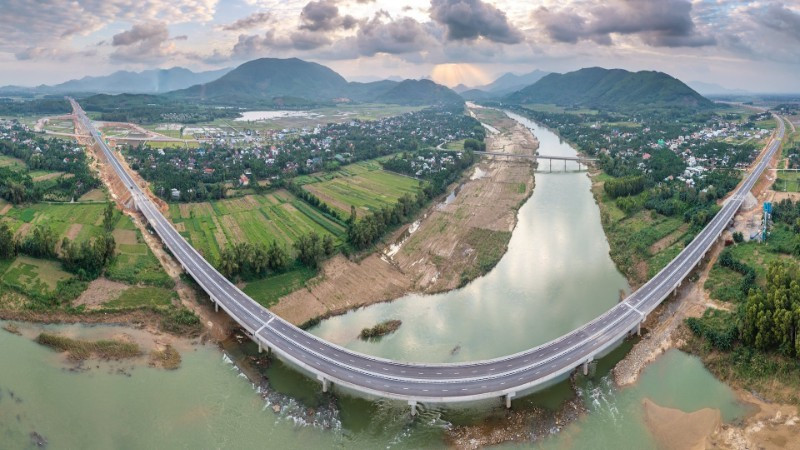
According to Minister of Construction Tran Hong Minh, as of December 19, a total of 3,513 kilometres of expressways had been completed or technically opened to traffic (including 3,188 kilometres of main routes and 325 kilometres of access roads). By the end of the year, the figure is expected to reach 3,813 kilometres (3,345 kilometres of main routes and 458 kilometres of access roads).
It is worth recalling that more than a year ago, when Prime Minister Pham Minh Chinh launched a nationwide drive to complete 3,000 kilometres of expressways by the end of 2025, many transport and construction experts stated that this goal represented a genuine leap forward in transport infrastructure, but also posed an enormous challenge.
In early 2010, Viet Nam had just over 40 kilometres of expressway, following the inauguration of the Ho Chi Minh City-Trung Luong project. According to Pham Huu Son, Chairman of the Board of Directors of Transport Engineering Design Incorporated (TEDI), if the 3,000 kilometres of expressways achieved today are regarded as a milestone, then the Ho Chi Minh City-Trung Luong Expressway should be seen as the starting point. Built to a four-lane standard and stretching 41 kilometres, the project broke ground in December 2004 and was fully opened to traffic in February 2010, creating a key gateway route to meet strong travel demand from the southwestern provinces to Ho Chi Minh City.
All comparisons are inevitably imperfect, but while the 40-kilometre-long Ho Chi Minh City-Trung Luong Expressway took five years to complete, today, in a little over one year, more than 1,000 kilometres have been completed, demonstrating how far the construction sector has progressed.
Le Quyet Tien, Director of the Department of Construction Investment Economics and Management (Ministry of Construction), noted that the 2020-2025 period marked the fastest and most dynamic phase of development of Viet Nam’s expressway network, representing a historic breakthrough in terms of investment scale, construction speed, operational length and investment efficiency. Over five years, the total length of expressways nationwide has more than tripled and is expected to reach nearly 3,350 kilometres (main routes) by the end of 2025. Construction during 2021-2025 averaged around 400 kilometres per year, more than four times the pace of the previous period and the fastest in the history of Viet Nam’s transport and construction sector.
According to Associate Professor Tran Chung, Chairman of the Viet Nam Association of Road Transport Infrastructure Investors (VARSI), experience has shown that every expressway completed and put into operation effectively converts time into money.
Quang Ninh is a prime example. Thanks to its strong infrastructure development and integrated transport connectivity, the province has become an attractive destination for investment, trade and tourism. By adopting new approaches and mobilising social resources, the province has completed three expressways, Hai Phong-Ha Long, Ha Long-Van Don and Van Don-Mong Cai, along with other transport infrastructure projects such as Van Don International Airport and Ha Long International Cruise Port, creating a modern, efficient and safe transport infrastructure system with faster regional and international connectivity.
“Expressways have clearly demonstrated their role in connectivity, shortening travel times and closely linking economic zones. Once an expressway network is formed and interconnected, it also helps reduce investment costs for other infrastructure, while minimising incidents and traffic accidents on nearby national and provincial roads. Given these substantial benefits, completing the entire north-south expressway in the near future is of enormous significance,” Associate Professor Chung said.
In addition to exceeding the target of 3,000 kilometres of expressways by the end of 2025 as directed by the Prime Minister, the construction sector has also invested in and brought into operation two international seaports, Lach Huyen and Cai Mep, capable of accommodating the world’s largest container ships; commenced and completed Phase I of Long Thanh International Airport; promptly updated and adjusted airport planning to attract investment, notably with Gia Binh International Airport launched in 2025; and approved investment policies for a number of important national railway projects.
To realise the goal of 5,000 kilometres of expressways nationwide by 2030, the Ministry of Construction and local authorities are implementing dozens of expressway projects with a combined length of more than 2,000 kilometres. These include large-scale projects such as Ben Luc-Long Thanh, Ha Noi’s Ring Road 4 and Ho Chi Minh City’s Ring Road 3. With progress on schedule, the target of around 5,000 kilometres of expressways by 2030 is well within reach.
Alongside the effective operation of existing infrastructure, the construction sector continues to advance the north-south high-speed railway project. During the 2026-2030 period, the Ministry of Construction has identified as key tasks the development of a synchronised, modern and intelligent infrastructure system; the concentration of central resources on strategic infrastructure; and the basic formation of a national infrastructure framework.
To fulfil these priorities and contribute to the implementation of the three strategic breakthroughs, the Ministry of Construction will focus on researching and establishing breakthrough mechanisms and policies to mobilise and efficiently utilise domestic and foreign resources, including private-sector capital, while strongly decentralising authority to localities in infrastructure management and operation.
At the same time, priority will be given to major projects with strong spillover effects, alongside the completion of national sectoral plans and specialised technical planning to ensure overall efficiency and balanced development across sectors.
In parallel, efforts will be made to develop a highly skilled workforce, with a focus on high-speed rail and urban rail sectors, as well as to promote smart urban development and intelligent transport systems, linked with the use of green, low-emission vehicles.
Beyond their significant economic impact, infrastructure projects also deliver considerable social benefits. Many rural workers have gained stable employment, while new urban areas and industrial zones have emerged, making important contributions to budget revenues and improving service quality and people’s lives.
Prime Minister Pham Minh Chinh has repeatedly stressed that infrastructure investment is not merely for the present but a forward-looking investment for the long term. Every expressway, bridge, airport or port completed today opens up major, sustainable development opportunities for generations to come.
Author: NDO
RECOMMENDED TOPICS