VN
VN
 EN
EN
26/07/2026, 02:38
Business economics
Connecting markets for consuming goods in ethnic minority and mountainous areas
Products from ethnic minority and mountainous areas have great potential, however, market connection and development in recent times has only partially met the needs. Therefore, more solutions are needed so that these products have the opportunity to participate in the supply chain in domestic and foreign markets.
 |
|
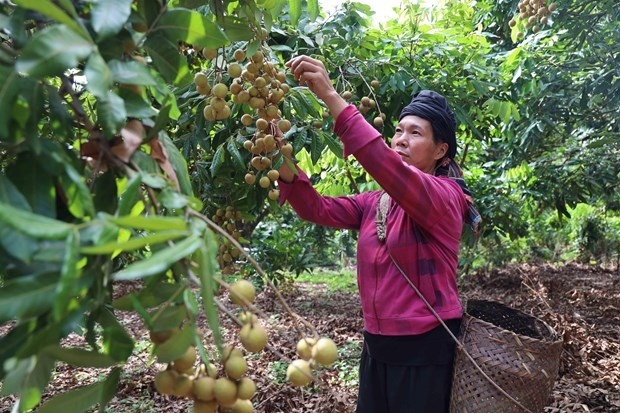
Open the way for mountainous agricultural products to reach large markets. Photo: VNA |
Step by step penetrate the market
At the seminar "Developing product markets in ethnic minority and mountainous areas", on September 20, Le Viet Nga, Deputy Director of the Domestic Market Department (Ministry of Industry and Trade) said that recently, there have been important steps forward in commercializing and bringing products from ethnic minority and mountainous areas into distribution channels in the domestic market as well as for export, such as organizing trade promotion activities, connecting supply and demand, and developing handbooks to introduce specialty products of ethnic minority areas.
In addition, an outstanding activity is organizing two-way sales points, providing essential goods to people in ethnic minority areas, and at the same time purchasing products and goods that have been commercialized of ethnic minority areas to bring to regions with large consumer populations such as Hanoi and Ho Chi Minh City.
As a mountainous province in the Northeast of the country, Lang Son has had many solutions to promote production as well as develop markets for ethnic minority products. Nguyen Trong Nghia, Deputy Director of the Department of Industry and Trade of Lang Son province, said that Lang Son currently has 19 key agricultural products, including typical products such as: Bac Son yellow tangerine, Bao Lam, Vanh Khuyen persimmon, and Chi Lang custard apple, star anise, black jelly,...
Along with the State's policies, Lang Son province also promulgates specific policies and mechanisms, plans and schemes to organize and implement them. For example: action plan on developing the anise value chain; planning for development of raw material areas associated with export processing; the province's key agricultural value chain development strategy... Currently, Lang Son province has over 94 products granted OCOP certificates from 3 - 4 stars.
Nguyen Trong Nghia said that the annual Vietnam - China international trade fairs organized by the Department of Industry and Trade of Lang Son province in collaboration with Bang Tuong (China) have created opportunities for businesses to exhibit. , promote, introduce and connect domestic product consumption, as well as in the Chinese market.
Sharing the story of accompanying a potential product of mountainous ethnic people, Dao Duc Hieu, Director of Suoi Giang Tourism Ecosystem Cooperative, said that Vietnam has been positioned on the world tea map. Among the ancient tea areas, I chose to stop at Suoi Giang because this is also known as the ancestor of ancient tea in the world. That means we have the opportunity to let Tra Viet be announced to the world.
Dao Duc Hieu shared that in such a poor area on the top of a high mountain, it has achieved 4-star OCOP and is on the way to strive for 5-star status with ECOCERT certification, the European ORGANIC standard, which means we Has a passport to travel to 26 countries around the world with geographical indications, planting area codes, and ISO in production.
“Vietnam ranks 5th in the world in tea export, more than 200,000 tons/year, but tea prices are very cheap compared to the world. Therefore, there needs to be a national strategy for tea, so that Vietnamese tea can have a new position, not just in cartons, plastic bags, not in tons, but in Vietnam we have to pack it in grams," Dao Duc Hieu expressed.
Regarding the current market, Le Viet Nga said that the domestic and international markets are tending to look for products with specific cultural elements and ethnic minorities have their own identities. Rough gems are being polished to be introduced to consumers.
Breakthrough policies are needed to attract large businesses to participate
However, Le Viet Nga also mentioned difficulties in developing product markets in ethnic minority and mountainous areas, since many ethnic groups are not proficient in commercializing their specialties.
Therefore, according to Nga, more comprehensive solutions are needed, with breakthrough policies to attract businesses to participate in supporting farming households and production households in ethnic minority areas. Nga gave an example: in the pilot phase, some localities such as Son La, Lang Son, Lam Dong were very successful in attracting large enterprises to invest in production, preliminary processing, purchasing and export or bring into the domestic market products of ethnic minorities.
In addition, models supporting ethnic minorities selling in modern distribution channels such as Saigon Co.op or BigC only contribute to the community and have not yet become the weekly, monthly, and yearly activities to support ethnic minorities in having their own space to perform culture and at the same time introduce to consumers these extremely precious products of ethnic minorities.
Author: Customsnews
RECOMMENDED TOPICS