VN
VN
 EN
EN
26/07/2026, 02:38
Business economics
Efforts made to build a strong maritime nation, prosperous from the sea
The documents of the 14th National Party Congress have both provided long-term strategic direction and set specific requirements for coastal localities to concretise them through programmes and models suitable to their practical conditions.
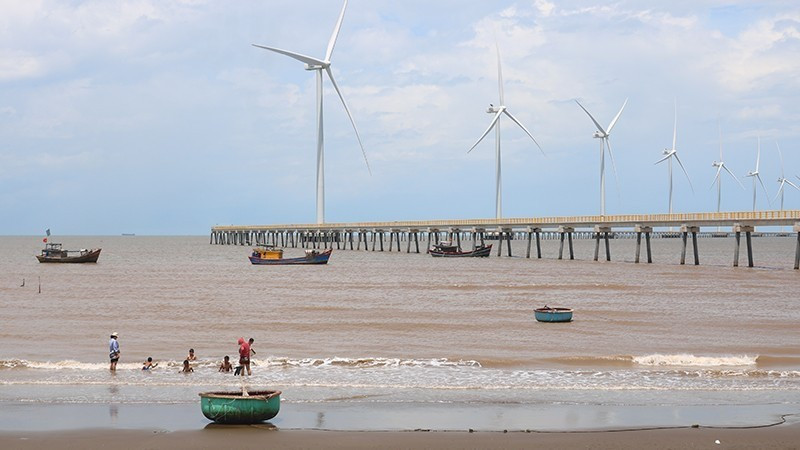
The documents of the 14th National Congress of the Communist Party of Viet Nam have emphasised the need to strongly develop marine economic sectors in a green and sustainable direction, effectively utilising marine space; developing coastal infrastructure, economic zones, industrial parks, and ecological urban areas; building fisheries logistics centres and marine logistics; promoting high-tech aquaculture, energy conversion, and the development of renewable energy sources associated with environmental protection and marine ecosystem conservation. This is both a long-term strategic direction and a specific requirement for coastal localities to concretise it through programs and models suitable to their practical conditions.
Following the reorganisation of administrative units, Vinh Long province has expanded its marine economic development space. Based on a thorough understanding of the Party’s viewpoints, the Vinh Long Provincial Party Committee has identified the marine economy as one of its strategic pillars, striving to ensure that by 2030, purely marine-based economic sectors contribute approximately 50% of the province's GRDP.
Duyen Hai Ward plays a crucial role as a “front-facing” coastal area, situated entirely within the planned Dinh An Economic Zone – a strategic gateway to the East Sea/South China Sea for the province and the Mekong Delta region. Adhering closely to this direction, the Ward Party Committee has set the goal of developing the marine economy based on biodiversity conservation, protecting the marine ecosystem, ensuring harmony between development and conservation, and balancing the interests of coastal and non-coastal localities.
Duyen Hai Ward has implemented many key solutions and achieved significant initial results. The fisheries economy has continued to affirm its pivotal role, with total production from fishing, harvesting, and aquaculture reaching over 25,000 tonnes by 2025, exceeding the set target; per capita income reaching 87.1 million VND/year; marine economic infrastructure and transportation connectivity gradually improving; and coastal businesses and services developing well...
The documents of the 14th National Congress of the Communist Party of Viet Nam have emphasised the need to strongly develop marine economic sectors in a green and sustainable direction, effectively utilising marine space; developing coastal infrastructure, economic zones, industrial parks, and ecological urban areas; building fisheries logistics centres and marine logistics; promoting high-tech aquaculture, energy conversion, and the development of renewable energy sources associated with environmental protection and marine ecosystem conservation.
The documents of the 14th National Congress have also identified energy transition as an inevitable trend and an important driving force for green growth and sustainable development. Leveraging its long coastline and significant wind and solar radiation potential, the Duyen Hai Ward Party Committee has identified renewable energy as a breakthrough in its marine economic development strategy. Currently, the ward and surrounding areas have established a system of thermal power plants, wind power plants, and solar power plants with a total capacity, contributing approximately 30 billion kWh/year to the national power grid.
Investing in integrated coastal infrastructure is also a suitable approach given Duyen Hai’s characteristics and advantages. Accordingly, the ward has focused on coordinating with various levels and sectors to invest in and upgrade the coastal transportation system, strengthening connections with the Dinh An Economic Zone and inter-regional transportation routes. The gradually improving infrastructure has opened up new development opportunities for coastal trade, services, logistics, and tourism; enhancing the capacity to attract investment and forming marine economic value chains linked to local advantages.
Along with Vinh Long, Dong Thap, with its advantage of 32km of coastline, has been proactively concretising its marine economic development strategy through programmes and steps appropriate to its practical conditions. Building on the results of Resolution No.36-NQ/TW dated October 22, 2018, of the 8th plenum of the Party Central Committee (12th term) on the Strategy for Sustainable Development of Viet Nam’s Marine Economy to 2030, with a vision to 2045, and linking it with the implementation of the 14th National Congress Resolution on the development of marine economic infrastructure, the province focuses on developing the eastern coastal economic corridor and National Highway No.50, considering this as one of the key economic corridors for the 2026-2030 period.
Dong Thap has placed particular emphasis on improving transportation infrastructure to create leverage for the marine economy. Many key transportation projects, such as Provincial Road No.864, the coastal road through the province, and inter-regional connecting routes, are being implemented, gradually forming a dynamic axis along the Tien River and the coast, effectively connecting economic zones, industrial parks, urban areas, and tourist destinations.
The synchronised investment in industrial and transportation infrastructure has helped expand the space for marine economic development, while also creating conditions for the formation of a coastal industrial-service-logistics zone in the east, aiming towards the construction of the Go Cong coastal economic zone. This is considered an important foundation for Dong Thap to effectively exploit its marine potential.
The above results provide valuable experience for many coastal localities nationwide in realising the sustainable marine economic development strategy in the spirit of the 14th National Party Congress documents, contributing to making Viet Nam a strong maritime nation, prosperous from the sea, and developing rapidly and sustainably in the new era.
Author: NDO
RECOMMENDED TOPICS