VN
VN
 EN
EN
23/07/2026, 02:00
Business economics
Khanh Hoa builds brand for clean agricultural products
Amid the scorching heat of the semi-mountainous southern region of Khanh Hoa Province, rows of lush green melons inside net houses in Ma Ty Village, Bac Ai Tay Commune continue to thrive. Gone are the days when cultivation depended entirely on the weather. Today, every drop of water and every nutrient is automatically regulated by modern technological systems.
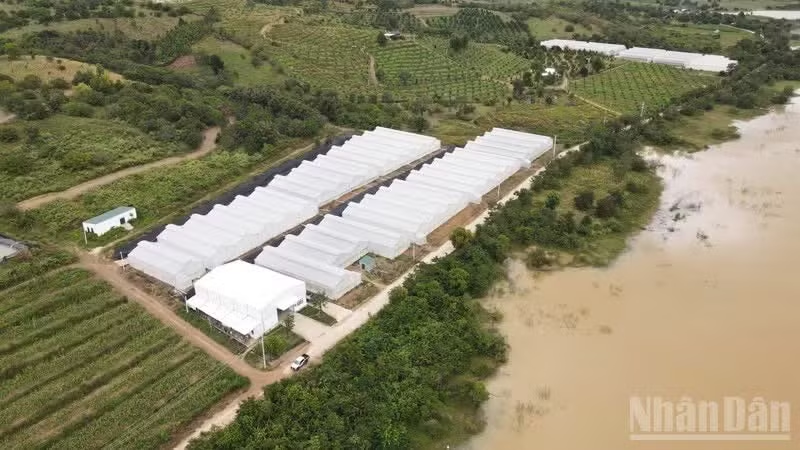
This image clearly reflects the transformation journey of Khanh Hoa’s agriculture from traditional farming to high-tech agriculture, from pursuing output to focusing on quality and sustainability.
When technology reaches arid farmland
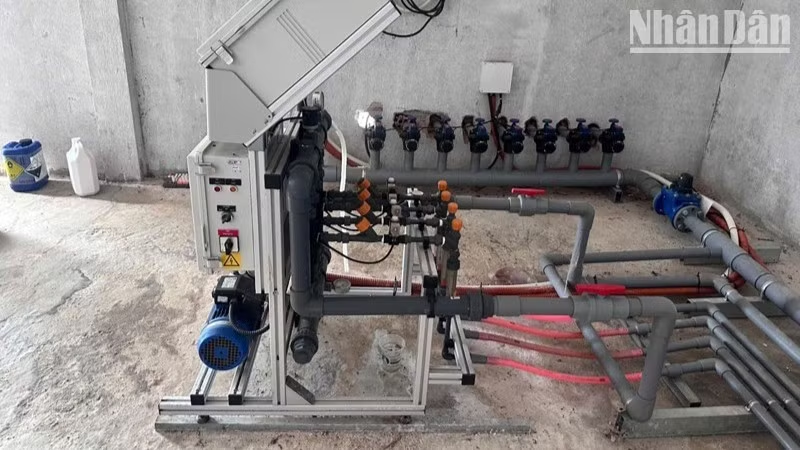
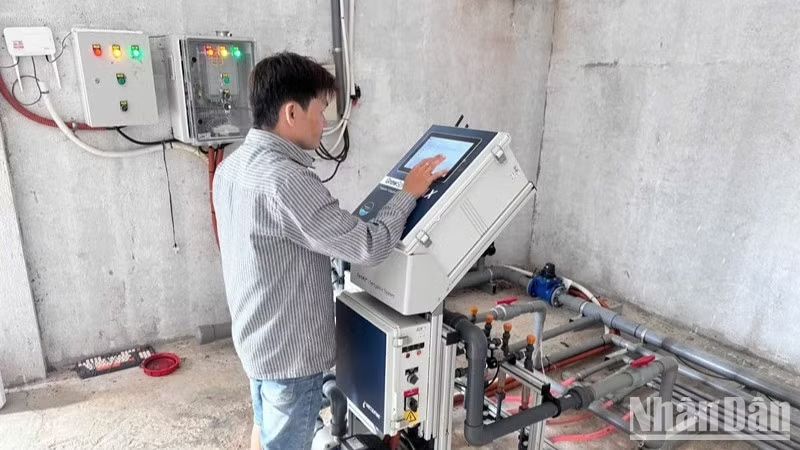
Inside the large net houses at Chapor Farm, Hoang Dinh Huy is checking the drip irrigation system and environmental sensors. More than one hectare of high-tech muskmelon cultivation across six systematically invested net houses is providing his family with a stable income.
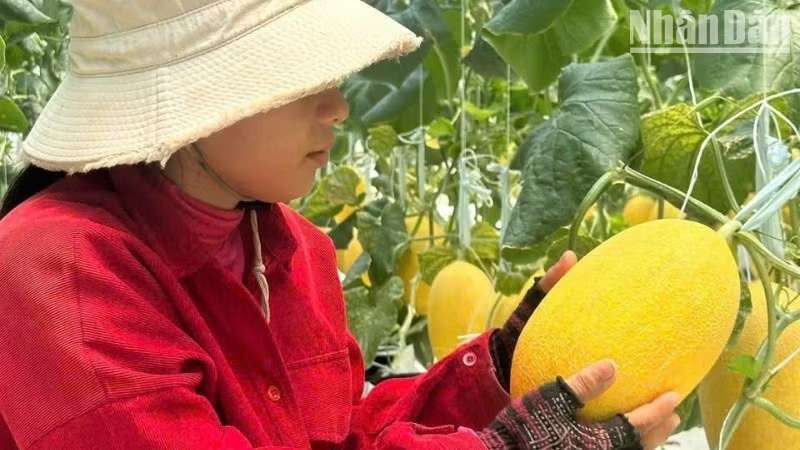
According to Huy, automatic irrigation systems, temperature and humidity sensors, together with a closed nutrient supply process, not only help save water and reduce labour costs but also significantly improve productivity and product quality. Each year, the farm harvests hundreds of tonnes of high-standard muskmelons that satisfy demanding market standards.
Under increasingly hot and harsh climatic conditions, Huy believes high-tech agriculture is no longer an experimental direction but has become an inevitable choice. To remain competitive, agricultural products must be clean, uniform, traceable, and meet market standards.
From pioneering models like this, high-tech agriculture in Khanh Hoa is gradually expanding both in scale and effectiveness.
According to the Department of Agriculture and Environment, the province currently has more than 720 hectares of production applying high technology, focusing on key crops such as grapes, apples, asparagus, and muskmelons. These models all prioritise greenhouses, net houses, water-saving irrigation systems, standardised production processes, and traceability to target the high-quality market segment.
Forming sustainable linkage chains
In addition to technological innovation, Khanh Hoa’s agricultural sector is also strongly transforming its production organisation methods. While fragmented and small-scale production used to be a “bottleneck” for local agriculture, large-field models are now gradually forming sustainable linkage chains among enterprises, cooperatives, and farmers.
For many years, Nha Ho Seed Joint Stock Company has cooperated with cooperatives to build concentrated raw material areas. A typical example is its linkage model with My Son Agricultural Production-Service-General Cooperative, covering 60 hectares of hybrid maize cultivation.
Within this linkage chain, enterprises provide seeds, transfer technologies, and purchase products, while cooperatives organise production according to unified processes. This connection not only reassures farmers about output markets but also gradually eliminates the long-standing mindset of spontaneous production.
From producing based on experience, farmers are gradually shifting towards production based on orders and market standards. Across large fields, key crops such as rice, maize, asparagus, shallots, and grapes are being developed towards large-scale commodity production, creating stable supplies for the market.
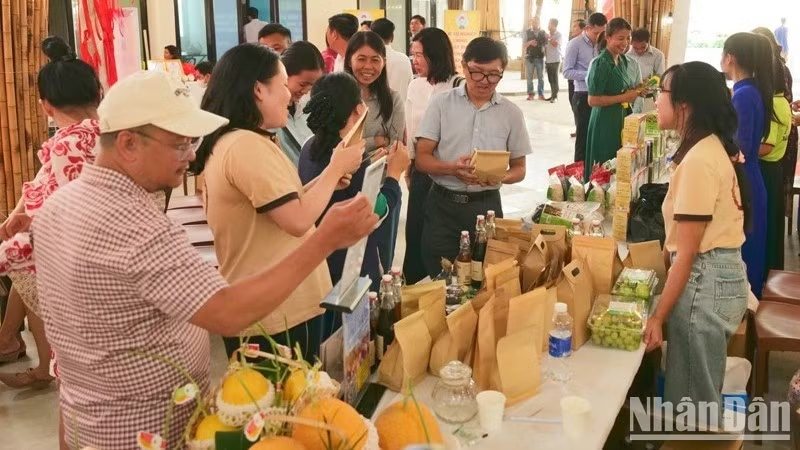
In 2026, Khanh Hoa’s agricultural sector aims to establish three additional large-scale rice production fields covering more than 232 hectares with the participation of 371 households, while maintaining and expanding the existing 33 large-field models covering more than 4,671 hectares and involving over 10,000 households.
Towards green agriculture
Behind the growth figures lies a new development mindset in the local agricultural sector: green, circular, and climate-resilient development.
Nguyen Duy Quang, Director of the Department of Agriculture and Environment, said Khanh Hoa is focusing on improving agricultural growth quality through green production models, high-tech applications, and large-field development. This is considered a strategic direction to enhance the value of agricultural products, traceability, and market competitiveness.
To realise this goal, the agricultural sector is implementing a series of fundamental and long-term projects. Notably, there is the project on assessing soil and agrochemical characteristics and building a database serving crop and livestock development for the 2026–2030 period. The project aims to clearly determine “which crops and livestock, and where” in order to maximise the advantages of each ecological zone.
Alongside this is the project on digitalising specialised crop and livestock farming areas to promote the transition from traditional production to smart agriculture; plans to develop safe vegetable production areas linked with traceability and consumer markets; and a project to develop key industrial crops following the implementation of the two-tier local government model.
Although many challenges remain, ranging from climate change and water shortages to market competition pressures, positive signals show that Khanh Hoa’s agriculture has entered a new development phase — one in which value is measured not only by output but also by quality, sustainability, and adaptability.
According to statistics from the Department of Agriculture and Environment, during the 2025–2026 winter-spring crop, rice achieved an average yield of more than 7.3 tonnes per hectare, up more than 0.5 tonnes compared with the previous year. Perennial crops such as grapes and apples also continued to post positive results, with output reaching nearly 5,900 tonnes, an increase of more than 3%.
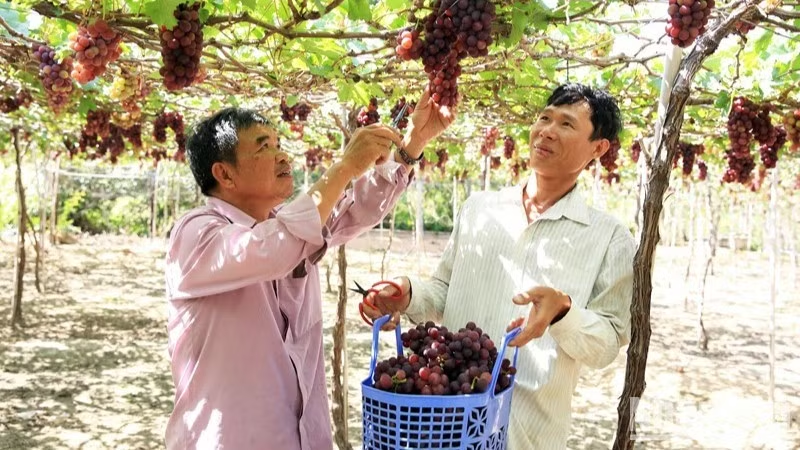
These figures not only reflect production efficiency but also demonstrate the strong transformation in development thinking taking place across the fields of Khanh Hoa. From a harsh sun-and-wind-swept land, a modern, green, and sustainable agriculture sector is gradually taking shape day by day, opening up new hopes for farmers and for the province’s long-term development.
Author: NDO
RECOMMENDED TOPICS