VN
VN
 EN
EN
26/07/2026, 02:38
Business economics
New momentum for fruit and vegetable industry
At the beginning of the second quarter of 2026, Vietnamese pomelos officially entered the Australian market, while the signing of protocols on the official export of pomelos and lemons to China has opened up new growth potential for the fruit and vegetable sector. As the global fruit and vegetable market continues to recover in 2026, these developments are expected to provide additional momentum for exports.
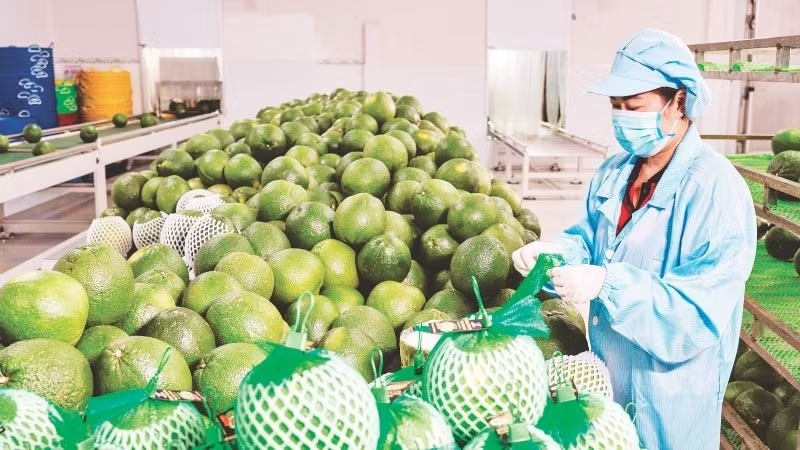
In mid-April 2026, the first officially exported shipments of Vietnamese green-skin pomelos were transported by air to the Australian market. After undergoing strict inspections on plant quarantine and biosecurity at the port of entry, the shipments were delivered to Sydney Markets – Sydney’s largest wholesale market – before being distributed to retail supermarkets. This is the sixth fresh fruit from Viet Nam granted market access to Australia, following dragon fruit, mangoes, lychees, longans and passion fruit.
According to Tran Thi Thanh My, Head of the Viet Nam Trade Office in Australia, the growth potential for Vietnamese pomelos in Australia remains considerable, as domestic production currently meets only around 20% of demand, with the remainder dependent on imports. In addition, Vietnamese pomelos are considered to have competitive advantages over products from markets such as the United States, Israel, Spain and New Zealand thanks to stable supply, mild sweetness and attractive appearance.
Alongside the opening of the Australian market, the signing of the Protocol on phytosanitary requirements for pomelos and lemons exported to China has also contributed to completing the legal framework for official exports, enhancing consumption efficiency and added value for products in this billion-consumer market.
Not only pomelos, but positive growth trends have also spread across many other fruit and vegetable products, helping fruit and vegetable export turnover in the first four months of 2026 reach nearly 2.06 billion USD, up 22% year-on-year. Dang Phuc Nguyen, General Secretary of the Viet Nam Fruit and Vegetable Association, noted that the sector is expected to continue improving in the second quarter of 2026 as many major fruits enter the peak harvest season, ensuring supply for exports. Notably, rising global consumer demand for fruits and vegetables is also helping the market gain momentum.
According to the Import-Export Department under the Ministry of Industry and Trade, the global fresh fruit and vegetable market in 2026 is projected to reach around 934.6 billion USD. Among them, the United States is one of the largest consumption markets, with strong demand for processed products and specialty fruits. Data from the United States International Trade Commission show that although the country reduced imports of fruits, vegetables and processed products from the world in the first two months of 2026, imports from Viet Nam increased, especially for key products such as pomelos and coconuts.
A similar trend has also been recorded in the European Union (EU), where the bloc reduced fruit and vegetable imports from non-EU markets in the early months of the year, but still increased imports from Viet Nam. This indicates that Vietnamese fruit and vegetable products have met the health-conscious and safe consumption trends of the US market, while also adapting promptly to increasingly stringent standards on environmental protection and sustainable development in the EU. Meanwhile, China is considered the fastest-growing market among major markets, with a projected compound annual growth rate (CAGR) of 6.2% during the 2026–2036 period.
In 2026 alone, demand for high-quality Vietnamese fruits such as durian, dragon fruit and coconuts remains high. In addition, the strategy of diversifying export markets has also proven effective as, besides key markets, “emerging” markets such as the Netherlands, Germany, Russia and Malaysia have all recorded strong growth, helping reduce dependence-related risks and creating a more sustainable foundation for exports.
Vo Thi Ngoc Diep, Trade Counsellor at the Viet Nam Trade Office in the Netherlands, said that among agricultural, forestry and fishery products exported to the Netherlands, fruits and vegetables recorded strong growth, rising 55.1% in the first two months of the year compared with the same period. “To further promote trade promotion activities, the Trade Office has communicated and promoted the direct Ha Noi-Amsterdam route operated by Viet Nam Airlines from June 2026, with a focus on connecting Viet Nam Airlines with Dutch and Vietnamese enterprises involved in importing and exporting fresh fruits and frozen vegetables,” Diep emphasised.
Despite positive signals, Viet Nam’s fruit and vegetable industry is also facing numerous challenges, including persistently high logistics costs and increasing technical barriers, especially requirements related to the management of growing area codes and product traceability.
Therefore, accelerating the standardisation of raw material areas and controlling quality right from the production stage have become urgent requirements for both farmers and exporting enterprises. At the same time, as many major fruits enter the peak harvest season in the second quarter of 2026, rising consumption pressure also requires improved efficiency across the entire logistics chain, from harvesting, transportation and storage to customs clearance, in order to ensure product quality and enhance the competitiveness of the whole sector.
Author: NDO
RECOMMENDED TOPICS