VN
VN
 EN
EN
26/07/2026, 02:38
Business economics
Credit for pioneer enterprises: International experience and lessons for Viet Nam
According to Mr Phung Xuan Minh, Chairman of PT Group & Saigon Ratings, the draft circular on the support programme for 1,000 pioneer enterprises, a group with the potential to lead and diffuse technology and value chains, as announced by the Agency for Private Enterprise and Collective Economy Development under the Ministry of Finance, is a highly important policy.
The policy helps concretize the Prime Minister’s decision toward developing 1,000 pioneer enterprises by 2030. Under this objective, policymakers aim to form 20 large enterprises capable of participating in global value chains, while at least 200 enterprises are expected to achieve breakthrough growth.
Leaders of the Ministry of Finance have noted that the Government’s support policy has shifted from a broad-based approach to a more selective one. Support resources are always limited, so policies must prioritize the right groups of enterprises, the right needs and the right timing. This raises major questions about how to create “leverage” and realize ambitious visions for the mission of enterprises.
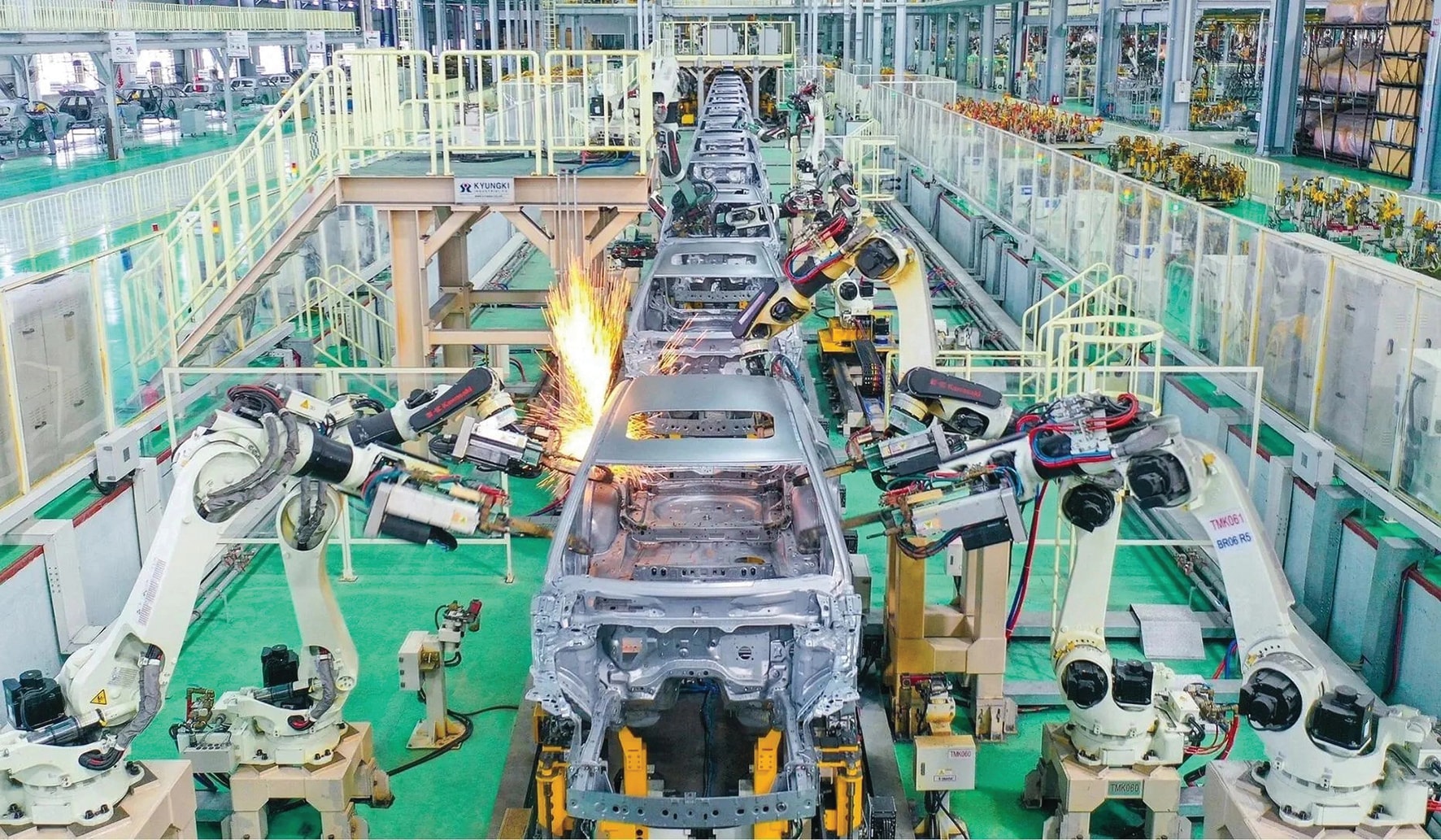
Vietnam needs private corporations with sufficient capital, governance capacity, long-term vision, and the ability to work with the State in strategic projects. Photo: Thaco automobile manufacturing plant.
International lessons on SMEs
After nearly 40 years of Đổi mới, the private economic sector has become one of the most important forces in Vietnam's economy, making major contributions to GDP, job creation, market expansion, and the formation of Vietnamese brands with regional competitiveness. However, for Vietnam to achieve its goal of becoming a high-income country by 2045, the private economy cannot continue to grow mainly in breadth, relying on real estate, short-term commerce, or low-value outsourcing.
The central issue is to build a strategy for developing Vietnam's private economy in a modern and transparent direction, with technological capacity, deeper participation in global value chains, and the ambition to reach the world. This can be seen as a foundation for policies designed to “back” 1,000 pioneer enterprises in the economy.
In practice, many countries have pursued similar approaches, offering lessons that Viet Nam can study, adapt, and draw experience from.
Japan provides a historical lesson as a country that was particularly successful in developing a network of small and medium-sized enterprises linked to large corporations. These satellite enterprises did not merely supply simple components. Over time, they became specialized suppliers with technological capabilities, high-quality standards, and the capacity for continuous improvement. This is a point Viet Nam urgently needs to learn from. If domestic SMEs remain fragmented and disconnected from large enterprises and FDI firms, it will be difficult for them to upgrade their technology.
Japan also offers lessons on investing in people and governance, which may be relevant to the Ministry of Finance’s planned program to train 10,000 CEOs. Management methods such as Kaizen, total quality management, lean production, and continuous improvement helped Japanese enterprises raise productivity from within. For Vietnam, this means that support for enterprises should not be limited to capital or tax incentives but should also include management consulting, engineer training, middle-management training, support for digital transformation, and the development of quality standards.
However, Japan also offers Viet Nam a cautionary lesson: slow adaptation can weaken dynamism. Vietnam, therefore, needs to move faster in investing in intangible assets, digital capacity, and new human resources, consistent with the policy orientation of positioning “pioneer” enterprises in the digital sphere under Resolution 57/NQ-TW.
Pioneer enterprises and large enterprises
Another lesson comes from South Korea, a prominent example of developing large private conglomerates with global competitiveness. Companies such as Samsung, Hyundai and LG helped transform South Korea from a poor post-war country into an advanced industrial economy. This success came from a combination of a clear industrial strategy, conditional State support, export pressure and the requirement that enterprises compete in international markets.
In Resolution 68, alongside the goal of developing two million enterprises, the Politburo set a target of having at least 20 large enterprises participate in global value chains. Resolution 79 also sets the goal of having 50 State-owned enterprises among the 500 largest enterprises in Southeast Asia, and one to three State-owned enterprises among the 500 largest enterprises in the world.
Mobilizing the combined strength of the State and private sectors, and encouraging enterprises to take the lead in areas such as semiconductors, the automobile industry, renewable energy, digital infrastructure, high-speed rail, global logistics and high technology cannot rely solely on SMEs. Vietnam clearly needs private corporations with sufficient capital, governance capacity, long-term vision and the ability to work with the State in strategic projects.
However, South Korea’s experience also shows the need to avoid the downsides and limitations of business models dominated by excessively large conglomerates. Vietnam, therefore, needs to support large enterprises, but such support must be tied to transparency, competition, investment efficiency, spillover responsibility, and modern governance.
Preferential policies should not become permanent privileges. They should function as conditional development contracts: enterprises receive support when they create technology, quality employment, exports, linkages with domestic firms, and contributions to national goals.
It can be said that the focus of the policy targeting 1,000 pioneer enterprises is not to pursue the number of enterprises but to improve enterprise quality. An economy with many small businesses but few companies capable of competing globally will find it difficult to achieve a productivity breakthrough.
Therefore, to create a real breakthrough, Viet Nam also needs synchronized institutional reforms and a more selective approach to designing policies for different groups of enterprises. The goal is not only profit but also the aspiration to build Vietnamese brands, strengthen national self-reliance, and uphold the social responsibility of every entrepreneur and enterprise.
Designing policies that allocate resources appropriately, fairly, strictly, and accurately will deepen the economy and upgrade national internal capacity. It can also help unlock further potential resources across society.
Author: TRUONG DANG
RELATED TOPICS
RECOMMENDED TOPICS