VN
VN
 EN
EN
26/07/2026, 02:38
Business economics
Expanding credit headroom, reshaping banking advantages
Amid rising risks from global monetary policy shifts, Circular 08/2026/TT-NHNN is being viewed as a “regulatory valve” that could help the banking system maintain liquidity stability without resorting to monetary easing.
Circular 08/2026/TT-NHNN took effect on 15 May 2026, amending several provisions of Circular 22/2019/TT-NHNN governing prudential ratios and safety limits in the banking system.
In the stock market, these structural changes are opening the door for a potential re-rating of banking shares.
.jpg)
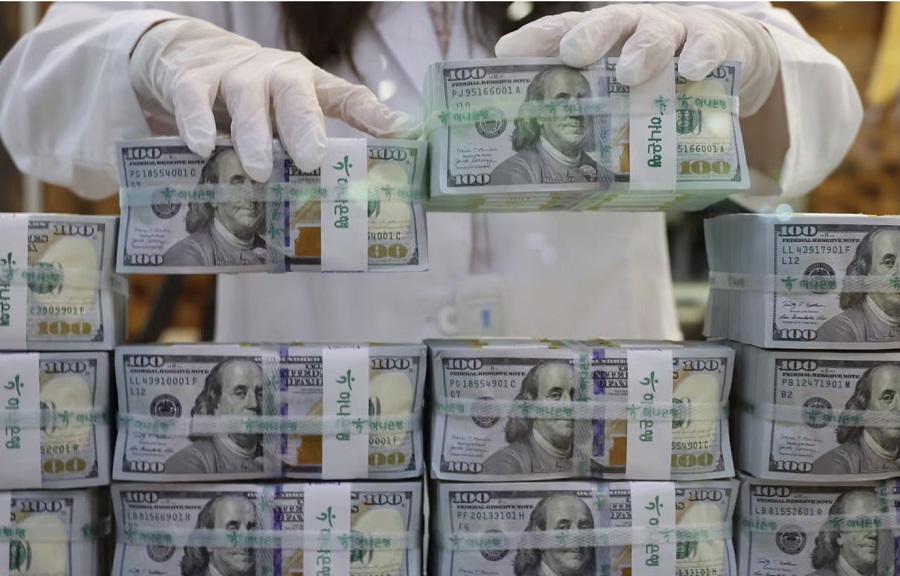
According to first-quarter 2026 data, total State Treasury deposits held at major banks such as Vietcombank, BIDV and VietinBank exceeded VND563 trillion.
“Big Four” gain more room for credit expansion
The most notable adjustment concerns the calculation of the loan-to-deposit ratio (LDR). Previously, under the tightening roadmap set out in Circular 26/2022/TT-NHNN, all term deposits from the State Treasury were excluded from total mobilized capital when calculating LDR. The new regulation now allows credit institutions to include 20% of those deposits back into their funding base.
Although technical in nature, the change could have a substantial impact at a time when system-wide banking liquidity is under increasing pressure. By partially reinstating Treasury deposits into mobilized capital, banks will gain additional headroom to expand lending.
According to first-quarter 2026 data, total State Treasury deposits at Vietcombank, BIDV and VietinBank exceeded VND563 trillion. Under the new rule, Vietcombank and BIDV alone are estimated to gain roughly VND37 trillion in additional recognized funding, significantly expanding their lending capacity.
Phan Le Thanh Long, a financial expert, said Circular 08 from the State Bank of Vietnam (SBV) creates a clear divergence of advantages within the banking system. Under the current public finance management mechanism, the State Treasury primarily deposits funds at the four major state-owned banks: BIDV, Vietcombank, VietinBank and Agribank. This means most of the liquidity benefits from the new regulation will be concentrated within the “Big Four”.
The advantage of the Big Four lies not only in liquidity scale, but also in funding cost structure. While many private commercial banks have had to sharply raise deposit rates to defend their funding base, state-owned lenders can use Treasury deposits as a “low-cost liquidity cushion”. This helps stabilize net interest margins (NIM) and strengthens their competitiveness in financing large-scale infrastructure, energy and public investment projects.
By contrast, private banks with high LDR ratios are likely to face greater adjustment pressure. Banks such as VPBank, VIB and MB may not only need to slow credit growth, but also restructure their balance sheets to bring LDR ratios back into safer territory before the SBV implements stricter quarterly supervisory mechanisms.
Analysts at MBS estimate Circular 08 could help the four major state-owned banks reduce LDR ratios by around 1.1–1.5 percentage points, thereby increasing lending capacity in 2026 without creating excessive pressure on funding costs.
Domestic “shield” against a Fed shock
Phan Le Thanh Long also emphasized the strategic significance of Circular 08 in the international context. The second half of 2026 is widely expected to bring greater volatility from US monetary policy, especially as Kevin Warsh is seen as a potential successor to Jerome Powell at the US Federal Reserve from June 2026 onward.
The banking system will become a key channel for capital mobilization through lending, syndicated financing and guarantees.
Circular 08 also marks a transition toward a new banking governance model.
Unlike the era of the “Powell Put”, during which the Fed often intervened aggressively to stabilize financial markets, Kevin Warsh is viewed as representing a more hawkish approach focused on shrinking the balance sheet and combating inflation more aggressively. If US Treasury yields continue rising under a new policy regime, pressure on capital outflows from emerging markets, including Vietnam, could intensify significantly.
In that scenario, Circular 08 acts as a form of domestic liquidity shield. Expanding lending headroom for the Big Four could help sustain domestic capital flows and reduce the risk of local interest rates spiking in tandem with the US dollar.
Notably, Circular 08 also signals a broader shift toward a new banking governance model. Quarterly liquidity supervision means asset-liability management will become increasingly critical.
Under the new environment, banks can no longer rely solely on balance sheet expansion to drive growth. Instead, they will need to deploy sensitivity analysis models to assess how international interest rates, exchange rates, and foreign capital flows affect their balance sheets.
Market risk management will become particularly important if the Fed changes policy direction. Banks will need to reassess foreign currency positions, bond portfolios and funding maturity structures to avoid asset repricing shocks if global yields rise sharply.
“At the same time, pressure to control asset quality will intensify. With total system-wide outstanding loans already exceeding VND19 quadrillion, expanding lending through newly created headroom will only be meaningful if accompanied by tight non-performing loan management. Capital flows are likely to be prioritized toward sectors with real cash flow generation and those benefiting from commodity cycles.
“In the longer term, the optimal strategy will no longer be maximizing absolute credit growth, but restructuring asset portfolios toward higher-quality liquid assets, tighter maturity control and prioritizing sectors with stronger resilience to economic cycles,” Long said.
Rather than injecting liquidity directly, the SBV has chosen to use regulatory adjustments to recreate lending headroom for the banking system while preserving macroeconomic discipline.
Author: DIEM NGOC - TRUONG DANG
RELATED TOPICS
RECOMMENDED TOPICS