VN
VN
 EN
EN
17/07/2026, 01:00
VCCI
PCI 2025: A turning-point reporting cycle for Viet Nam’s private sector
VCCI President Ho Sy Hung emphasized that the success of reform should not be measured solely by PCI rankings, but by the substantive development of the private sector.
Today (15 May), the Vietnam Chamber of Commerce and Industry (VCCI) officially held the launch ceremony for the Viet Nam Private Economic Report 2025 and the 2025 Provincial Competitiveness Index (PCI 2025).

The launch ceremony for the Viet Nam Private Economic Report 2025 and PCI 2025 took place on the morning of 15 May 2026 in Hanoi.
Speaking at the event, VCCI President Ho Sy Hung noted that this year marks a special milestone as PCI enters its 21st year of listening to the voice of businesses, reflecting the quality of economic governance, and promoting business environment reforms nationwide.
A Trusted Benchmark
According to the VCCI President, PCI has evolved from an initial initiative into a trusted benchmark, accompanying localities in their efforts to strengthen competitiveness and nurture the private sector, which is increasingly asserting itself as a key driver of the national economy.
He added that this year’s report is being released at a particularly significant moment, as Viet Nam enters a new development era with ambitions of achieving double-digit GDP growth from 2026 onward.

VCCI President Ho Sy Hung: PCI has become a trusted benchmark, accompanying localities in efforts to improve competitiveness and foster the private economic sector.
Alongside this target are three simultaneous reforms unprecedented in scale: reducing the number of provincial-level administrative units from 63 to 34 provinces and cities; transitioning to a two-tier local government model; and institutionalizing Resolution No. 68-NQ/TW of the Politburo, which for the first time identifies the private sector as “one of the most important driving forces” of the economy.
“The legislative philosophy is also fundamentally shifting toward development-oriented governance, placing businesses and citizens at the center, under the principle that laws should pave the way for innovation and growth rather than follow a mindset of ‘if it cannot be managed, prohibit it,’” VCCI President Ho Sy Hung stressed.
In his opinion, this context opens unprecedented development space for the private sector, while also placing new demands on enterprises’ adaptability and on the policy implementation capacity of government authorities at all levels.

Leaders from local authorities attended the event.
Reform Highlights and Persistent Bottlenecks
Against this backdrop, the Vietnam Private Economic Report 2025 was developed with a broader scope and deeper analysis than in previous editions.
According to the VCCI president, the report not only assesses provincial economic governance quality but also provides a comprehensive overview of the private sector, from enterprise structure and operational efficiency to the resilience of more than six million household businesses, as well as initial assessments of innovation and digital transformation capacity.
This year’s survey collected feedback from approximately 4,000 domestic private enterprises and foreign-invested companies, alongside a separate survey of more than 1,000 household businesses across 34 provinces and cities.
Survey findings show that the business community continues to recognize progress in information transparency, online administrative reform, and the quality of legal institutions.
However, according to the VCCI President, the report also reveals several concerning bottlenecks. Difficulties in finding customers have increased sharply; access to finance remains heavily dependent on collateral; unofficial costs remain common in many interactions with the public sector, while private sector innovation remains modest compared to regional and global peers.
In particular, household businesses continue operating on thin profit margins with a predominantly defensive mindset, while legal compliance burdens have become the greatest pressure they face.
First Introduction of PCI 2.0 and the BPI Index
A major highlight of this year’s release is the debut of PCI 2.0, a comprehensively upgraded version of the Provincial Competitiveness Index.
The VCCI President said PCI 2.0 was designed to measure governance quality within the new administrative structure of 34 provinces and cities while expanding its focus from the “business environment” to the broader “private sector development ecosystem.”
The new framework consists of nine component indices, covering market entry conditions, access to resources, transparency, fair competition, and the enabling role of government.
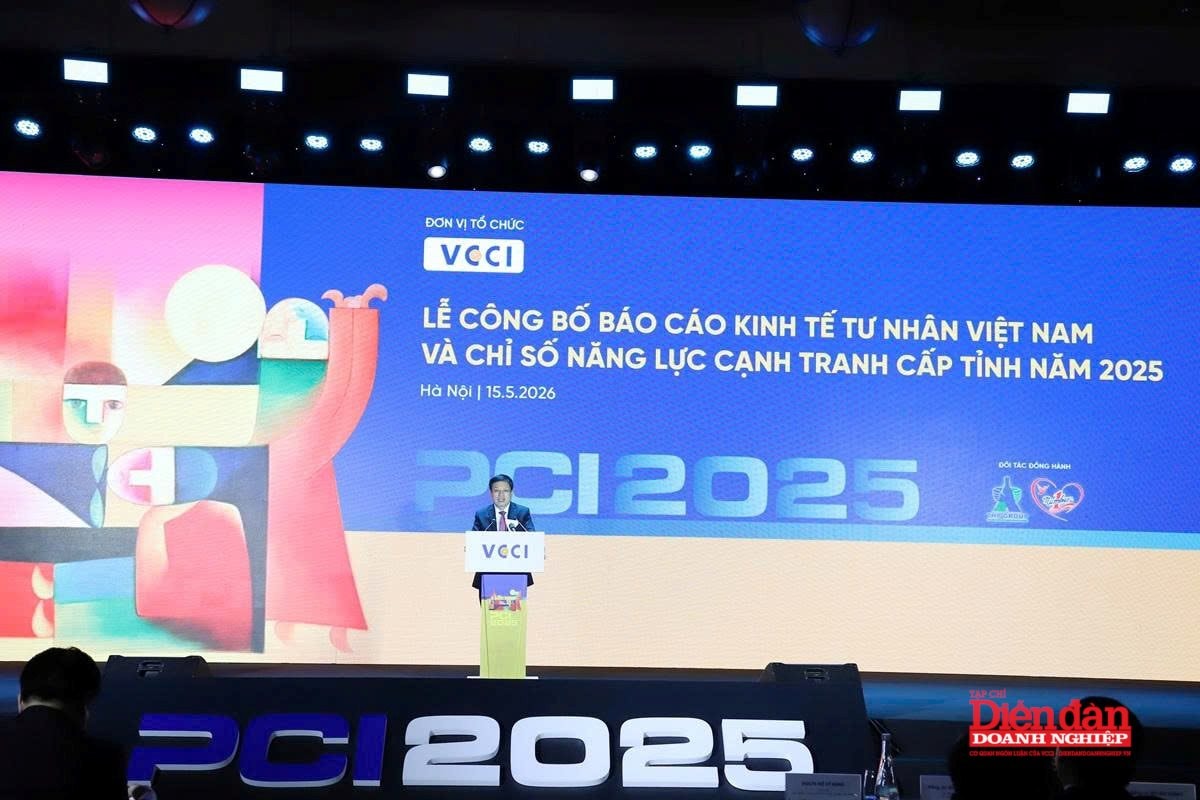
VCCI expects the Viet Nam Private Economic Report 2025 and PCI 2025 to provide additional practical evidence to support policymaking and promote private sector development.
Notably, for the first time, the Business Performance Index (BPI) is also being piloted as a complementary indicator to assess the actual health of the private sector in each locality.
“A good business environment should not only be measured by the speed of licensing procedures but also by whether businesses can survive, generate profits, and move up the value chain,” VCCI President Ho Sy Hung emphasized.
VCCI expects the Viet Nam Private Economic Report 2025 to serve as a valuable reference for central government agencies, the authorities of 34 provinces and cities, investors, international organizations, and the business community.
In this pivotal period of transition, success will no longer be measured solely by PCI rankings but by the ability to transform a favorable institutional environment into core competitiveness and genuinely sustainable development for the private sector.
“That is the pathway to realizing the aspiration of making the private sector the most important driving force of the national economy in the country’s new era of advancement,” the VCCI President affirmed.
Author: Dang Truong
RELATED TOPICS
RECOMMENDED TOPICS