VN
VN
 EN
EN
10/07/2026, 02:38
Business economics
Stimulating domestic consumer demand
Achieving high double-digit growth is becoming a challenging goal amid export risks, weak consumption, and public investment serving as the main driving force.
In this context, policy support to promote domestic consumption is highly anticipated.
The "Key" to Growth
According to calculations by experts from Dragon Capital, to achieve the GDP growth target of 10% by 2030, the Government needs to adopt an economic model that heavily leverages domestic stimuli while controlling inflation and asset prices. With over 30 years of experience in the Vietnamese market, Dragon Capital has outlined a trajectory to achieve this high-growth path.
To maintain a 10% growth rate, many experts recommend combining several factors:
- Strong credit expansion: Annual credit growth must be maintained between 16% and 20%.
- Robust domestic consumption: Domestic consumption growth needs to increase to 11–12% per year, compared to the average of 8% during the 2021–2024 period.
- Fiscal stimulus: The budget deficit should be kept at 4–5% of GDP to support large-scale public spending, especially for key infrastructure projects.
- Foreign trade: Export growth must be sustained above 12% per year (compared to the current 10%) and contribute a $50 billion trade surplus by 2030.
- Inflation control: Inflation needs to be kept within the 4.5–5% range.
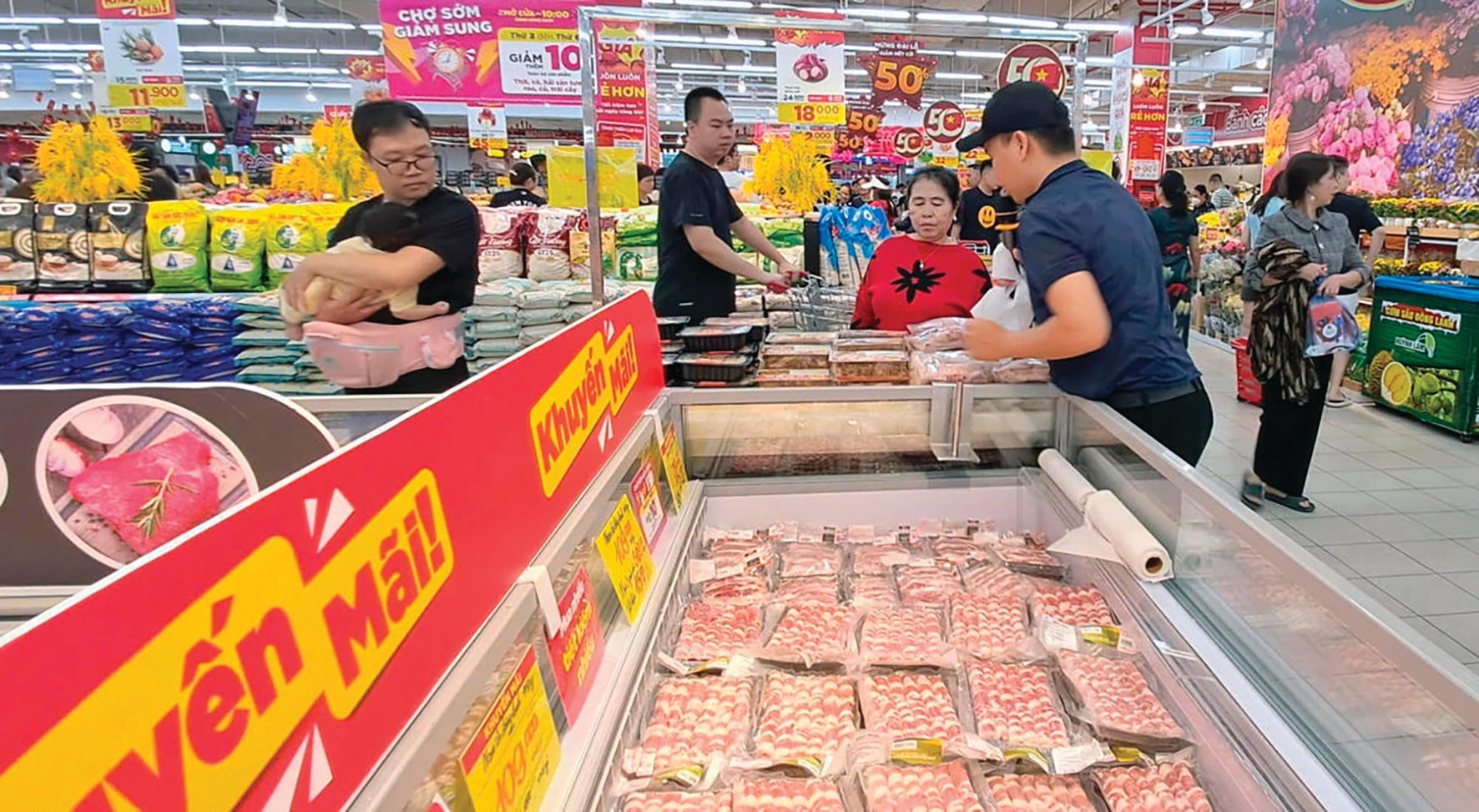
Domestic consumption in the first four months of 2026 increased by 11.1%. However, excluding the price factor, the real growth of total retail sales and consumer service revenue during this period was 6.3%. This reflects that domestic consumer demand is consolidating steadily despite ongoing pressures from commodity costs. The remaining factors remain under control and align with the targets set to support economic growth.
Therefore, experts point out that the "key" to ensuring high economic growth ambitions this year—alongside maintaining exports and boosting public investment—is to implement specific policies that not only help domestic consumption recover but also maintain strong growth.
Policy Proposals
Dr. Phạm Viết Thuận, Director of the Institute of Resource and Environmental Economics, stated that the household business sector is facing numerous pressures from tax policies, electronic invoicing, proof of origin for goods, and complex declaration procedures. According to him, the growth momentum of domestic consumption has continuously slowed down since 2024. One of the major reasons is the sharp rise in input costs driven by the prices of gasoline, raw materials, and expenses related to tax policies and electronic documents/invoices.
Dr. Thuận added that fluctuations in fuel and raw material prices have driven up the average price of goods and services by 20–22%, putting great pressure on consumers. When prices rise, people are forced to tighten their spending, causing a widening spiral of declining purchasing power. It is estimated that around 4.2 quadrillion VND in cash is currently outside of circulation, contributing to a cash flow shortage in the market.
Consequently, Dr. Thuận proposed several solutions. Notably, the Government should consider returning to the flat-rate tax mechanism for household businesses with annual revenues between 1 billion and 5 billion VND. Additionally, he suggested exempting value-added tax (VAT) on essential goods at supermarkets and retail stores to ease the spending burden on citizens.
According to many experts, although the basis for estimating the 4.2 quadrillion VND figure is not entirely specific, small and medium-sized enterprises (SMEs) and household businesses believe that, in terms of morale, flexibly supporting tax and fee mechanisms would significantly relieve difficulties for businesses. Mr. Nguyễn Phước Hưng, Vice Chairman of the Ho Chi Minh City Union of Business Associations (HUBA), cited a HUBA survey on local business operations showing that over 31% are concerned about declining consumer demand, emphasizing that the focus of fiscal policy needs to shift toward stimulating consumption.
Dr. Đinh Thế Hiển, an economic expert, argued that while a localized VAT exemption policy makes sense from a social welfare and demand-stimulation perspective during difficult economic times, it does not fully align with the broad regulatory nature and stable revenue source of VAT if applied broadly and permanently. In reality, consumers are still benefiting from the 8% VAT reduction policy. Instead of a full tax exemption, studies should focus on extending this reduction policy to avoid weakening the consumer-regulating role of taxes and narrowing State budget revenues.
Furthermore, the Government has issued Decree No. 141/2026/NĐ-CP, officially raising the tax threshold for household and individual businesses to 1 billion VND per year. This regulation provides practical support for millions of small traders nationwide. Therefore, any similar tax regulation policies, if any, need to be thoroughly and carefully studied based on the practical application of the new tax policy.
In addition, Mr. Hiển suggested considering options to allocate and channel capital to SMEs through preferential access and cost mechanisms. "An auxiliary credit program with unsecured disbursement regulations, expanded to an SME scope of just a few tens of trillions of VND—which is lower than a single transportation infrastructure project—is a package well worth investing in for SMEs. These enterprises remain the most critical pillars of the domestic economy and domestic consumption. Therefore, to boost domestic consumption, we must practically enhance the strength of the SME sector," Mr. Hiển emphasized.
Author: LE MY - TRUONG DANG
RELATED TOPICS
RECOMMENDED TOPICS