VN
VN
 EN
EN
17/07/2026, 01:00
VCCI
Upholding the role and historic mission of Viet Nam’s business community
VCCI President Hồ Sỹ Hùng shares insights on the historic mission and pioneering role of Viet Nam’s business community in industrialization, innovation, international integration, and the country’s sustainable development.
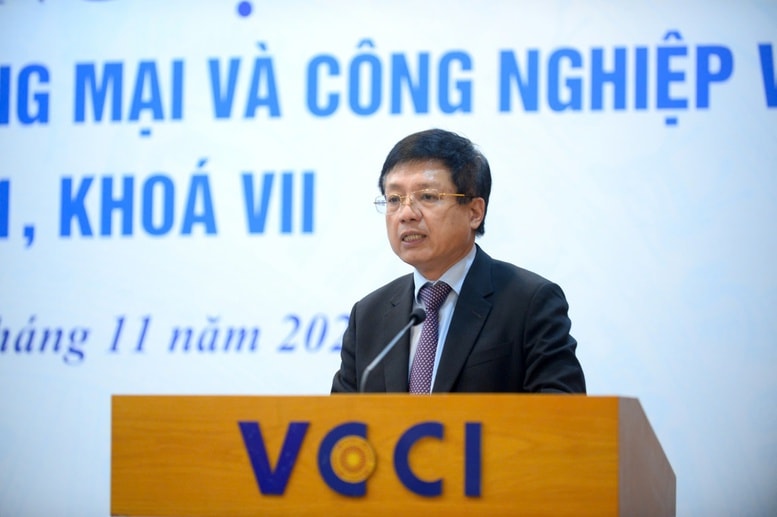
Assoc. Prof. Dr. Hồ Sỹ Hùng, VCCI President. Photo: VGP
The historic mission of Viet Nam’s business community is to take the lead in industrialization and modernization, develop a knowledge-based economy, build a socialist-oriented market economy, and help realize the national goal of a “prosperous people, a strong country, democracy, equity, and civilization.” This mission is pursued through innovation, international integration, enhanced competitiveness, safeguarding national defense and security, and the development of an advanced corporate culture—thereby contributing to the country’s sustainable development.
On the occasion of the 14th National Congress of the Communist Party of Viet Nam, Comrade Hồ Sỹ Hùng, Party Secretary and President of the Viet Nam Chamber of Commerce and Industry (VCCI), spoke with Business Forum about the historic mission, role, and position of Vietnamese entrepreneurs and enterprises in the new development phase.
— In the current context of industrialization, modernization, and international integration, how do you assess the role, position, and development of Viet Nam’s entrepreneurs and enterprises after 40 years of Đổi mới (Renovation)?
After 40 years of Đổi mới, the role of Vietnamese enterprises has shifted from merely providing goods and creating jobs to becoming key drivers of economic growth, leaders in innovation, engines of international integration, and pillars of sustainable development. Politburo Resolution No. 68-NQ/TW dated 4 May 2025 on private sector development affirms that: “In a socialist-oriented market economy, the private sector is one of the most important driving forces of the national economy, playing a pioneering role in promoting growth, job creation, labor productivity, national competitiveness, industrialization, modernization, and the restructuring of the economy toward a green, circular, and sustainable model.” At the same time, state-owned enterprises retain a leading and pivotal role in strategic sectors, making substantial contributions to GDP and the state budget, and generating critical resources to support the national goal of achieving high-income status.
It is evident that respect for and recognition of the business community has become a common societal mindset in a country that is energetically advancing on the economic front. From a position once ranked last among social strata under the traditional notion of “scholars, farmers, artisans, and merchants,” Vietnamese entrepreneurs and enterprises now occupy a position of pride in society. They have become a core force making ever-greater contributions to socio-economic development, helping transform Viet Nam from a country barely visible on the global economic map into one ranked among the world’s top 40 economies by GDP and top 20 by trade volume.
Looking back, three decades of war (1945–1975) and the pursuit of a classical socialist economic model following national reunification (1975–1985) constrained market forces and resulted in the absence of an entrepreneurial class. However, in 1986, the Đổi mới reforms—centered on the transition to a socialist-oriented market economy—ignited the strong development of Vietnamese entrepreneurs and enterprises. While the early 1990s saw only around 5,000 private enterprises nationwide, today the private sector comprises nearly 900,000 enterprises, forming a robust force driving economic growth.
Thanks to the Party’s and State’s enabling policies, Vietnamese enterprises have seized opportunities and achieved significant breakthroughs. After nearly four decades of Đổi mới, the business community has matured substantially.
Vietnamese enterprises are no less resilient or capable than those of any other country. Leading enterprises play a decisive role in shaping Viet Nam’s economic standing internationally. A strong, sustainable business community with global competitiveness, coupled with entrepreneurs driven by aspiration and a strong sense of national pride, is a crucial foundation for Viet Nam to become an independent, self-reliant, and prosperous nation.
— In your view, what are the major opportunities and challenges currently facing Viet Nam’s entrepreneurs and enterprises?
First, opportunities arise from technological development and digital transformation, which enable enterprises to innovate business models, improve products and services, and expand markets. Enterprises can leverage artificial intelligence (AI), blockchain technology, and e-commerce to enhance productivity and competitiveness.
Second is international integration. Viet Nam’s participation in multiple free trade agreements (FTAs), such as the CPTPP, EVFTA, and RCEP, creates favorable conditions for enterprises to access global markets, scale operations, and increase export value.
Third is the trend toward sustainable consumption. Enterprises can capitalize on green and environmentally friendly consumption trends to develop sustainable products and services, thereby enhancing brand value and attracting international customers.
Alongside these opportunities, challenges remain significant. Global economic slowdown, inflation, and geopolitical instability have strongly affected export markets and supply chains.
Enterprises are also facing rising input costs and weakening consumer demand.
Moreover, while digital transformation offers many benefits, it requires investment capacity, knowledge, and skills. Many small and medium-sized enterprises continue to struggle with adopting advanced technologies due to limited resources and expertise.
In my view, the most pressing challenge is ensuring financial sustainability and adaptability to changes in the business environment. Maintaining cash flow, cutting costs while preserving operational efficiency, and coping with increasing competition from both domestic and international markets require enterprises to adopt flexible, long-term development strategies.
— To further promote the historic mission of Viet Nam’s business community, what should entrepreneurs, enterprises, and VCCI prioritize?
As “soldiers in peacetime,” the Vietnamese business community must further strengthen its pioneering role in socio-economic development—for the interests of the nation and the people, for a strong and prosperous country, and for the well-being of all citizens.
First, enterprises should take the lead in working alongside the Party, the State, and the people to successfully implement Party resolutions, State policies and laws, and the aspirations of the people; pioneer scientific research, technological application, and innovation; lead national digital and green transitions; promote Vietnamese brands and products globally; and spearhead breakthroughs in areas such as healthcare, education, and energy.
Second, enterprises should take the lead in policy contributions by proactively gathering feedback, reflecting challenges in production and business—particularly those related to legal and regulatory frameworks—and submitting timely recommendations to the Party and the State to facilitate rapid and sustainable enterprise development. This is also a key responsibility of VCCI.
Third, enterprises should pioneer entrepreneurship, innovation, digital and green transitions, and the application of AI, big data, semiconductors, and other advanced technologies in production and business; develop green and circular economic models aligned with ESG standards to meet the increasingly stringent requirements of major markets. Each enterprise should focus on modern governance, process standardization, transparency, and integrity to improve productivity, quality, and competitiveness.
Fourth, enterprises should take the lead in fostering linkages and solidarity within the business community. Unity, cooperation, and dialogue are indispensable in the development process.
Fifth, enterprises should take the lead in strengthening national unity and social security efforts, ensuring that social progress, equity, and welfare are not sacrificed for purely economic growth, leaving no one behind, and contributing to the country’s sustainable development.
— What solutions does VCCI propose to the Party Central Committee and the National Congress?
First, VCCI recommends that the Party Central Committee reach a high level of consensus on the particularly important role of enterprises—especially private enterprises—in socio-economic development, affirming private sector development as one of the most important drivers of growth, labor productivity, and national competitiveness.
At the same time, the Party and the State should consider establishing a clearer political status for the rapidly growing community of entrepreneurs (now exceeding two million business owners and managers), and create additional channels and opportunities for entrepreneurs to contribute, participate in state management, and engage in policymaking—together realizing the goals of the 14th National Congress.
Second, focus on institutional reform, identifying institutions as the “breakthrough of breakthroughs,” to create the most favorable possible business environment.
Third, unlock all resources by using public resources to mobilize, guide, and activate social resources.
Fourth, develop mechanisms and policies to form and grow large-scale national enterprises capable of leading domestic value chains and expanding into international markets, while enhancing the effectiveness of the Investment Support Fund.
Fifth, stimulate domestic demand and expand markets for enterprises, creating conditions for domestic producers to manufacture goods in which Viet Nam has competitive advantages and can gradually secure and dominate the domestic market.
With absolute confidence in the Party’s leadership and the success of the 14th National Congress, Viet Nam’s business community pledges unity, determination, and creativity to swiftly translate the Congress’s resolutions into action, working together with the entire Party, people, and armed forces to realize the aspiration of a prosperous and happy nation.
— Thank you very much.
Author: NGUYEN HUONG reports - TRUONG DANG translates
RELATED TOPICS
RECOMMENDED TOPICS