VN
VN
 EN
EN
26/07/2026, 02:38
Business economics
Viet Nam–China railway connectivity is strategic breakthrough in economic cooperation: Party chief
Cooperation in infrastructure and railway connectivity between Viet Nam and China holds great significance, as it reduces logistics costs, shortens transportation time, and enhances competitiveness, reiterated General Secretary To Lam.
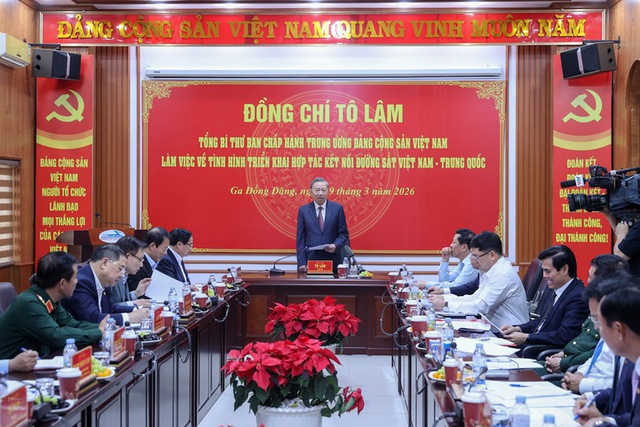
General Secretary To Lam (standing) chairs a meeting on cooperation in infrastructure and railway connectivity between Viet Nam and China, Dong Dang Station, Lang Son Province, March 19, 2026 - Photo: VGP
The Party chief made the above statement while chairing a meeting on Viet Nam-China railway connectivity at Dong Dang Station in Lang Son Province on March 19.
The meeting saw the participation of Prime Minister Pham Minh Chinh, Minister of Public Security Luong Tam Quang, Minister of Foreign Affairs Le Hoai Trung and Chief of the Party Central Committee's Office Pham Gia Tuc, among others.
Viet Nam and China have formalized an agreement to cooperate in the construction of three standard-gauge railway lines: Lao Cai–Ha Noi–Hai Phong, Lang Son–Ha Noi, and Mong Cai–Ha Long–Hai Phong.
Addressing the meeting, the Party leader highlighted the significance of Viet Nam-China cooperation in infrastructure and railway connectivity, which contributes to guiding trade relations between the two countries into a new stage of development towards a more substantive, effective, and sustainable manner, opening up further space for economic growth.
The leader noted that the promotion of infrastructure connectivity between the two nations helps develop logistics centers, border-gate economic zones, and industrial clusters in border provinces while connecting Viet Nam to the Eurasian railway transport network, thereby diversifying international transport routes and reducing dependence on maritime shipping.
It targets to speed up the formation of economic corridors and regional production chains, strengthen regional economic connectivity and enhance Viet Nam's position in the Asian supply chain, stressed the Party leader.
He emphasized the need to build diverse and sustainable financing mechanisms, as well as establish a unified national-level coordination mechanism for these strategic infrastructure connectivity projects.
It is necessary to ensure synchronized alignment between transport infrastructure development and regional economic planning, logistics systems, and industrial zones along economic corridors, rather than focusing solely on railway projects, noted To.
He urged the Ministry of Construction to develop a plan for developing Viet Nam–China railway connectivity as part of Viet Nam's overall railway development strategy for the 2026–2030 period, with visions to 2045, 2100, and 2130./.
Author: VGP
RECOMMENDED TOPICS