VN
VN
 EN
EN
26/07/2026, 11:20
Investment
What will sustain GVR’s growth in 2026?
Assessing the stock performance of Vietnam Rubber Group (HOSE: GVR), SSI Securities believes this company has solid prospects for 2026, particularly driven by its industrial-park (IP) segment.
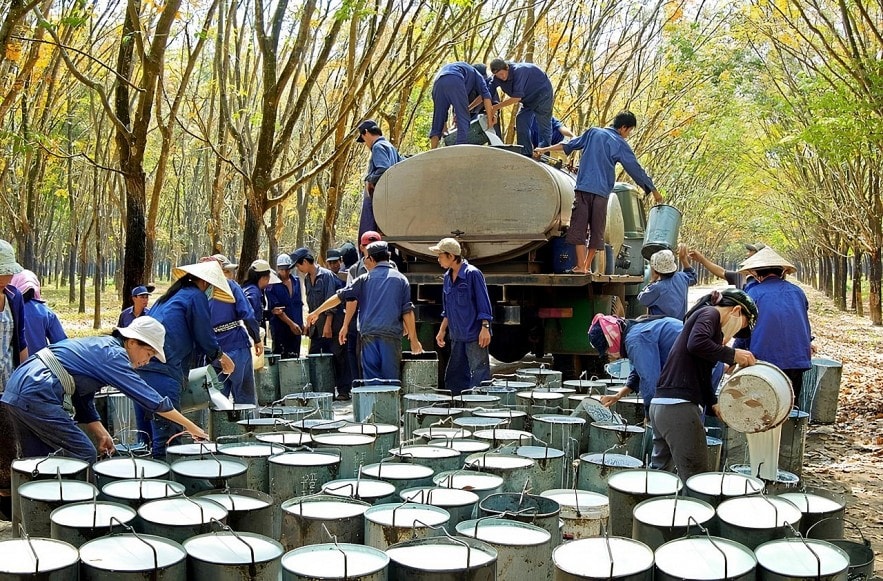
SSI notes that GVR shares carry strong prospects and stand to benefit from the industrial-park business.
Although 2025 has one month left, GVR has already recorded nearly VND 25.88 trillion in revenue for the first ten months, fulfilling 83.4% of its annual plan. Its pre-tax profit reached VND 6.4 trillion, equivalent to 109% of the full-year target.
These positive results mainly stem from strong rubber price growth, rubber-wood liquidation activities, and compensation income from land converted for industrial-park use.
In its latest performance update on GVR, SSI forecasts that in Q4/2025, the company will achieve VND 8.6 trillion in revenue and VND 1.6 trillion in after-tax profit. Of this, natural rubber revenue is projected to reach VND 6.02 trillion. Meanwhile, revenue from rubber-wood products is expected to decline sharply as demand weakens in export markets due to U.S. tariff policies.
Industrial-park revenue alone is expected to reach VND 344 billion, up 6%, supported by higher land-lease prices. In addition, compensation income is estimated at VND 340 billion, mainly from the expansion of the Bac Dong Phu Industrial Park. For full-year 2025, SSI projects GVR’s revenue and after-tax profit from this segment to reach VND 29 trillion and VND 6.4 trillion respectively, up 41% and exceeding the company’s initial plan by 7%.
Looking ahead to 2026, SSI forecasts revenue of VND 31.7 trillion (up 9.2%) and after-tax profit of VND 7.3 trillion (up 7.9% YoY). The industrial-park business remains the company’s key “trump card.”
GVR is currently preparing investment procedures for multiple industrial-park projects on converted rubber land, with a total approved area of 2,604 hectares across Ho Chi Minh City, Tay Ninh, and Gia Lai. These include: Hiep Thanh IP Phase 1, Nam Tan Uyen Expansion Phase 2, Rach Bap Expansion, Bac Dong Phu Phase 2, Minh Hung III Phase 2, Nam Dong Phu Phase 2, and Nam Pleiku IP. New leasable industrial-park space is projected at 95 hectares, generating estimated revenue of VND 1.3 trillion—up 30%. Most of the leasing volume will come from new parks such as Nam Tan Uyen 3 and Bac Dong Phu Phase 2, which have already signed memoranda of understanding (MOUs) with tenants.
Regarding land-conversion progress, GVR is prioritizing legal approvals, securing investment policy decisions, and developing IP infrastructure in alignment with provincial land-use planning for 2025–2030. The total projected industrial-park area for 2025–2030 could reach 23,444 hectares, concentrated in Tay Ninh, Binh Duong, Dong Nai, and Ba Ria–Vung Tau. Accordingly, land-transfer revenue is forecast at VND 3.2 trillion—up 102%—with pre-tax profit estimated at VND 2.63 trillion.
Based on these factors, SSI gives a positive outlook for GVR in 2026, supported by the company’s position as the largest owner of rubber land in Vietnam, with a total of 394,782 hectares across provinces such as Binh Duong, Dong Nai, Ba Ria–Vung Tau, Tay Ninh, and others. The planned conversion of more than 23,000 hectares of rubber land into industrial-park developments marks a new growth phase for the company.
Using the sum-of-the-parts valuation method, SSI sets GVR’s 12-month target price at VND 35,700 per share and maintains a “positive” view, implying an upside potential of 27.5% from the current price. However, investors should be aware of risks including potential delays or complications in converting rubber land for industrial-park development due to legal-approval processes, as well as the possibility of declining demand for natural rubber amid global economic uncertainties.
Author: DUONG THUY - TRUONG DANG
RELATED TOPICS
RECOMMENDED TOPICS