VN
VN
 EN
EN
09/07/2026, 11:15
Investment
3 factors may drive global currency market
There are a large number of crosscurrents at play in the FX market this week. They include the backdrop of the US-Iran deal to reopen the Strait of Hormuz, a test of Japan’s resolve to lift the yen, and the first FOMC meeting for new Fed Chair Warsh.

There are a large number of crosscurrents at play in the FX market this week. Photo: Getty Images
The conflict in Iran might be over, but it has not been a conflict that’s been as kind to the US dollar as we might have expected. The currency is sitting at practically the same level against other G10 currencies as it did at the start of the conflict. We’d regard this as a poor performance, as both theory and history would have suggested a rise in the US dollar on account of the positive terms of trade effects and safe-haven demand. The fact that the US dollar did not rise leaves us feeling that underlying sentiment towards the US dollar is still broadly negative, as it has been for much of President Trump’s second period in office.
The FOMC meeting on Wednesday, the first for new Fed Chair Warsh, will likely see the bank move to a more neutral post-meeting statement, and the accompanying DOTS plot of interest rate projections may prove more hawkish than before. However, these changes are presumably priced in by the market, while there is a notable possibility that Chair Warsh puts a somewhat more dovish spin on the outcome of the meeting in his post-meeting comments. In addition to this, the US/Iran deal seems likely to push the market to price out the one rate hike that is currently anticipated by the Federal Funds futures market.
In short, Steven Barrow, head strategist of the Standard Bank, suspects that the FOMC meeting is more likely to weigh on the dollar than lift it. All told, we suspect that the euro/dollar won’t stray too far from a 1.15-1.20 range in coming months but still see the longer-term direction as being towards 1.30, not 1.10 and below.
The euro’s ability to take the fight to the US dollar does not seem to have been aided by last week’s rate hike from the ECB. That’s partly because a hike was widely anticipated, as indeed is another one to follow. It is also because the ECB is hiking, not because the economy is strong and threatening to create demand-driven inflation, but because of the supply shock coming from the surge in oil prices.
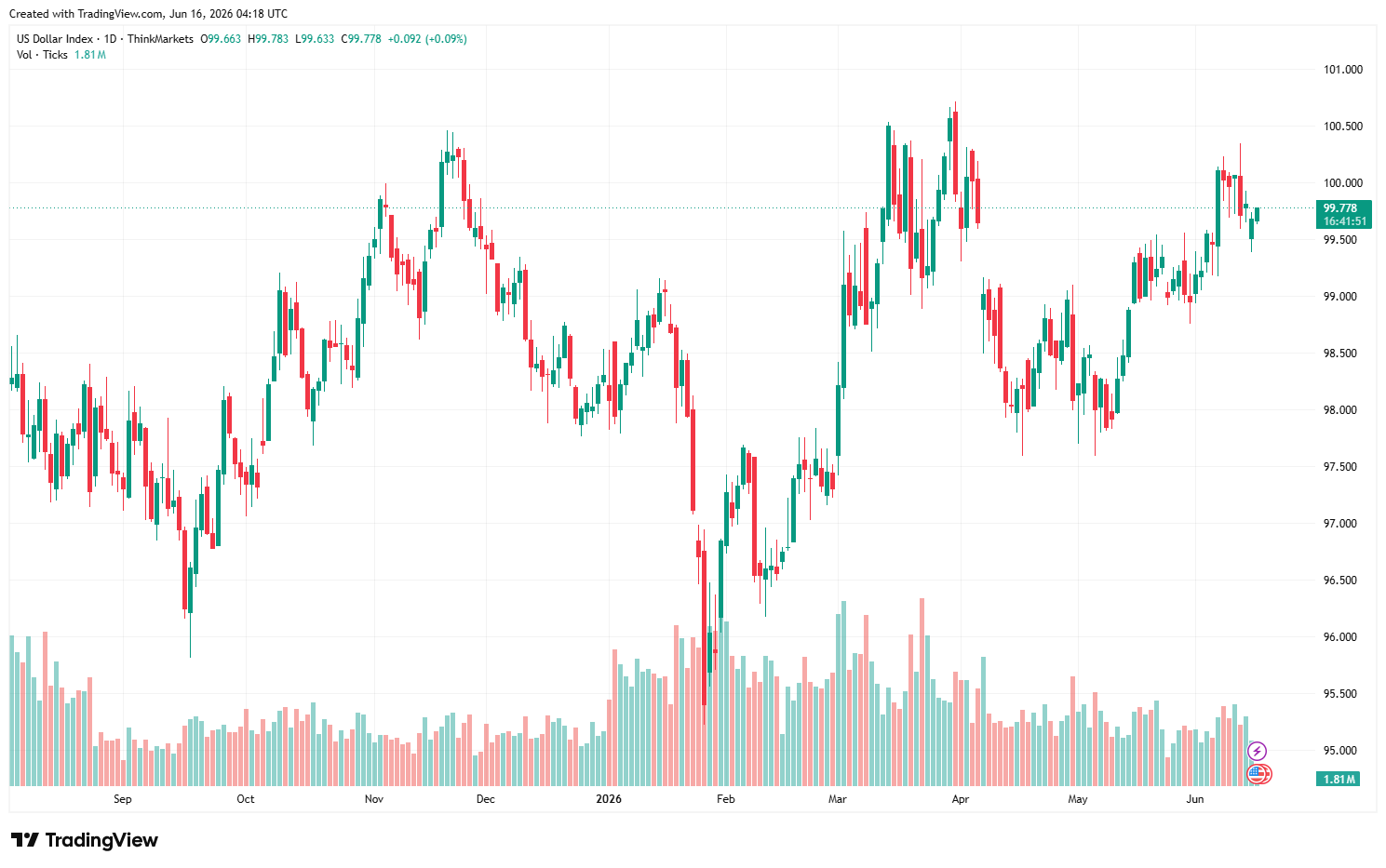
The USD index is in an uptrend.
In Steven Barrow’s opinion, such supply-driven monetary tightening is unlikely to lift the euro and may well damage it if the cost of rate hikes is even weaker growth. Hence, even if the euro does hold its own against the US dollar, he expects losses outside the major G10 currencies. Indeed, he thinks that all the major currencies—the US dollar, euro, yen, and sterling—are likely to slide against other G7 currencies and most emerging market currencies as a result of the apparent end of hostilities in Iran. Many currencies have been hit hard by the Middle East conflict, particularly in emerging markets, and he expects the deal between the US and Iran to mark the start of a sustained and significant recovery process for the previously battered currencies.
“We continue to list the yen as a vulnerable major currency even though the BoJ will likely hike rates tonight and despite the continual threat of BoJ intervention. Just over two years ago, the Japanese authorities managed to lift the yen significantly through intervention and tighter monetary policy. But the latter was a shock to the market, both in terms of the timing of the rate hike and the announcement that JGB purchases would be halved. This time around surprises may be few and far between, and that suggests a lackluster reaction in the yen," said Steven Barrow.
Sterling’s vulnerability comes down to politics this week. The Makerfield by-election on Thursday is expected to see a victory for former Manchester Mayor Andy Burnham. His victory will set up a leadership contest for the post of labor leader and PM, which Steven Barrow expects him to win. The issue for the pound is that this would mark a notable shift to the left within the Party; something that should unnerve investors. But it may be even worse if Burnham loses in Makerfield as this would leave the Labour Government in a very tight spot and with even more credence given to the idea that the anti-immigration Reform Party could form the next government. In short, the pound seems to be sitting between a rock and a hard place.
Author: NGOC ANH
RECOMMENDED TOPICS