VN
VN
 EN
EN
26/07/2026, 02:00
Investment
How will the US dollar move after the US Supreme Court’s tariff decision?
The US dollar has been set back by the US Supreme Court’s decision to rule the bulk of the tariffs illegal. Many analysts doesn’t see this as a fatal blow to the US dollar and it may actually be supportive over the long haul.
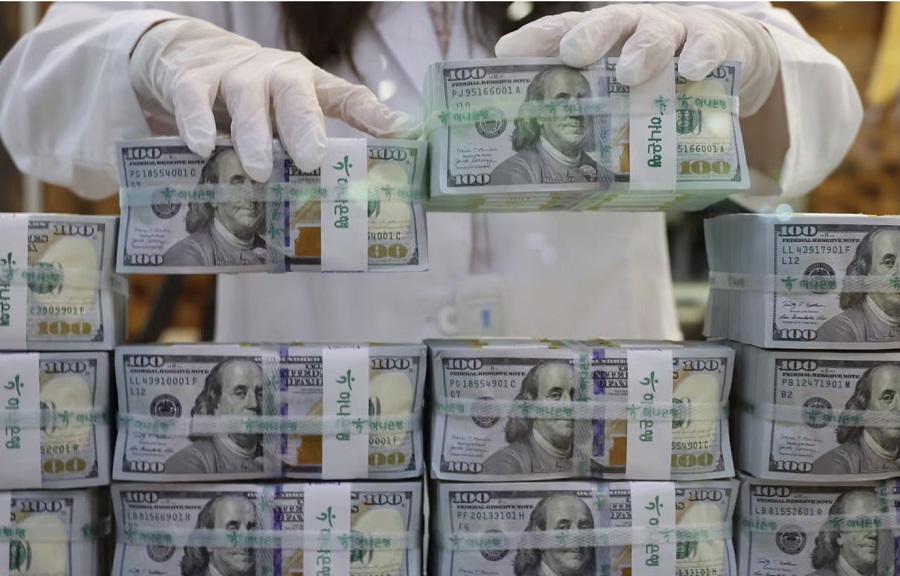
The US dollar weakened on Monday as traders evaluated US tariff policies after the US Supreme Court on Friday struck down President Donald Trump's tariffs
Many analysts have long regarded the US Administration’s attempt to use the International Emergency Economic Powers Act (IEEPA) to impose tariffs as illegal on two grounds. The first is that there is no genuine ‘emergency’. The second is that the extent of the tariffs has been so substantial that they have been a significant generator of revenue, but it is Congress that has the constitutional right to major expenditure and revenue decisions, not the president. The decision is an undoubted blow to the Administration. But is it a decision that’s likely to create, or accelerate, dollar weakness?
Steven Barrow, Head of Standard Bank G10 Strategy is not so sure for two reasons. The first is that there are other ways the Administration can impose tariffs so that there won’t be any revenue shortfall. The second is that the ruling is an important check on the Administration’s powers. Previous decisions by the Supreme Court have consistently favoured the President, leading to concerns that he could unilaterally announce almost any policy and the Supreme Court would push it through if it were challenged. But the tariff decision shows that there is some sort of check and balance on the Administration.
For instance, there should be more confidence now that the President will fail in his attempt to sack Fed Governor Cook whose case is also up before the Supreme Court. Now none of this makes us believe that the US dollar will rally over the medium term. But, by the same token, the Standard Bank is not revising down its forecasts for the US dollar just because of this tariff ruling.
In fact, if we just look at euro/US dollar, we can see that recent bouts of uncertainty, such as that associated with the Administration’s claim to Greenland, or this latest tariff ruling, have failed to really break the currency out of its stride. There’s an eerie calm in euro/US dollar that seems to persist no matter how loud the external noise becomes.
“We had speculated earlier that the tariff decision could break this calm in euro/dollar but it has not happened, at least so far, and we now doubt that it will. Part of the reason for this could be that traders and investors are already running with quite substantial short-dollar positions. As a result, our forecast for euro/US dollar to drift up slowly over time the 1.25-1.30 range still applies, as does our call for the dollar to lose modest ground against other G10 currencies as well”, said Steven Barrow.
The US President Donald Trump has been put under pressure by the Supreme Court and, in the UK, Prime Minister Starmer could come under pressure by the electorate in Thursday’s byelection. This is of significance for sterling as Steven Barrow believes that politics could potentially pull the pound down while the economic outlook seems to be offering more support for sterling. The political danger for the pound lies in a leftward drift in the ruling Labour government. This could occur because PM Starmer is forced into a leftwards drift because of the slump in Labour’s opinion polling or, worse still, by a leadership challenge from the left of the Party that sees Starmer ousted.
Thursday’s by-election in the Gorton and Denton seat will almost certainly see Labour lose with either the Reform Party or the Greens taking the seat. If that’s not bad enough, local elections in May will likely see more Labour losses, and more pressure on PM Starmer. But while we don’t doubt that the political heat could be turned up on PM Starmer, Steven Barrow believes that he is likely to ride through the challenges and remain leader. However, the cost could be a leftward drift in the Party and this would leave Chancellor Reeves as the key figure. The pound would likely be hit hard if she were sacrificed to keep Starmer in power. Her case is likely to be helped by improvement in the economy.
“We are already seeing some early signs of this, and more should come as we progress through 2026. This leaves economics and politics to battle it out for the attention of traders and investors in the pound and other UK assets. Our belief is that the bulls will win, particularly when it comes to the pound against the dollar, as we see a rise to the mid 1.40’s in a year’s time, but progress against other G10 currencies is likely to be challenging”, forecasted Steven Barrow.
Author: NGOC ANH
RECOMMENDED TOPICS