VN
VN
 EN
EN
18/07/2026, 14:57
Investment
More room for foreign loans
In the context of increasingly diversified capital channels but extremely high demand and numerous barriers to access, foreign loan sources will be wide open for businesses that meet the requirements.
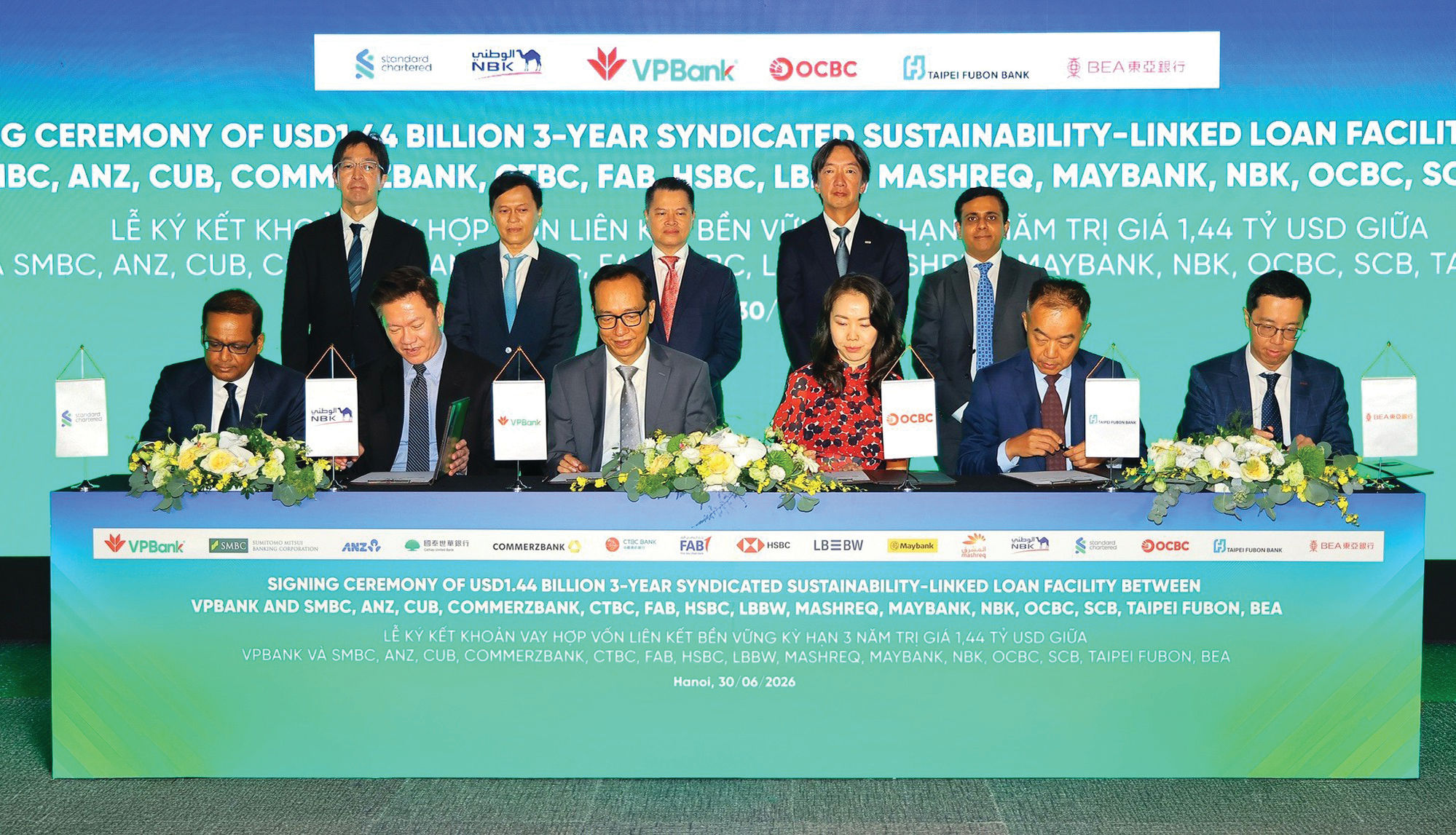
VPBank signed a syndicated sustainability-linked loan facility worth USD 1.44 billion with the participation of 15 international financial institutions
Unlike the 2022–2024 period, which was characterized by a sharp increase in international capital costs due to the Fed's monetary tightening cycle, 2026 witnesses a clear improvement in capital accessibility. Along with that is a change in appraisal criteria and the purpose of capital flows. A series of foreign loan deals are demonstrating this.
Foreign Loans with New Structures
For banks, the current trend of foreign borrowing is very clear: it is no longer a matter of "liquidity rescue" as seen in the 2022–2023 period, but has shifted to serving investment expansion, green transition, and the diversification of capital sources. This represents a structural change in Vietnam's capital market.
Typically, VPBank has just signed a syndicated sustainability-linked loan with 15 international financial institutions worth USD 1.44 billion. Similarly, HDBank signed an international syndicated loan in the form of a social loan worth USD 721 million, exceeding the initial mobilization scale by about 60%.
Thus, the purpose of these huge loans has been restructured according to the shifting trend toward the sustainable development of the economy, matching the shift of international investment capital flows and ESG investments. It no longer stops at the purely conventional framework of borrowing to "supplement general business capital" as before.
Besides the trend of seeking syndicated loans, bilateral credits, or funding from IFC, ADB, AIIB, JBIC, JICA, and development banks helps businesses (including commercial banks) reduce capital costs and extend loan maturities, while taking advantage of green financing or sustainable development programs. Businesses such as Phuc Sinh, Nafoods... have also accessed attractive low-cost loans/financing to invest in green business and sustainable development from institutions with strict green standards like Green, FMO... Meanwhile, large loans from "giants" like Vingroup, Masan... still smoothly attract foreign currency to Vietnam based on the expectations of foreign investors.
Advantages and Challenges
From a policy perspective, alongside stable economics, politics, and society, a favorable business environment and double-digit growth targets back the foreign borrowing capacity of enterprises. In particular, the legal framework has also become more supportive. Starting from 2026, Law No. 141/2025/QH15 amending and supplementing several articles of the 2017 Law on Public Debt Management takes effect, aiming to shorten the negotiation process, increase decentralization, and simplify procedures. In addition, Circular 17/2026/TT-NHNN also shortens the processing time for foreign loan registration dossiers.
However, changes from international lenders themselves in appraising businesses seeking capital are also driving the restructuring trend, shifting investment flows toward banks with good disbursement capabilities according to the capital's purpose, as well as screening to lend to enterprises with good governance quality and resilience to external shocks. Mr. Phung Xuan Minh - Chairman of Saigon Ratings, stated that this makes the gap between large enterprises and medium-sized enterprises distinct. Groups with credit ratings or transparent financial reports still access capital quite smoothly. Conversely, many medium-scaled enterprises can hardly borrow directly and still have to go through domestic banks.
In addition, there are other important factors that businesses should keep in mind. Mr. Nguyen Hoan Nien - Senior Manager of the Analysis Center at Shinhan Securities Vietnam, believes that for enterprises mobilizing foreign capital, they must clearly define and care about short-term or long-term capital needs. In the short term, businesses can rely on exchange rate movements to consider borrowing options in USD.
"With exchange rate developments in 2026 and current policies, it can be seen that the exchange rate will be controlled at a stable level. This will help large enterprises, especially those with massive capital needs such as banks, securities companies, alongside large-scale enterprises like Masan, look to access foreign capital sources to get more attractive interest rates compared to the domestic market," Mr. Nien commented. However, according to Mr. Nien, long-term USD borrowing abroad carries certain risks. Therefore, when borrowing foreign currency, there must be scenarios and contingency plans for fluctuations.
Furthermore, Mr. Nien affirmed that in the coming time, the development of an international financial center, as well as the fact that some banks want to act as intermediaries introducing investors to mobilize foreign capital, could support businesses in issuing to the international market. However, it should be noted that the infrastructure tied to this plan will require major changes and takes time.
In such a context, the outlook for opening the door to foreign loans from now until the end of 2026 for businesses is still evaluated relatively positively. Opportunities to mobilize international capital are likely to continue improving thanks to a more stable global interest rate environment, Vietnam's elevated economic position, and legal reforms in foreign loan management. Yet, international capital will only focus on leading enterprises, exporters, infrastructure, renewable energy, logistics, banking, and green transition projects. Meanwhile, small-scale enterprises with a lack of transparency or weak financial capacity will find it difficult to gain access.
Author: LE MY - TRUONG DANG
RELATED TOPICS
RECOMMENDED TOPICS