VN
VN
 EN
EN
11/07/2026, 02:00
Business economics
Surging construction material costs: How are contractors coping?
A broad surge in construction material prices is forcing contractors to adopt a range of measures to ease mounting financial pressure.
Since early March, the construction materials market has seen widespread price increases across most key categories, including steel, sand, stone, cement, and concrete.
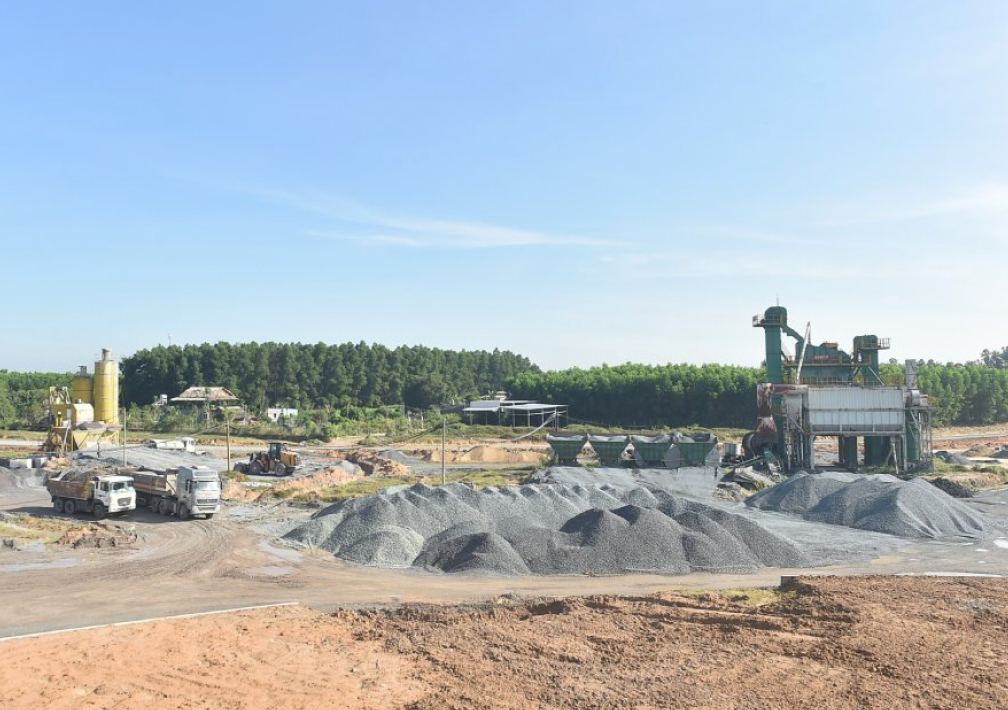
Since early March, the construction materials market has recorded widespread price hikes.
Tightening Costs
According to the latest notice, the North Central office of Hoa Phat – Binh Dinh One Member Co., Ltd. has raised prices of deformed bar steel and wire rod by VND 600,000 per tonne, while drawing wire rod increased by VND 400,000 per tonne. Previously, companies under Hoa Phat Group had already implemented multiple price hikes, each ranging from VND 200,000 to 300,000 per tonne depending on the product.
This trend is not limited to Hoa Phat but has spread across the industry. Many firms such as Viet Y Steel and Viet Duc Steel have also raised selling prices, typically by around VND 200 per kilogram depending on the product.
Beyond steel, other materials have also recorded sharp increases. Brick prices have risen from VND 1,800 to VND 2,100 per unit (excluding transport costs); black sand from VND 470,000 to VND 570,000 per cubic meter; yellow sand from VND 750,000 to VND 800,000 per cubic meter. Notably, ready-mix concrete M300 has surged from VND 1.1 million to nearly VND 1.5 million per cubic meter within just a few weeks.
A representative of the Vietnam Association of Construction Contractors said that recent price volatility is placing significant pressure on construction firms, particularly those bound by fixed-price contracts. Many contractors are seeing profit margins eroded, with some even facing losses if no adjustment mechanisms are introduced.
Dr. Le Nhu Thach, Chairman of Bcons Group, attributed the surge primarily to rising fuel prices driven by geopolitical factors, which have pushed up both production and transportation costs. Concrete prices alone have increased by around VND 100,000 per cubic meter in a short period, adding substantial pressure to input costs.
In response, Bcons has reviewed project timelines, temporarily suspended projects that have not yet been launched for sale, and accelerated construction on ongoing projects to maintain progress and credibility. The company has also implemented cost-cutting measures, including streamlining its workforce, optimizing material usage, and even exploring the use of recycled materials. “At this stage, avoiding losses is already a positive outcome,” Thach noted.
A Need for Market-Stabilizing Mechanisms
According to Dr. Pham Viet Thuan, Director of the Ho Chi Minh City Institute of Natural Resources and Environment Economics, as Vietnam sets ambitious growth targets for the coming period—largely driven by public investment—rising material costs are becoming a significant constraint. Projects funded by the state budget, especially those under lump-sum contracts, face heightened pressure as costs rise without corresponding adjustments.
In light of this, the Vietnam Road Infrastructure Investors Association (VARSI) has urged ministries and agencies to closely monitor market developments and promptly introduce measures to stabilize fuel and input material prices.
VARSI also proposed establishing a mechanism to regularly update construction price indices in line with market realities, thereby providing a legal basis for adjusting contracts between investors and contractors and reducing financial risks. For heavily impacted projects, the association recommended extending timelines and introducing risk-sharing mechanisms when costs exceed initial investment estimates.
Additionally, ensuring fuel supply, prioritizing key projects, and allowing contractors to purchase fuel in bulk are seen as necessary steps to prevent construction disruptions. Authorities are also called upon to strengthen oversight of the construction materials market to curb speculation and unjustified price hikes.
Sharing a similar view, the Vietnam Association of Construction Contractors noted that fluctuations in fuel and material prices are directly affecting the financial health of construction firms, particularly in transport infrastructure projects that require large volumes of fuel and bulk materials.
The association therefore recommended allowing fuel cost compensation mechanisms in construction contracts from March 2026 until the market stabilizes, along with tighter control over transportation costs and local material prices. In cases where volatility persists due to geopolitical factors, force majeure clauses should be considered to enable contract adjustments.
Moreover, encouraging businesses to form supply chain linkages for construction materials is seen as a necessary step to mitigate supply risks and price volatility, thereby helping to ensure the timely delivery of key national projects.
Author: VI ANH - TRUONG DANG
RELATED TOPICS
RECOMMENDED TOPICS