VN
VN
 EN
EN
09/07/2026, 11:15
Investment
Untangling the knots in old apartment building renovations
Hanoi has issued a new mechanism for renovating old apartment buildings with many notable regulations on consensus, compensation, and investment incentives, hoping to resolve bottlenecks that have dragged on for years.
The Hanoi People's Council has just passed a Resolution regulating a number of policies on urban renovation, embellishment, and transit-oriented development (TOD). The Resolution was enacted to concretize the specific mechanisms of the Capital Law, while simultaneously removing prolonged obstacles in the renovation and reconstruction of old apartment complexes.
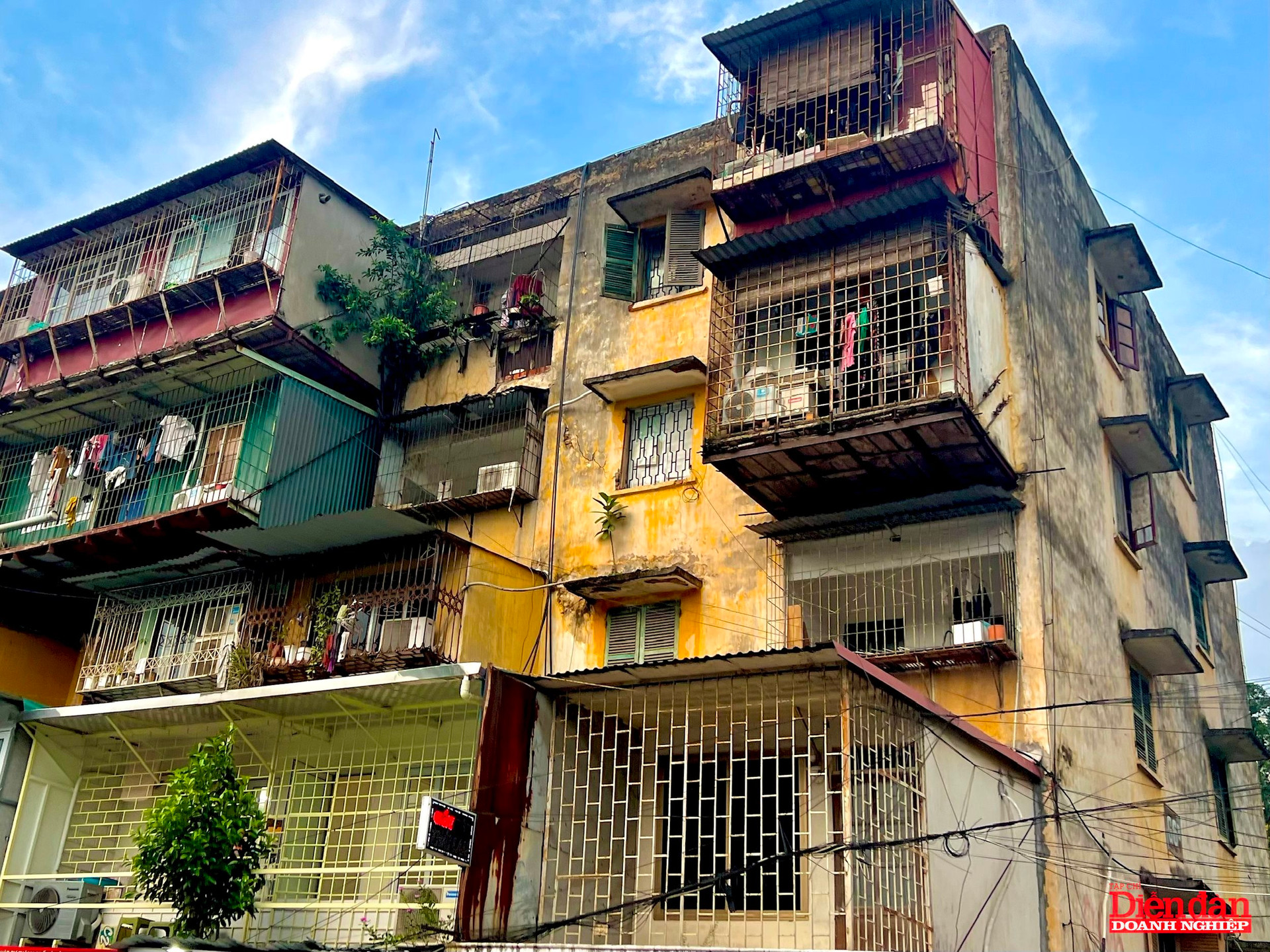
Renovating old apartments has always been one of Hanoi's difficult puzzles for many years. Photo: VA
Removing Institutional Bottlenecks
According to the resolution, in cases where the project developer carries out the renovation and reconstruction of an old apartment building not chosen by the residents, the Commune-level People's Committee will coordinate with the investor to collect opinions from the homeowners and land users. The maximum time for collecting opinions is one year, which can only be extended under force majeure circumstances for no more than 6 months.
Notably, the compensation, support, and resettlement plan will be approved when there is consensus from at least 51% of the homeowners and land users, verified by the Commune-level People's Committee. This rate is lower than the 75% level previously proposed during the drafting process.
The adjustment of the consensus rate is expected to help clear one of the biggest bottlenecks in old apartment building renovations. In reality, over many years, numerous projects have been dragged out due to a lack of consensus among owners, while many buildings have seriously degraded, affecting the safety and quality of life of the residents.
In addition to adjusting the consensus rate, the resolution also adds a series of mechanisms regarding compensation, resettlement, and policies for investors to increase the feasibility of the projects.
Accordingly, the compensation coefficient (K) for apartment units is to be mutually agreed upon by the developer and the owners, but must not exceed two times the legal usable area of the apartment. In cases where the parties cannot reach an agreement, the K coefficient will be set at 1.0 time for apartments from the 2nd floor up, and 1.2 times for 1st-floor apartments.
In cases where all homeowners and land users within the project scope unanimously propose to self-implement the renovation and reconstruction of the old apartment building, the owners have the right to select the investor. Subsequently, the investor will formulate a detailed planning scheme to submit to the Hanoi People's Committee for approval, and the parties will mutually agree on the compensation, resettlement support, and temporary accommodation arrangements in accordance with regulations.
To ensure the rights of residents during the project implementation period, homeowners will receive full housing rent support for a maximum of 3 years. In the following two years, the city will support 50% of the rent cost, with the remainder covered by the developer. If the project extends beyond 5 years, the developer must pay the entire cost of the rent.
For businesses, the developer of an old apartment renovation and reconstruction project is entitled to a maximum targeted profit margin of 15% of the total investment capital. This is expected to create additional leverage for businesses to participate in a sector that typically features long implementation timelines, high costs, and significant risks.
Experts analyze that old apartment building renovation is a highly specific field because it directly involves the benefits of multiple owners, urban planning, and investment resources. Therefore, perfecting the mechanisms regarding consensus, compensation, resettlement, and investor selection is viewed as a crucial condition to elevate the feasibility of projects, while creating a foundation to mobilize social resources for urban embellishment.
Approaching from an Urban Regeneration Perspective
According to Dr. Arch. Dao Ngoc Nghiem - Vice President of the Vietnam Urban Planning and Development Association, renovating old apartments is not merely about rebuilding degraded structures but needs to be viewed as a process of urban regeneration. The goal is not only to ensure safety for residents but also to reorganize urban spaces, upgrade technical and social infrastructure, and improve land-use efficiency.
Mr. Nghiem stated that after many years of implementation, Hanoi's old apartment renovation program still faces many difficulties due to obstacles at various stages, from planning, investment mechanisms, and investor selection to compensation, resettlement, and building consensus among the people. According to the expert, to accelerate progress, it is necessary to continue perfecting mechanisms and policies toward transparency, ensuring the selection of capable investors while harmonizing the interests of the State, businesses, and residents.
According to him, within the context of Hanoi developing its urban landscape under the TOD model, old apartment renovations must be placed within the overall urban planning scheme, tied to the development of transport and social infrastructure, and the efficient exploitation of land funds.
The promulgation of new mechanisms is expected to contribute to untangling the bottlenecks regarding consensus, compensation, and resource mobilization for the old apartment renovation program. However, the effectiveness of the policy will depend on the implementation process as well as the coordination between the government, investors, and the people.
Hanoi currently has 11 old apartment renovation projects underway and 3 completed projects. The city aims to complete the renovation of about 20,000 apartments subject to demolition by 2030, and basically complete the embellishment and regeneration of about 2,160 old apartment buildings by 2035.
If implemented synchronously, the new mechanisms will contribute to speeding up the progress of renovating degraded apartment blocks, while creating room for Hanoi to achieve its goals of urban embellishment and regeneration towards sustainable development.
Author: MAN NHI - TRUONG DANG (translates)
RELATED TOPICS
RECOMMENDED TOPICS