VN
VN
 EN
EN
26/07/2026, 02:00
Investment
NT2 faces risk of reduced market share in the gas-fired power race
Despite a recovery in 2025, PetroVietnam Power Nhon Trach 2 JSC continues to face mounting competitive pressure, declining gas supply and rising receivables risks in the period ahead.
.jpg)
2025 is widely viewed as a recovery year for NT2
A Short-Term Recovery Phase
After a volatile year in 2024, when operations fell into a “below-cost” position due to liquidity constraints at Vietnam Electricity (EVN) and the dominance of lower-cost power sources, NT2 entered a critical transition phase.
According to analysis by BSC Securities, 2025 is widely viewed as a recovery year for NT2, as several unfavorable fundamentals gradually ease thanks to changes in the weather cycle, policy orientation under Power Development Plan VIII, and the completion of income recognition items. However, alongside this recovery, risks are becoming increasingly visible toward late 2025 and early 2026, as competition in the gas-fired power sector enters a new phase.
Pham Duc Toan, an analyst at BSC, noted that the current investment thesis for NT2 rests on four core pillars.
First, commercial electricity output is rebounding strongly from the very low base of 2024, allowing the company to move out of a prolonged period of inefficient operations.
Second, the weather cycle has quickly shifted back to neutral following the end of La Niña within the first two months of 2025, weakening the dispatch advantage of hydropower—previously a major source of pressure on gas-fired thermal plants.
Third, Power Development Plan VIII, which assumes nationwide electricity demand growth averaging 10% per year through 2030, continues to serve as a long-term support framework for strategic gas-fired power sources in southern Vietnam.
Fourth, NT2’s 2025 earnings are significantly bolstered by the completion of accounting for VND 177 billion in foreign-exchange gains and VND 91 billion in forest environmental service fees. While non-recurring, these items play an important role in the recovery year.
“On this basis, financial projections show a clear improvement in NT2’s profit outlook for 2025. Revenue is expected to reach VND 6,309 billion, up 6.1% year-on-year, while net profit is estimated at VND 273 billion, representing a 228.8% increase. Net profit margin is therefore projected to improve to 4.3%.
However, it should be emphasized that these profit figures include one-off income from foreign-exchange gains and forest environmental fees, which help ‘polish’ the recovery-year financial picture but do not provide a sustainable earnings base for subsequent years. The expected cash dividend of VND 1,000 per share, equivalent to a 5.4% yield, remains an important support for investors amid market volatility,” the BSC analyst said.
Market Share Erosion Risks
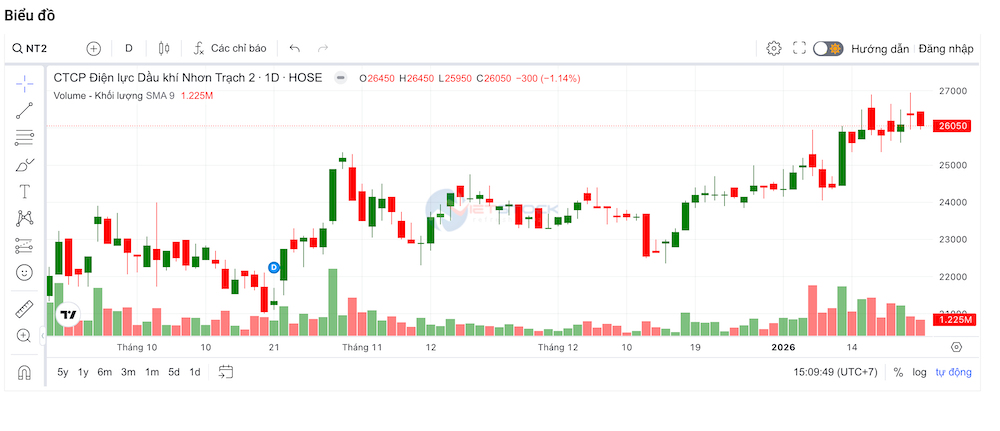
BSC also warns that from late 2025 into 2026, risks to NT2 become more pronounced. Specifically, the commissioning of Nhon Trach 3 in June 2025 and Nhon Trach 4 in the fourth quarter of 2025 is set to trigger a genuine “efficiency race” within the gas power segment.
The new plants utilize Class H gas turbine technology, which has significantly lower heat rates than the Class F technology currently used by NT2. As a result, they are prioritized in dispatch order, pushing NT2 into a less favorable position.
At the same time, NT2 faces margin compression pressures. Input gas prices are projected to rise to around USD 9.6/MMBtu, up 3% year-on-year, mainly due to higher downstream transportation costs. In contrast, the average electricity market price (FMP) is forecast to fall to VND 1,249/kWh, a decline of 16.7%, as low variable-cost power sources increase their share of dispatch. This mismatch between input and output prices will directly erode NT2’s margins if contracted output does not improve.
Similarly, DNSE notes that while growth prospects for the power sector remain stable, momentum is slowing compared to previous periods. This reflects not only weaker demand growth but also the increasingly evident substitution effect from distributed energy sources—particularly rooftop solar—which are not yet fully captured in the system statistics. This trend intensifies indirect competition and constrains medium- to long-term output growth potential for gas-fired plants such as NT2.
In parallel, the long-term decline in domestic gas supply is identified as a structural and difficult-to-reverse trend. NT2 has taken proactive steps to mitigate this risk by accessing gas from new fields under the Nam Con Son 2 project since 2020. Looking further ahead, the Su Tu Trang Phase 2B project, expected to deliver first gas from 2027 with an additional supply of approximately 2 billion cubic meters per year, is anticipated to significantly enhance gas supply security for the region. Nevertheless, this remains a future solution and cannot fully alleviate pressure during the 2025–2026 period.
Another notable risk lies in the quality of short-term assets, particularly receivables. By the end of 2025, NT2’s short-term receivables reached VND 3,615 billion, accounting for nearly 40% of total assets—up sharply from VND 2,326 billion at the end of 2023 and VND 2,989 billion at the end of 2024. This sustained upward trend reflects ongoing cash-flow pressure, even though most receivables are owed by EVN’s Power Trading Company. While default risk remains low, prolonged receivable cycles could negatively affect cash-flow turnover and financial flexibility.
Overall, NT2 faces three main layers of challenge: limited growth headroom in the power sector, long-term gas supply risks, and rising receivables pressure. These factors do not negate the short-term recovery story, but they play a critical role in constraining the company’s sustainable growth prospects in the period ahead.
Author: DIEM NGOC - TRUONG DANG
RELATED TOPICS
RECOMMENDED TOPICS