VN
VN
 EN
EN
26/07/2026, 11:20
Investment
Stock Market Weekly Forecast: Avoiding risks of unexpected correction
Investors should limit new purchases of stocks that have already risen sharply and are approaching resistance levels/previous peaks to avoid the risk of unexpected corrections.
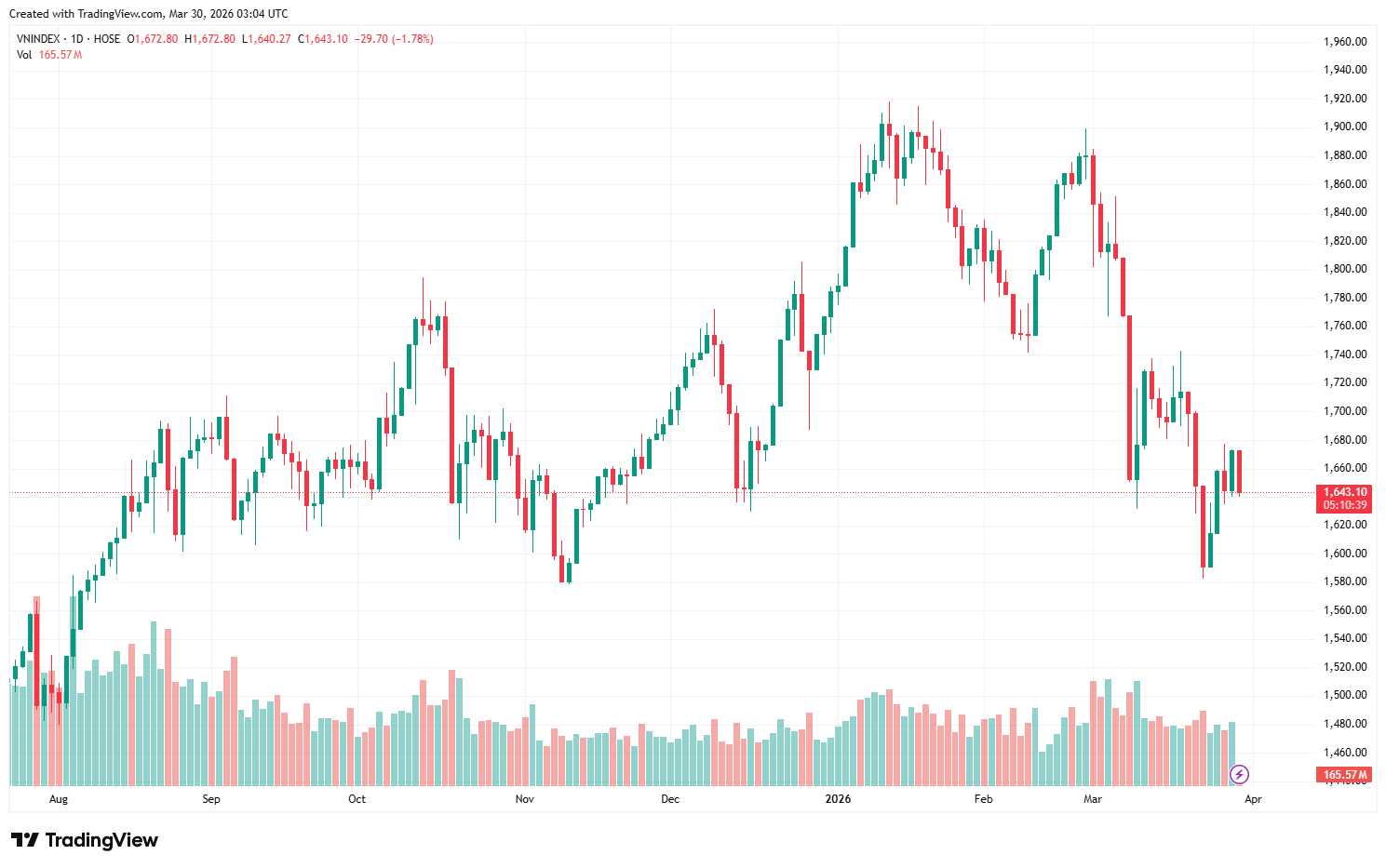
For the last week, the VN-Index increased by 24.99 points (1.52%) compared to the previous week.
Last week, the Vietnam stock market witnessed an impressive recovery effort after successfully testing the 1,585-point support zone. Although the new week started in the red under negative pressure from fluctuations in world oil prices, leading to a sell-off that caused the VN-Index to lose the important psychological support level of the MA200 (corresponding to the 1,650-point zone), the subsequent developments showed a positive shift.
In the first half of the week, the index mainly fluctuated within a large range of 1,580–1,630 points. However, towards the end of the week, buying pressure quickly returned, starting from large-cap stocks and spreading across the entire market. This consensus helped the VN-Index maintain its upward momentum and head towards the 1,670 point mark in the final trading session of the week.
Regarding foreign investors, international capital continued its net selling position with a total value of 3,314 billion VND; however, this pressure eased significantly, decreasing by more than 753 billion VND compared to the previous week.
In the final trading session of the week, the VN-Index continued to move within the 1,640–1,660 range, with the index mostly in positive territory. Large-cap stocks such as VIC, VJC, and VPB contributed nearly 6 points to the overall index. Conversely, stocks like MCH, PNJ, and STB put pressure on the VN Index. In this morning's session, large-cap stocks attracted significant capital inflows, with the VN30 index rising more than 7 points compared to the VN Index's nearly 4-point increase. At the end of the morning session, the index closed at 1,652.89, up 8.26 points from the reference point.
In the afternoon trading session, the index quickly extended its gains, and from after 2 PM, especially during the ATC session, strong buying pressure surged in the banking, real estate, and oil and gas sectors, pushing the VN-Index towards the 1,670-point mark. Foreign investors continued net selling today with a total value of over 154.70 billion VND, focusing on selling STB, DGC, and FPT. At the close of the session, the VN-Index closed at 1,672.80 points, up 28.17 points, or 1.71%. For the week, the VN-Index increased by 24.99 points (1.52%) compared to the previous week.
The VN-Index closed with a white Marubozu candlestick, gaining 28 points and consolidating the 1,660-1,670 range, equivalent to the market's MA200. On the daily chart, technical indicators such as MACD, RSI, and CMF are all trending upwards, reinforcing the market's recovery momentum. Technically, the VN-Index maintains a solid bullish structure. The 1,660 point level (corresponding to the MA200) will act as key support, while the previous peak of 1,710-1,720 points will be short-term resistance.
On the hourly chart, in VCBS’s view, the VN-Index has risen above the upper Bollinger band, and technical indicators are also showing an upward trend. However, it is also necessary to note the possibility of intraday fluctuations to retest the nearest resistance area around 1,700 points. The VN-Index continues its upward trend thanks to strong momentum from large-cap stocks. The positive sentiment continues to spread across market sectors, indicating a market recovery.
Given the current market developments, VCBS recommends investors look for stocks that are holding their price levels or are at strong support levels after the VN-Index's sharp fluctuations last week, and also those belonging to sectors with expected strong Q1 earnings results, to gradually invest during market dips in the coming sessions. Additionally, investors should limit new purchases of stocks that have already risen sharply and are approaching resistance levels/previous peaks to avoid the risk of unexpected corrections. Some notable sectors during this period include banking, retail, and construction.
Author: NGOC ANH
RECOMMENDED TOPICS