VN
VN
 EN
EN
15/07/2026, 10:39
Investment
VNDIRECT strives to regain market share
Amid intensifying competition in technology and trading fees, VNDirect Securities Corporation (HoSE: VND) has gradually lost ground to its rivals.

The Ho Chi Minh City Stock Exchange (HoSE) recently released brokerage market share data for the first quarter of 2026. VND ranked seventh with a 4.78% market share, up slightly from the end of 2025. However, compared with previous years, the company has clearly been overtaken by several competitors.
Brokerage Market Share Slips
Before 2024, VND consistently ranked among the top three brokerage firms, behind only VPS and SSI, with a market share exceeding 8%. In recent years, however, competition in the brokerage industry has intensified as major securities firms entered the market and rolled out commission-free trading policies, including VPBankS and TCBS.
According to market analysts, one of the main reasons behind VND's declining market share is its refusal to join the race to offer zero-fee trading, lower margin lending rates, or higher broker commissions. While other firms aggressively introduced incentives to attract investors, VND's management maintained that pursuing market share at any cost would undermine shareholder interests and fail to create sustainable value. This conservative approach has resulted in a sharp decline in brokerage revenue. Once generating between VND 400 billion and VND 500 billion annually, brokerage income now represents a relatively small portion of the company's core business.
As the stock market operates in cycles, securities firms that build comprehensive financial ecosystems encompassing brokerage, investment banking, asset management, and related services tend to enjoy a significant competitive advantage. For VND, its contrarian strategy, combined with operational disruptions caused by past system incidents, has contributed to the erosion of its brokerage market share.
Stock Trades Near Book Value
VND's share price has broadly reflected the company's business performance and strategic direction. Since late 2023, the stock has traded close to its book value. As of May 28, VND shares were trading around VND 17,750 per share. In contrast, peers such as SSI, TCX, HCM, and VCI have reached higher valuation levels. More concerning, average daily trading volume for VND has remained at only 15 to 20 million shares.
Financial analysts note that VND continues to pursue a conservative business model. The company has avoided aggressive capital raising, refrained from competing solely through interest rates, and resisted large-scale workforce expansion during peak market periods. This strategy may help preserve asset quality, control risks, and protect profit margins, particularly following the Trung Nam bond-related challenges. However, as Vietnam's securities industry enters a period of deep restructuring, remaining on the sidelines may leave the company vulnerable to further market share losses.
The Challenge of Winning Back Market Share
Speaking at the company's 2026 Annual General Meeting of Shareholders, Chairwoman Pham Minh Huong said that after a period of significant turbulence, the company had been forced to "slow down" to address internal issues, including a cyberattack and challenges related to the corporate bond market. She acknowledged that VND missed opportunities to expand market share while focusing resources on resolving bond-related matters and restoring its trading system.
Following financial difficulties linked to the Trung Nam bond group, Vietnam Electricity (EVN) proposed a solution for the renewable energy projects involved. This development marks an important step not only for Trung Nam but also for VND. The company still holds more than VND 4 trillion in bonds related to Trung Nam and is working with relevant parties on restructuring plans to ensure principal and interest payments to investors.
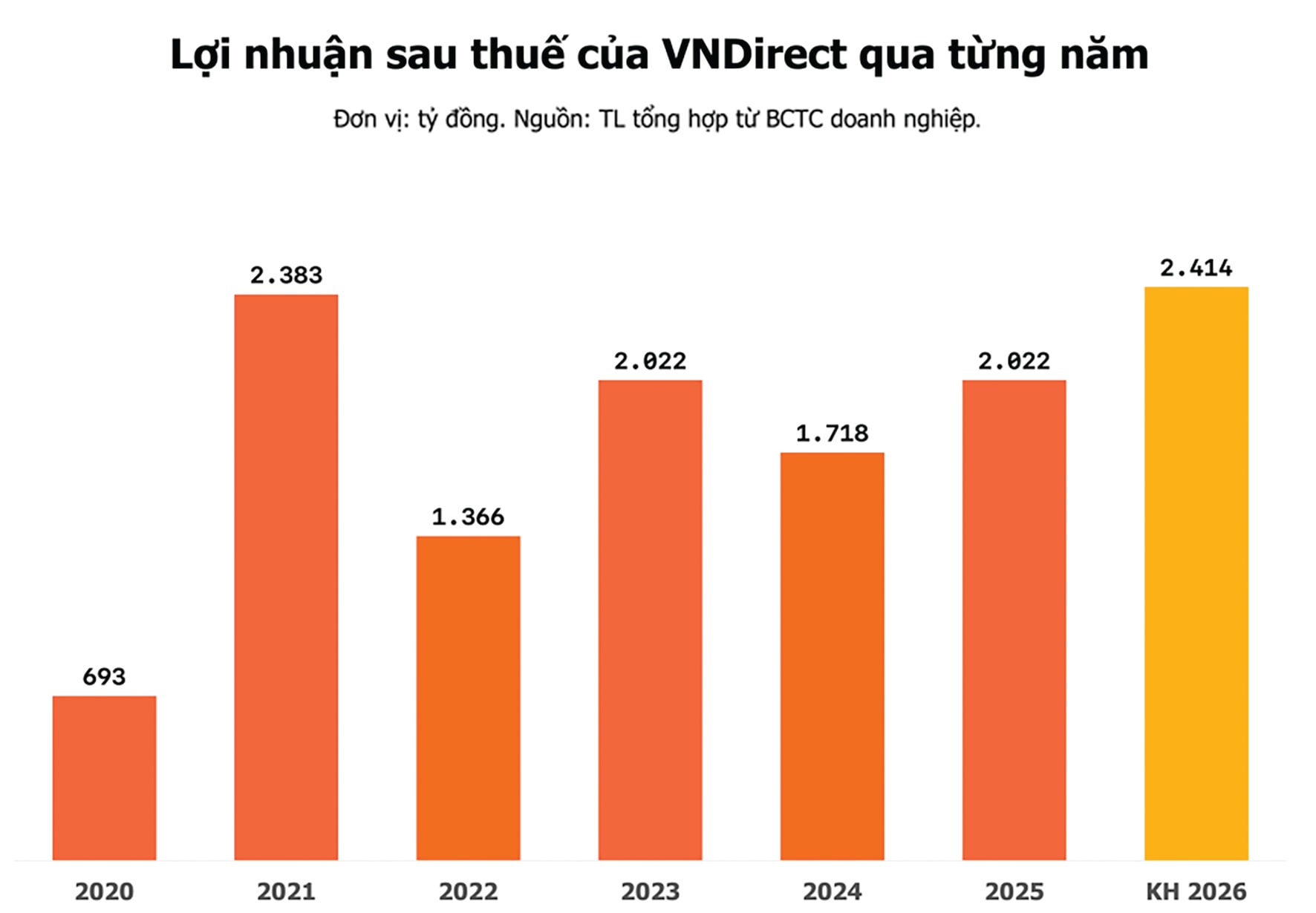
Looking ahead, VND plans to re-enter the competitive race while simultaneously transforming its business model and maintaining a return on equity (ROE) of at least 15% over the next five years. At the recent AGM, shareholders approved a 2026 business plan targeting revenue of VND 5.569 trillion, up 9% year-on-year, and net profit of VND 2.414 trillion, an increase of 19%.
To support growth, the company plans to issue up to 462 million shares through three separate offerings. These include a private placement of up to 106.6 million shares to investors, a rights offering to existing shareholders, and the issuance of up to 30 million ESOP shares for employees.
Although significant challenges remain, VND is attempting to regain momentum and recover lost market share. Achieving that goal will not be easy in an increasingly competitive securities industry.
Author: HA PHUONG - TRUONG DANG
RELATED TOPICS
RECOMMENDED TOPICS