VN
VN
 EN
EN
15/07/2026, 10:39
Investment
What outlook for Vietnam’s stock market in June?
June is expected to be a sensitive period for Vietnam’s stock market as the VN-Index faces the risk of falling toward the 1,800-point level amid weakening liquidity.
Vietnam’s stock market is facing a combination of external headwinds and increasingly visible domestic challenges. The VN-Index's recent performance reflects asset repricing in an environment characterized by elevated interest rates, exchange rate volatility, and weakening capital flows.
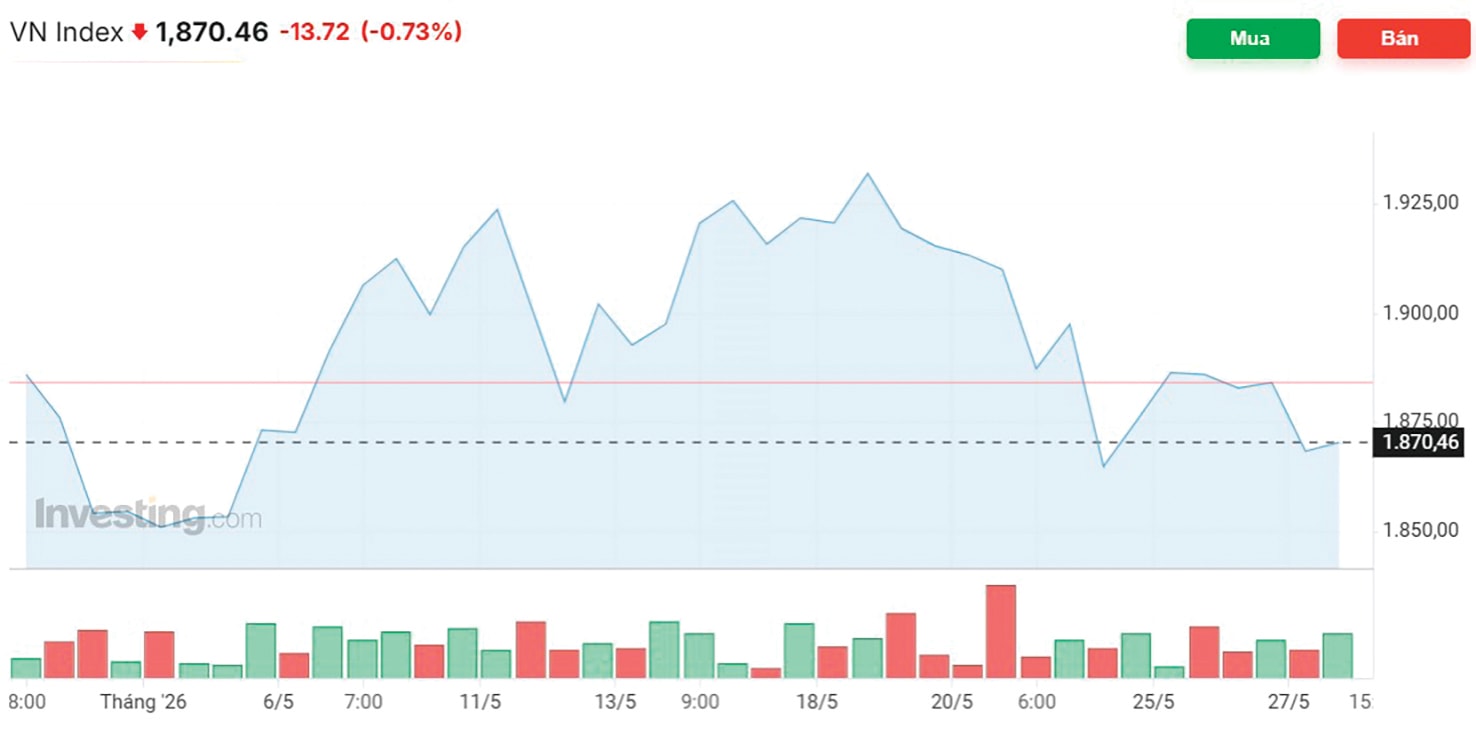
VN-Index Falls Below 1,900 Points
According to MBS, global markets continue to paint a mixed picture. On Wall Street, investor enthusiasm remains strong, driven by expectations surrounding artificial intelligence (AI). The S&P 500 has recorded eight consecutive weeks of gains, while the Dow Jones Industrial Average continues to reach new record highs. However, rising U.S. Treasury yields suggest persistent concerns over inflation and the possibility that the Federal Reserve may maintain a restrictive monetary policy stance for longer than previously expected.
In particular, the appointment of Kevin Warsh as the new Chair of the Federal Reserve has reinforced expectations of a hawkish policy stance throughout 2026, diminishing hopes for early interest rate cuts.
Across Asia, exchange rate pressures are also intensifying as capital flows shift. In South Korea, private-sector investors have increased overseas investments rather than retaining foreign currency domestically, placing additional pressure on the won. Indonesia has raised interest rates by 50 basis points to stabilize the rupiah, while Japan is reportedly preparing for another rate hike in June 2026.
In Vietnam, the VN-Index officially fell below the 1,900-point threshold after declining 44.5 points, or 2.3%, during the most recent week. According to MBS analysts, the influence of a handful of large-cap stocks has distorted the overall market picture.
Excluding the impact of those stocks, the VN-Index would effectively be equivalent to around 1,776 points. This suggests that the majority of listed shares had already entered a deep correction before the benchmark index formally broke through a key psychological support level.
One of the most concerning signals, according to MBS, is the continued withdrawal of foreign capital. Foreign investors have recorded their tenth consecutive week of net selling, with total net outflows reaching VND 6.349 trillion. During the first five months of 2026, cumulative net foreign selling amounted to approximately VND 60.036 trillion, equivalent to US$2.3 billion, VND 18.5 trillion higher than the same period last year. This suggests a strategic withdrawal from emerging markets rather than short-term portfolio rebalancing.
A Global Capital Rotation
In June 2026, global capital markets are expected to enter a new wave of IPO activity, led by the anticipated IPO of SpaceX, which is expected to list on Nasdaq under the ticker symbol SPCX.
Nguyen The Minh, Director of Investment Banking at ABS Securities, believes that SpaceX’s size could quickly give it a significant weighting in major indices such as the S&P 500.
At the same time, investors are also anticipating potential IPOs from major AI companies including OpenAI, Anthropic, and Databricks. Taken together, these listings could trigger a new global IPO cycle, potentially larger than the SPAC boom of 2021.
This development could indirectly affect Vietnam’s stock market. A mega-IPO such as SpaceX may attract international capital back to the United States as major investment funds rebalance portfolios. It could also prompt ETF and passive funds to raise liquidity in preparation for purchasing SPCX shares.
If Nasdaq were to quickly include SpaceX in major indices such as the Nasdaq-100, technology funds, AI-focused funds, and thematic investment funds would likely increase their exposure to U.S. assets, reducing allocations to frontier and emerging markets.
On the other hand, Vietnam could still benefit if the SpaceX IPO proves successful and helps launch a broader global IPO cycle. Improved risk appetite could encourage venture capital and international investors to expand allocations beyond the U.S. market and return to emerging economies. In that scenario, Vietnam’s market-upgrade story could become more attractive to global investors.
Investment Strategy
Looking ahead, MBS analysts believe the VN-Index is likely to test the 1,800-point support level if current downward momentum continues. This will be a critical threshold for assessing the strength of underlying demand once the influence of index-supporting stocks fades.
In this environment, investors should prioritize capital preservation and portfolio risk management by taking partial profits where appropriate. Maintaining cash reserves may also provide opportunities to accumulate assets at more attractive valuations if the market continues to correct. Although painful in the short term, a deeper adjustment could help restore valuation discipline and reduce speculative excesses.
From a value-investing perspective, Dang Tran Phuc, Chairman of AzFin Vietnam, noted that many leading companies are now trading at historically low valuations. As a result, asset selection criteria should become more selective. He highlighted four priorities: focusing on companies with low financial leverage in an environment where interest rates remain around 8-9% annually; favoring industry leaders benefiting from market consolidation; only investing at valuation levels below the five-year median or near historical lows; and placing greater emphasis on asset quality and the ability to generate sustainable cash flows.
Author: DIEM NGOC - TRUONG DANG
RELATED TOPICS
RECOMMENDED TOPICS