VN
VN
 EN
EN
09/07/2026, 11:15
Investment
Outlook for the Vietnamese stock market after Lunar New Year
On February 23, 2026 (the 7th day of the Lunar New Year), Vietnam’s stock market resumed trading after the Tet holiday. What are the prospects for the first six months of the year?
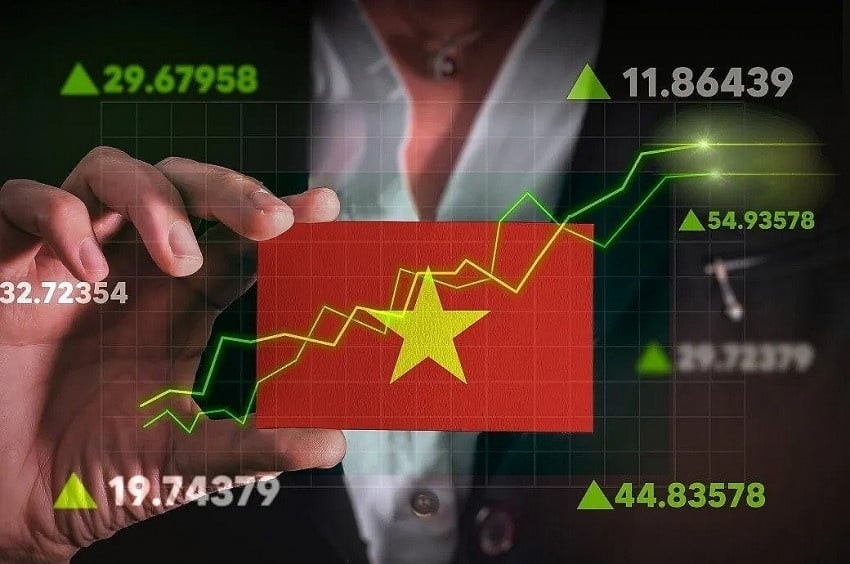
Vietnam was officially upgraded by FTSE Russell from a frontier to a secondary emerging market on October 8, 2025. In the first half of 2026, the market faces two key milestones: the FTSE review in March 2026 and the possibility of being added to MSCI’s Watchlist in June 2026.
After a highly differentiated K-shaped recovery in 2025, Vietnam’s stock market enters 2026 with a new mindset. Mr. Nguyen Minh Hanh, Director of Research at SHS Securities, expects 2026 to be a year of sideways movement within a narrow range, requiring more rigorous stock selection. Risk appetite and capital allocation strategies will need to adjust as macroeconomic forces pull in different directions.
Macroeconomic conditions in the first half of 2026 are expected to reflect a tug-of-war between ambitious growth targets and system liquidity pressures.
In the second quarter of 2026, the exchange rate may show clearer adjustments to support growth by stimulating credit momentum. On the interbank market (Market 2), maintaining swap spreads at the 3.x% level seen at the end of 2025 may prove difficult if credit expansion is to be supported. The system will likely need to capitalize on potential Fed rate cuts to improve liquidity from Q2 onward.
On the primary market (Market 1), retail deposit rates and funding costs indicate that the era of “cheap money” has ended. System liquidity has reached its limits, prompting regulators to consider easing certain constraints—such as incorporating State Treasury deposits into the loan-to-deposit ratio (LDR) calculation—to relieve bottlenecks. In this context, 2026 may be favorable for fixed-income investments such as bank deposits, certificates of deposit (CDs), and corporate bonds.
Meanwhile, the government bond market faces mounting pressure. Planned development investment spending for 2026 is set to increase by 23% year-on-year, significantly expanding government bond supply. However, demand from banks and insurance companies is unlikely to increase sharply in the short term. As a result, the yield curve may steepen unfavorably, with shorter maturities facing particular pressure.
Despite liquidity challenges, Mr. Nguyen Minh Hanh believes the stock market in the first half of 2026 will still be supported by structural pillars.
First, interest rates are expected to remain relatively low, while exchange rates and inflation are kept within reasonable bounds. Strong growth plans for the coming years will place significant pressure on monetary and fiscal policy in 2026. Maintaining low rates to support growth, stabilizing the exchange rate, and controlling inflation simultaneously will be a delicate balancing act. These pressures may directly affect macroeconomic indicators and the performance of the financial-banking sector.
Second, Vietnam is witnessing a surge in infrastructure investment. With projected annual infrastructure spending approaching $200 billion, this wave of investment could provide a powerful boost to the economy. It may lay the groundwork for a new multi-year growth cycle, benefiting companies and sectors positioned to capitalize on these opportunities.
Third, Vietnam’s upgrade to secondary emerging market status. The country has largely met the criteria for this classification and is expected to receive formal recognition in 2026. However, portfolio rebalancing by frontier and emerging market funds may offset each other, limiting immediate capital inflows. Significant foreign inflows are more likely once Vietnam secures MSCI upgrade status.
A critical milestone will be the possibility of MSCI adding Vietnam to its watchlist in June 2026. According to SSI, fundamental conditions are increasingly aligning. Vietnam has met most MSCI market accessibility criteria, supported by the stable implementation of the non-prefunding (NPF) mechanism, progress in establishing a central counterparty clearing (CCP) model, expanded hedging and short-selling tools via index futures, improved English-language disclosures, and ongoing improvements in foreign ownership limits (FOL).
Notably, SSI highlights that the overall FOL ratio—especially on HOSE—has improved significantly from 2025 into early 2026, partly due to the inclusion of large-cap stocks with 100% foreign ownership room. This broadens the investable universe for index-tracking funds and enhances market depth and representation in global indices.
Remaining challenges primarily relate to foreign exchange liberalization, an important MSCI evaluation criterion. However, this is not necessarily a decisive bottleneck, as several existing MSCI emerging markets also fall short of ideal standards in currency and capital-flow mechanisms.
“Overall, Vietnam enters 2026 with the most favorable structural foundation ever for MSCI reclassification. This is no longer merely a long-term expectation but an increasingly tangible and time-trackable objective,” SSI experts note.
In the near term, however, the story for the next six months remains one of “waiting,” as described by SHS.
After a K-shaped recovery in 2025, what can investors expect in 2026? Mr. Nguyen Minh Hanh predicts a narrow trading range with significant stock-level divergence. Stocks that performed strongly in 2025 may face less favorable conditions in 2026, while real opportunities are likely to arise from company-specific narratives.
“2026 will be the year when bottom-up investment strategies come to the forefront. For optimal performance, investors may consider allocating around 60% of their portfolios to a passive VN30 strategy and 40% to bottom-up stock selection,” the SHS expert emphasized.
Author: LE MY - TRUONG DANG
RELATED TOPICS
RECOMMENDED TOPICS