VN
VN
 EN
EN
16/07/2026, 02:38
Investment
VN-Index moves sideways, awaiting a new cycle
Declining liquidity and cautious investor sentiment are keeping the VN-Index in a consolidation phase. However, attractive valuations and emerging growth drivers could create opportunities for the market's next upward cycle.
The stock market closed May with growth momentum weakening significantly, as information on first-quarter 2026 earnings had already been largely priced in.
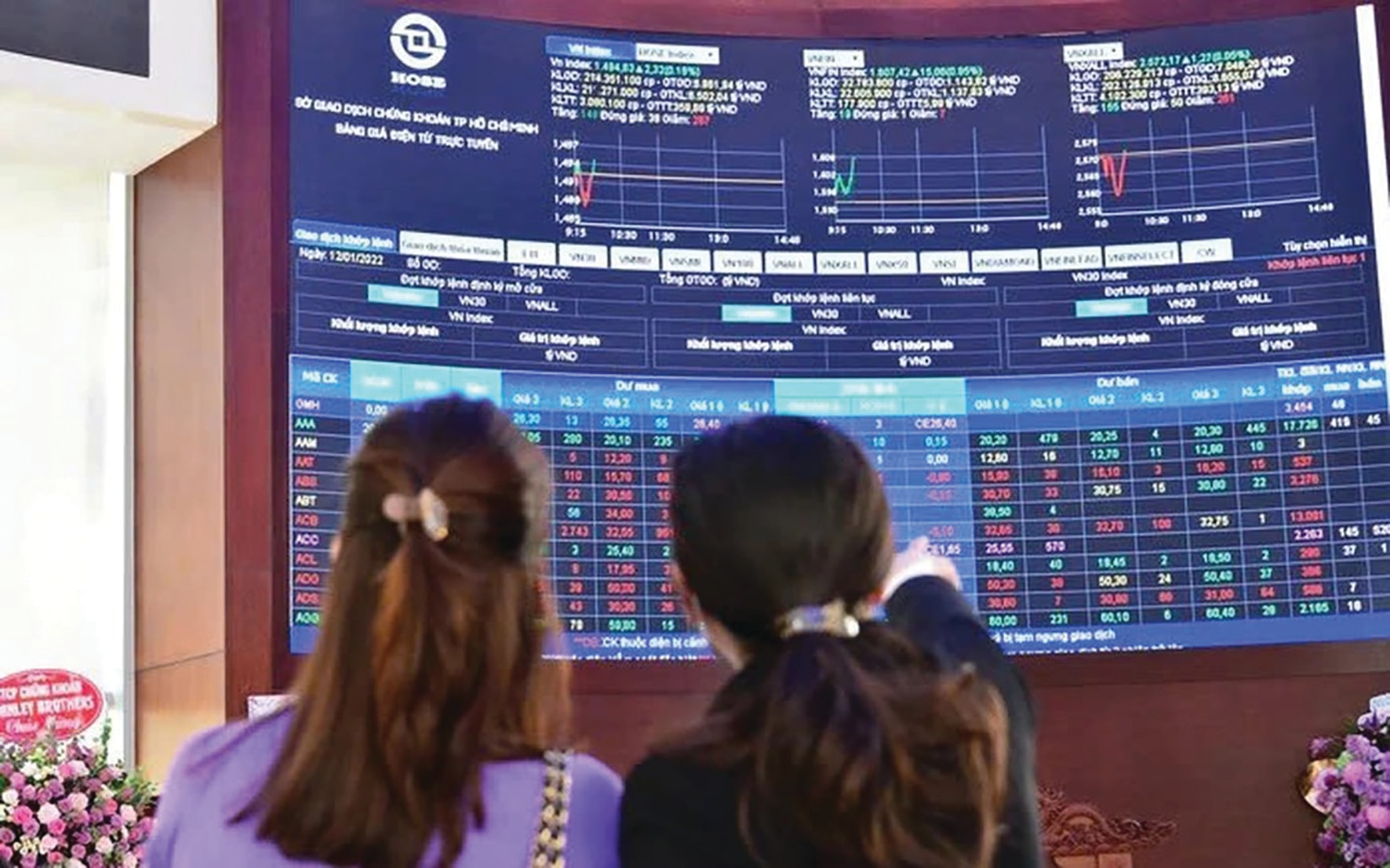
While major stock markets such as the United States, Japan and South Korea continue to reach record highs, the Vietnamese stock market remains in a defensive posture. Illustration photo.
Capital Flows Turn Defensive
Market analysts believe the VN-Index has entered a period characterized by a lack of new catalysts, persistently low liquidity and prolonged sideways movement. These developments reflect growing caution among investors and declining efficiency in capital allocation across the market.
According to Vu Duy Khanh, Director of Analysis at Smart Invest Securities (AAS), one of the most notable features of the current market is the growing divergence between Viet Nam and the rest of the world. While major markets such as the United States, Japan and South Korea continue to set new highs, Viet Nam's stock market remains defensive.
In South Korea, when Samsung's value triples, the KOSPI index tends to reflect a corresponding increase. In Viet Nam, however, gains are concentrated in a small group of leading companies while the broader market sees little benefit. As a result, capital becomes increasingly concentrated and fails to generate wider wealth or confidence effects.
Daily trading value has fallen to around VND 18-20 trillion, clearly reflecting this defensive stance. Investors are either withdrawing from the market or choosing to remain on the sidelines rather than take on additional risk. In this environment, short-term rallies have increasingly become classic "bull traps". AAS data show that most recently surging stocks have been able to sustain gains for only one to one-and-a-half trading sessions.
Notably, the market has started to ignore positive news. Many companies reported strong first-quarter 2026 earnings growth, yet their share prices barely reacted. In market theory, this often signals either an extended consolidation phase or a sharp shakeout before a new trend emerges.
From a more optimistic perspective, Nguyen Manh Dung, Senior Director of Market Strategy Research at HSC, noted that large-cap companies now account for a significant share of the VN-Index and serve as the primary drivers of both index performance and market liquidity. This creates benchmark risk for both passive and active funds, as substantial movements in leading stocks can force portfolio managers to adjust holdings to control deviations from benchmark indices.
In practice, most sectors require confirmation from market leaders before attracting large-scale capital inflows. Once leading stocks enter a growth cycle, portfolio rebalancing can trigger fresh inflows and create a positive feedback loop among liquidity, investor sentiment and index performance.
Khanh also warned that one of the major risks not yet fully priced into the market is the possibility of U.S. tariffs under Section 301 after July. Areas under scrutiny include industrial overcapacity, labour issues and, in particular, intellectual property protection.
The experience of the 2018 U.S.-China trade war showed that a universal tariff of 25% can effectively erase competitive advantages built over many years by exporting economies.
If tariffs are imposed, textiles and seafood would likely be among the first sectors affected. Global supply chains that have shifted toward Viet Nam could partially reverse, especially in labour-intensive industries dependent on cost advantages. Investors may therefore need to reconsider portfolio allocations and reduce exposure to export-oriented companies vulnerable to trade barriers.
In the current environment, trading strategies need to change fundamentally. The breakout-buying approach is becoming less effective in the absence of strong trend-confirming capital flows. Instead, accumulating shares at lower price levels within trading ranges may prove more effective.
With market liquidity hovering around VND 19 trillion per session, the use of margin remains highly risky. A cash-to-equity ratio of 50/50, or even 70/30, may be more appropriate to maintain flexibility in the face of unexpected volatility.
Opportunities in Low-Valuation Segments
Despite overall market weakness, several sectors appear to be trading below intrinsic value due to widespread pessimism.
AAS analysts highlighted retail as one of the more attractive sectors. Companies such as MWG and MSN could benefit from an estimated 7% recovery in consumer demand and tighter regulation of small household businesses, enabling larger firms to expand market share.
.jpg)
If leading stocks continue to guide the market and public investment disbursement stays on track, the VN-Index could reach new highs by the end of 2026. Photo: ITN.
In banking, many stocks are trading at price-to-book ratios of around 1.0 to 1.5 times, historically low valuation levels given their stable medium-term earnings outlook. This makes the sector attractive for value accumulation strategies.
Industrial park real estate remains a long-term bright spot, particularly companies with readily available land banks and those benefiting directly from social housing policies, such as VGC.
In residential real estate, KDH is viewed as an overlooked opportunity, trading at historically low price-to-book valuations, while companies such as TCH and NLG continue to demonstrate real sales capacity.
By contrast, exposure to oil and gas and export-oriented sectors may warrant reduction. Oil prices appear to be approaching the peak of the current cycle, while exporters face rising input costs alongside growing tariff risks from the United States.
"Historical data show that the Vietnamese stock market typically moves in cycles of around four years. Within these cycles, corrections exceeding 20% often occur before a larger growth phase begins.
What we are witnessing today may be a period of calm before the next major move, a market that lacks neither information nor opportunities, but lacks sufficient confidence and capital inflows to confirm a new trend. Investors should therefore position themselves proactively for the next cycle," Khanh said.
Looking ahead to the end of 2026, Dung argued that Viet Nam's stock market remains attractively valued. Current price-to-earnings ratios of around 12-13 times, with forward P/E below 10 times, imply expected equity returns significantly above deposit rates of 6-7%. This equity risk premium reinforces the attractiveness of stocks as a long-term asset class.
If leading stocks continue to support the market and public investment is disbursed as planned, the VN-Index reaching new highs by the end of 2026 remains entirely achievable.
From a portfolio management perspective, Dung recommended increasing exposure to large-cap companies capable of improving EBITDA and maintaining leadership positions within the index. Investors may also consider thematic allocations to construction material companies directly linked to the public investment cycle. Maintaining an appropriate cash position to take advantage of market pullbacks driven by interest rate fluctuations or capital reallocation will remain an important component of risk management.
Author: DIEM NGOC - TRUONG DANG
RELATED TOPICS
RECOMMENDED TOPICS