Are banks returning to their reliance on traditional loans?
While the banking sector aims to reduce its reliance on net interest income, this driver actually continues to grow and remains the primary contributor to total revenue,...
There is quite a contrast between the response of the Federal Reserve to the surge in energy prices and that of most other central banks.
Experts forecast that persistently high interest rates, coupled with rising household leverage, will increase the risk of deterioration in banks’ asset quality.
MBS believes the Circular 08/2026/TT-NHNN will expand the lending headroom of state-owned banks, given that they currently hold around 99% of total State Treasury...
Amid rising risks from global monetary policy shifts, Circular 08/2026/TT-NHNN is being viewed as a “regulatory valve” that could help the banking system maintain...
The strongest bright spot of the market in the first quarter of 2026 came from the earnings season. The strong growth momentum in the opening quarter has raised...
As per the directives issued by the State Bank of Vietnam (SBV), a substantial number of commercial banks implemented reductions in deposit interest rates over the past...
Following a meeting with the State Bank of Viet Nam, commercial banks moved almost immediately to cut deposit interest rates.
This week sees monetary policy meetings at all the major central banks: the Fed, ECB, BoJ and BoE. None are expected to move rates now. How these meetings impact the US...
It seems clear that most G10 central banks will avoid rushing to hike rates even as inflation surges on account of higher energy prices. But just because they stall now...
Many joint stock banks are forecast to face liquidity pressure. Will bank profits be affected in 2026?
The consensus move by the banking system to lower interest rates is expected to create fresh momentum for businesses and the real estate market at a time when...
Unsurprisingly, the surge in energy prices last week has led to a sharp reassessment of the G10 monetary policy outlook. Inflation will undoubtedly rise, if only...
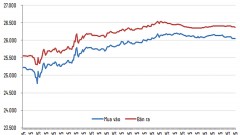
In 2025, the USD/VND exchange rate rose by around 3.2%, remaining within the band set by the State Bank of Vietnam (SBV). However, when viewed in a broader context,...
Despite being under control, the practical challenges of managing asset foreclosures and executing judgments put non-performing loans (NPLs) at risk of rising once...
Over the past week, shares of State-owned banks—led by major lenders in the VN30 index—have continued to attract strong investor inflows following the issuance...
Most G10 central banks have been cutting policy rates, but long-term yields have risen. This is highly unusual. While factors such as Trump’s tariff tantrum in the...
With capital costs rising due to higher interest rates, pressure on Net Interest Margins (NIM) could make NIM the most unpredictable variable for the banking industry in...
Higher credit growth is prompting several banks to prioritize optimizing their loan portfolios, especially as many lenders have yet to be fully released from credit...
A number of G10 central banks have become more cautious about policy easing. Here we’d include the Federal Reserve, Bank of England and Reserve Bank of Australia. But...
While most G10 central banks remain in easing mode, it is clear that the path to lower rates is becoming a little trickier.
Credit is continuing to expand strongly, reflecting robust loan demand and high capital absorption capacity in the economy.